2024 Auto Trends: Financing, Sales, and Consumer Behavior
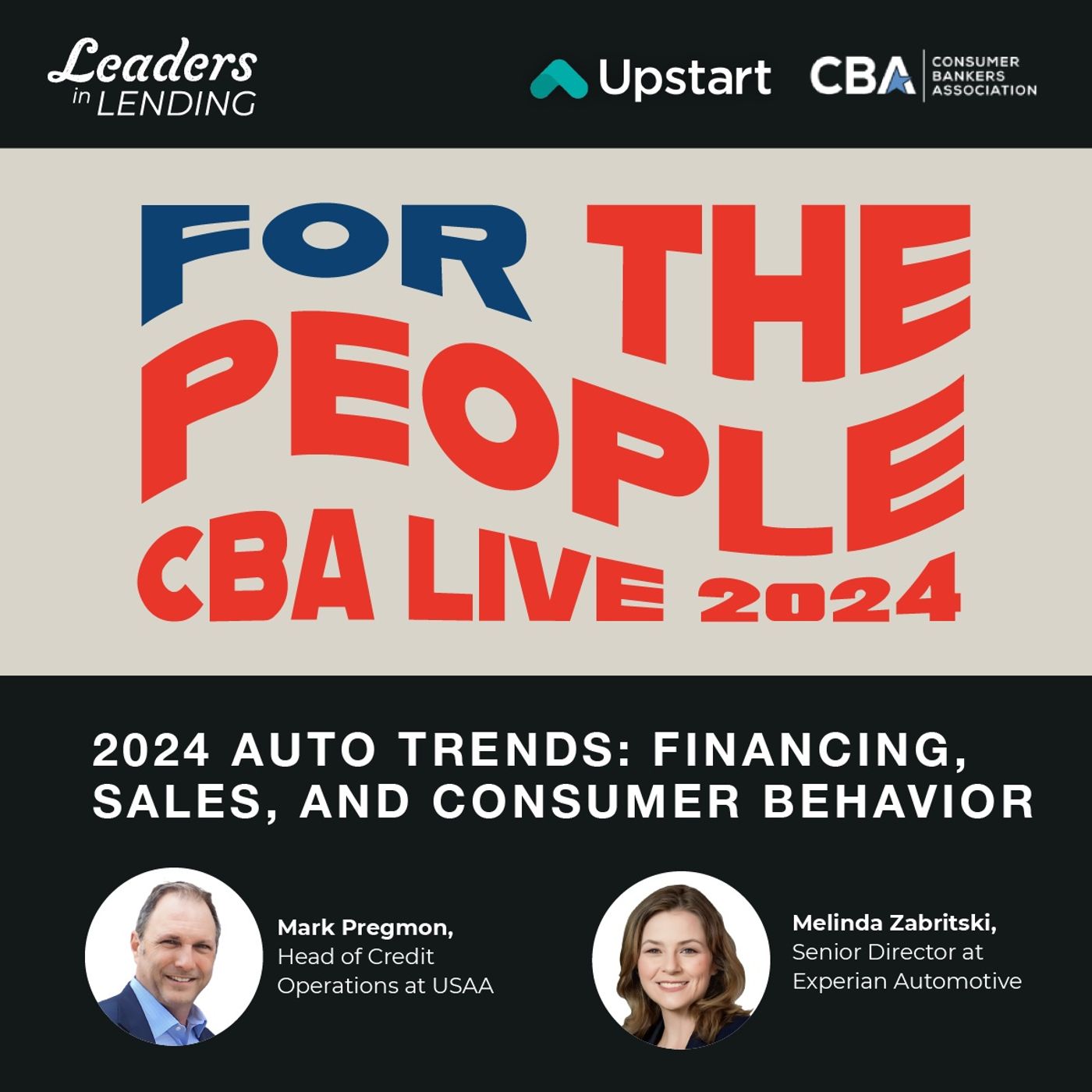
On today’s episode, host Matt Snow is joined by https://www.linkedin.com/in/melinda-zabritski-3951834/, Sr. Director at https://www.experian.com/automotive/auto-data, and https://www.linkedin.com/in/mark-pregmon-aa4b922/, Head of Credit Operations at...


On today’s episode, host Matt Snow is joined by Melinda Zabritski, Sr. Director at Experian Automotive, and Mark Pregman, Head of Credit Operations at USAA. Whether due to rapid technological innovations (like the advent of electric vehicles) or economic factors (everything from lending rates to unemployment), the landscape of auto sales and lending is shifting more rapidly than ever.
With their collective experience and expertise in lending and the auto market, Mark and Melinda are perfectly suited to help us make sense of this current moment — to give us a sense of where we may be heading.
Discussed this week:
- Why concerns surrounding affordability persist, despite the rise in average loan amounts
- The challenges hindering EV adoption
- How limited inventory impacts affects loan-to-value ratios and shapes consumer purchasing patterns
- Growing delinquency rates, and what they may be attributed to
0:02 You are listening to leaders in lending from Upstart, a podcast dedicated to helping consumer lenders grow their programs and improve their product offerings. Each week, here, decision makers in the finance industry offer insights into the future of the lending industry, best practices around digital transformation, and more. Let's get into the show, all right, Welcome everyone. This is Matt Snow live from the CBA conference here in DC with Mark and Melenda. Thank you both for joining me. When we take a minute and introduce yourself, tell everyone where you are today. You've been about your role and how you got to it. Sure, so, Melnda Szabritski and with experience automotive and have been for twenty years. I do a lot of product development, product positioning, but probably the biggest role that I have is I host a quarterly industry presentation, say in the automotive finance market, talking about the trends occurring in auto finance.
0:58 Great, I know that's something we look forward to and I'm started as well to really in depth great look at the industry. So appreciate you doing that. Mark, Mark Brkman a general manager at USA Financial Savings Bank and so I run consumer lending. So that's basically all our lending proc with exception of real estate and credit cards. So I think auto lending, unsecured personal loans marine RV been there about four years, but in the industry over thirty plus years previous that was with P and C Bank and Truest Bank. So but out of finance my whole career and a returning podcast guest, early early guests with Jef during the pandemic. Oh right, so it's going to be doing this in person then exactly. And I know you know. One of Jeff's things was to ask a few questions at the end, and one was to ask for a bold prediction. I don't know if you remember yours. I went back to your your episode today. Remember what did I say? So your your bold prediction was that banks would still be around. And I know you know between now and then there we've had some banks failed, but it seems like they're still around. You stick with that prediction, Yeah, I do. I think thanks generally are healthy. I think everybody's going to the stress test again now. But I think you'll see with the new Cecil rules out there, with the way you have to reserve for loan losses and take care of those those ups and downs you see because of the industry or just because of what's going on with the economy. I think banks are much stronger position now underrunning standards because I've been consumer credit. I think are much stronger, especially in real estate, and I've done real estate underrunning before. I don't do that here, you'll say, but I think the qualify for loans now there's the kind of the asset test I think is much better in colouteral values. So I mean, I think we're cloutteral values were generally pretty strong.
2:30 Yeah, yeah, so much stronger from a credit perspective. How about deposits, I know, you know, getting deposits now is a pretty hot topic. I feel like that's not my forte deposits, but just being adjacent to it with my peer. I think banks are still pretty flush with deposits. I think the pandemic added to that, with everybody and their balance sheets got strong because of all the stimulus, or didn't have to make your mortgage payment, you're student loan payment. But I think the industry in general is starting to see draw down and their savings. Another checking accounts, we just don't have that. I think mainly because it's going towards inflationary type. On is just trying to keep the lifestyle that they have out there, whether it's travel, whether it's just food on the table. We're seeing, we're seeing the industry in general seeing a flight from deposits. Yeah, and I know we'll dig into that much more with Melina. Maybe you can give us a thirty thousand foot view of the state and industry. You had a really good session earlier today. What are some of the trends that have stuck out to you? So there's of course, affordability still remains, you know, top of mind for most of the industry. Availability is getting better. You know, originations a bit, we're a little suppressed. But what's been nice to see is over the past six months or so six eight months, is the growth and loan amounts to slowed down. You know, average new loan amounts been hovering around forty thousand. Used has come down a bit as well, still high, but of course the raising interest rates still continue to push those payments even higher. And then with those rates and now incentives coming back, there's been a lot of shifting and share as far as you know who's who's doing the originating. I mean, captives started coming out of blood incentives towards the end of last year, and that shifted a lot of share back towards the captive way. Yeah, I was really surprised with that. I mean,
4:03 the market moving primer in general, but captives more incentives. Is the rising price of cars helping them do that? Or how was that value coming in? Really tied into the fact that there was inventory, you know, without in any inventory, we really saw no incentives. That was, of course the same time that the rates were going up. Credit unions being slow to raise their rates, really took on share became the largest lending segment, especially unused But with day's supply coming back, inventory back, we did start to see the incentives back in the industry and that really just pushed the captives share. Gotcha, And I know you had a stat mark you mentioned you talked about like inflation and the cost going up not only for vehicles, but the total cost of ownership with the vehicle really adding burden to the consolatory.
4:46 Today, just in CPI, we came out of auto insurance across industry, the share of the last years up twenty percent. It was just a little bit north until twenty point five. I saw. So when you look at the consumer of the average car payment with interest rates being a we just looked at average the number one car finances, the F one fifty, and so that's pretty much all banks for finances. But you look at the average cost of last year versus day with interest rates going up, cost to insure and gas, it's almost two y forty dollars a month difference between this time last year. It's huge. It's it's I think what Linda talked about it, that's what's impacting. I think affordability in general. I think that's also why the captives are out there subventing. I think if they did, if their cars weren't selling themselves like they were in the pandemic, I don't think they would do that. I think at interest rates were normal, they probably wouldn't have to do it either. Yeah, and I think that. I think the last time I looked at the F one fifty, I think the average loan payment was around twelve hundred dollars. That's insane. I remember, like you think a truck in and out like forty thousand dollars f one fifty you're talking minimum seventy yeah, I mean yeah, so our consumers making different choices given that burden. Are they choosing lower models? Are they changing the way they financed these cars? You know, it's it's funny because I've been doing this for a long time and people would always ask, like, what's the consumer stress or will we see consumers that they start getting stressed going back into cars and like away from the big trucks in the SUVs. And that's just not the case. You know, We're we're still, like I said, f one fifty CRV the SUVs. It's it's sixty over sixty percent of what
6:16 we finance are SUVs and cuvs, and they have price points higher than cars. Of course, we're also not making as many cars, but we're not seeing consumers, you know, shy away from those vehicles. You know, leasing's coming back, so that's helping because that's bringing a lower payment. But consumer behavior hasn't changed. The most interesting shift in consumer behavior that I've seen in the data is with the raising interest rates is cash. We've seen a lot more cash come into the market. You know, we used to do about fifteen percent cash. We're now over twenty for new used as like over seventy percent cash or a little over sixty percent cash, so a lot more cash. Yeah, So was that fuel do you think by the stimulus or what now? It was after that? It was it was really tight hand in hand with the raising interest rates. Okay, And if the captors weren't running incentives, if you did have that zero percent or one to nine.
7:11 And I asked you a question in the seminar today, but basic last is is it home equity when they come up to the table, and it's not. It's cash, it's real cash for people have that. I understand bright the chuck and go off the line as they get the text ductibility and I could do it over maybe twenty years. You know, Yeah, they get that payment down, but I said the true cash which you can which is kind of surprised me. But I think that affordabilities is the biggestue. I think I looked at their going longer terms, but I do think some of the consumers out there just sit on the sidelines. I think that's why you see the sub bench out there. Car dealers are coming off the price that they were MSRP only. So I think there's start to see them come off the price before and so. But I think it's just over affordability. You said sixteen percent over one thousand dollars. I was like, yeah, my first house payment maybe thousand dollars, but I can't even imagine a thousand dollars car payment. And it's on the lower credits scores, is what you told me. It's well for new I mean, new car buying is always going to be very prime. But it's still a prime score, but it's one of the lower scores compared to like the six hundred payments of the you know, four hundred dollars payments, but yeah, it was one of the lower and even on the U side four and a half percent over one thousand.
8:18 Yeah, and they're they're those big trucks. Well, I think it's it's I saw a statue for the banking I don't not include the capsus, just banks and prime lenders out there. Thirty percent of the market is terms greater than seventy two months thirty percent and so, but the average liquiment, I mean, the average term is still sixty eight on average, And what's your book on that on average? But thirty percent I was shocked at that number. Two that's across the industry. So I think consumers are just choosing those longer those longer terms to get the payment, just to get the pay out out there. So other than extending term to get the payment down, are there other things you're seeing in terms of how people are financing these cars or innovations in the automotive, the dealer, the lendings based this is pretty playing vanilla lending. I just I think we're seeing longer terms. There's nothing exotic out there. I mean, acts just do balloon lending a long time ago to kind of keep up with the leasing. I just don't I think for auto lees to stick to the tribes, I've not seen anything innovative out there.
9:16 And the consumer I think we're seeing put more money down. You just try to get that payment down as well. And then people along the sidelines I think too as well. So you can't create demand, you just can't. Well, I think we also one thing that really helped from a consumer standpoint was even though inventory was scarce, it drove up used values and that led to the past couple of years consumers having a lot more equity in their vehicle. I mean you could look at the top, like the top ten most commonly purchased used vehicles and the trade in values or even just that the retail value on those cars were higher than the original MSRP from when they were bought two or three years ago. So that really helped. And so that's it's been beneficial fort thanks but also beneficial for consumers and bringing those loan to values down quite a bit on us. Now we're still kind of seeing the opposite of that. On the new vehicle side, it's getting better, but with the inventory scarcities and things selling well over MSRP, we saw those loan to values just really skyrockets. So we're kind of recovering from that, but it's still looking really good for the used market. And I'll give you my personal experiences. So my daughter went to school in DC. Her car got stolen Shesing crad school. So that's what I had to pay MSRPN. Never paid MSRP in my life. So two years ago, go to the car dealer and there was like, hey, we got three we got three subers coming in meat or they're going to be gone. So I had that.
10:39 We let the truck pulled up. Cars got off. So her car got stolen, they recovered. The crowds like, oh car, I did the post found it and it was it was a totyter rep for we paid twenty one thousand dollars for she went to school, and I think I'm going to get it was a total loss claim. Okay, I said, I'm going to get The value I got was fifteen thousand dollars and the car is five years old, and I was like twenty I paid twenty one for it. So then I had the other shock I had was like going to the car, You're like, while we're waiting for the Semi Darted to pull up with the cars, were looking at used cars and the price of the same car was more expensive on the new car. I was shocked. Yeah, yeah, definitely, those values were really surprising. I'm not the only one that during you know, twenty twenty one made money selling a car, which is that doesn't happen now. The cases of people, especially with trucks, saying you know, hey I made fifteen thousand on this truck. You know, it's just it was crazy. But yeah, so those those days are gone.
11:39 Yeah, I was just so where do you see that end? Like or are we in a new normal or what where's the industry go from here? Yeah, I mean, well, values are still a little inflated, and I don't expect that to third. They're down, they're still yeah, they're still high. I don't expect that really to change because when you do look at the used car market, you know, so much of the used car market is content and upon off lease vehicles. You know, that constant supply of late model used vehicles coming back. And we're still doing strong on the returns from three years ago when we were leasing over thirty percent, But keep in mind we've had you know, a year and a half rereleasing was under twenty So in the future, starting towards the end of this year and really into twenty twenty five, we're going to be down over a million units of off lease vehicles that we were used to So I think we've got the potential for that to impact values in the future. The off lease is still doing well right now, but it's the reduction's coming. Interesting. Do you see have you seen any changes to underwriting in terms of you said, like the landing side usually have tried and true. Yeah, I will say this, I said for the indirect lenders out there, not for the direct lenders.
12:50 In general, the industry, we've seen it typening in both pricing and also in credit policy, especially when you come into a recession. You're going to see that. When your directly, that's a little bit differ because it's a known customer, it's a known member for USA, you know them, and they probably have another product service with you. But when I'm buying paper from a car dealers, it's a brokeren loan, So there's some risk. You carry higher risk because of that, because they don't see you as their primary bank and the consumer that gets the car. So there's a little bit more risk in this. But I think the indirect letters and the large lenders have tightened up their bybox. I don't think there's been wholesale changes, but they think they've tightened it up, and then they've also priced up to take on because they're looking for more risk down the road and losses or with the economy now, I think we're coming to a soft landing. I don't know what you want to call it. Economy. Yeah, Rice, it is weird, So I do think you'll see it again. It will open back up. I think again too when it does, I don't know yet what are you saying, because you have access to again to a lot of data and experience in terms of trends, what are other lenders doing? You see pockets of that loosening up. Yeah, so I don't see it loosening per se. You know, credit scores continue to increase, just overall, sumer credit is increasing, more consumers are prime scores are just rising. But when I look very specifically, like if i'm if I'm looking like the top ten banks, you know, almost everybody your your credit score increases, you know, fewer originations and subprime, and it's a bit of a mix because yes, there are fewer subprime consumers out there, but the reduction, especially in
14:22 the bank population, is well well beyond what just normal increase credit scores. So I definitely see the banks tightening up. Like I said, the loan to values for the banks on the U side, it has been really really strong. It's like ninety percent rates versus you know, well over one hundred. So I definitely see trends like that, and I think you know a lot of also, you know, there's been reduction in banks share, but so much of that was credit union driven and you know, captive driven and a few banks leaving. It'll be interesting to see as the market continues to rebound and you know, win delinquency start to come down, which are not coming down right now, it'll be interesting to see if those lenders come back to the market. Yeah, so that was actually going to be my next question, are you are you seeing the delinquency is kind of just returned to a normal So we're seeing that spike right now, but it's just kind of renormalizing. But for the most part, you know, if you look across the various trade types that we're tracking delinquency, you know, bank, card and mortgage and you know, unsecured lending, et cetera, they're kind of returning to you know, pre COVID levels, which was extremely suppressed. So those are sort of returning to more you know, normal type levels. Auto is a little inflated right now. The auto delinquency numbers that I'm seeing are relatively high, Like the percentage of loans themselves are kind of similar to what the peak was in two thousand and nine. The balances are higher, but in part we also have twice the amount of balances, you know, one point four trillion in automotive loan balances. It was half of that in two
15:52 thousand and nine, so of course it's going to be higher. To ask, question, yeah, yeah, right ahead, question I answer. But curious with the FICO scores going up is just in your experience, maybe the numbers one should but as delinquencies arising, charge us a rising and revolving balances, debt's going up on revolvers right this one, you think you'll see a natural scores come down. You know, it's interesting because the score increase has been going on for years and years. It's it's not a relatively new phenomena. Like I said, it's been like six points every year since twenty thirteen. We didn't see it come down when the delinquencies declined after two thousand and nine, so it's been kind of continuing to go up. I think the rate of acceleration will probably decrease because you also have to look at that whole you know, the aged mix of the consumer population. And you know, people ask, well, how can scores go up and delinquency increase. It's like, well, the delinquency is increasing in the younger population, which is where the lower scores are and you know your aging population has higher scores.
16:57 Yeah, yeah, so that I agree with that. I'm curious what you think is there's a lot of I think consumers are more aware of their FCAL score. Now they're more aware, they can go to places and they can say, how do I improve my score? I'm wondering if that's some of it too. It is, We've done a lot of analysis around that, because there's of course there's there's aging, but the awareness of consumer credit. I think every single credit card I have, probably USA included, gives me the opportunity to see my credit score, every single one. And we did a survey recently of consumers asking them do you know your credit score? And universally people were like, yes, I know my credit score. If they didn't know it exactly, they knew the rough range that their credit was in.
17:45 You know, it is an everyday discussion, which is like when I travel and people ask where I work, I'm very hesitant to sometimes saying because everyone wants to discuss, you know, credit score, how can I exactly vice? But yeah, people are well aware. It is crazy how that's changed, even in my lifetime, from the point where like you would only know maybe as you're going in to apply for credit or if you got the cartage especially right, Yeah, and that's the only time you really would know, but never before you shop for a car. Now. And so we're seeing consumers in general, not not just artment but they're like general population out there. But they're going to say how much what's my score because I know it's tied to my rate? What can I do? Then? And then you see and there's some aggregators out there that are and that they're not banks, but there you go there and they'll help you figure out what you can do get your score to get a better price. Or I have a loan it's at this rate. Now, I had to get a high rate because my credit score was good. What can I do? When can I rEFInd to get them down? So I can rEFInd my rate down. So there's a lot of accuracy that just they didn't exist before. Yeah. Well, they like experience boost, you know, booster, use alternative data boost your credit scores, a lot more consumer education. Yeah, exactly, I want to go back maybe a little bit. Mark. I think you have, especially with the member based at the USA, a lot more connection to uh, you know, their their story and how they interact with the banking world.
19:03 Are you hearing from them as delinquencies are going up? Like why you know, because we're seeing primer consumers and delinquencies going up. Are there different reasons? Are they they calling in looking for helpers, insights? And pretty much what my coal experiences. Maybe it's just there's some type of a hardship going on, you know, loss of the job, but it's still very good. So it's it's like you had dual income coming in and then one lost their job or it's between jobs, and so it's a short term kind of event. But there's nothing I think out of just like there's any new things that we're seeing out there. I think in the industry now, that's just it's just a regular thing. It's just normal. I think it's again affordability. Everything's expensive, yeah, and so I just everything's more expensive now, and I think that's what's also leading to us seeing delinquency occur in segments that traditionally don't account for the majority of delinquency. You know, your lowest credit scoring consumers will of course represent the majority of delinquency scores work, but we're increasingly seeing them near prime consumer and we're talking like a you know, consumer scores and are six hundred to six sixty. You know, that's kind of middle of the road. They're increasingly representing more of what's going to linkuent and that really started with COVID. Like you would see you know, near prime be five percent of you know, delinquency accounts and now it's like twelve.
20:21 So that's that's I think where we're starting to see that. And you're starting to see these consumers also use more alternative finance and or you know, like you know, short term loans and hitting you know online kind of those those online loan brokers and such, and you would know more than I. I read a stat was that comes Wall Street Journal that was like sixty percent of consumers or paycheck to paycheck. Yeah, and if that's the case, and with inflation up, one paycheck missed, I mean that's that's a big deal. Yeah. No, we see lots of stats like that. Do I think I've seen that same one or the average household can absorb you know, maybe a three to four hundred dollars or something emergency, you know, they have to fix something ac goes out. I mean that's that's a big event. Right. You can't delay put off the AC to live in Texas in the summer, right, you can't do it. Yeah, And you can't miss a car payment because you need your car to get at the job and you probably have your job. Right. But but I but that's some life event because things. I mean, just look at the cost of repair a car, cost to fix your home. I mean, I got I replaced my AC is like it was almost three x pre COVID. I mean, it's crazy come home from business trip and you're fully stopped, refrigerator stopped working. Yeah. Life is full of them. So you know, we're day one maybe more. If you're involved in the CBA into the conference, what have you guys picked up so far? If you attended other sessions, anything that you're learning. Yeah, I've mostly focused on the AUTO sessions.
21:40 You know, went to the EV session before ours and then I honestly, I've had meetings. It's been catching up and just kind of getting work. I've been on the AUTO too as well, but I haven't had a chance to go to that one thing. I just thought just the CBA, that's what this is one of the best events out there, I mean, no doubt. I think the other thing is is that the energy here. I think you all, like the folks here that are in the exhibit all, I think energy is up. And it's a tough year. I mean, but the energy is still up, which is good. And for me, it just it just more confirms on we're not the only one. I mean, it's it's it's just it's it isn't and so it's like it's like we're experiencing everybody's experiencing the same thing. So I think it's just it's a whole general just like you learned that like a confirms more confirmation of things. I don't think anything yet. I still still we can still with the conference ahead of us. Nothing new, aha, But some of your stats were all hot. But other than some of that, I mean, like big, like am I missing something? I didn't think we're missing something big. I read a stat last year that auto fraud finance fraud outpaced card and deposit fraud.
22:44 That was that was a I saw that the industry stat, and so I'm seeing a lot of people talking about fraud here at that that it was always talked about. But I think because in auto lending. I'm hearing more of the auto lenders out there talking about frauds. I think it's been increasing, so I think all those things. AI is probably behind on the fraud's side right to do those type of things, but I think that's one thing I have. I haven't yet to go to that, so but I'm hearing a more interesting attendant of the fraud sessions. Yeah, focus on I think with any tool, like, the bad guys tend to get all of them before the good guys. So it's good that we're able to have some of the I mean the fraud of the industry. Because there was an expert that was talking about it at another conference and the thing that shocking was, it's not the hacker in the basement, it's sovereign nation fraud. It's like it's big yeah, yeah, yeah. Auto is always a little different because it's not like credit card where you're worried about you know, bust out fraud and sure and all of that. It's you know that car is I mean that what didn't make it makes sense you think about it. But the reason why the frosts have moved on from credit card deposits is because it takes I have to do sixty one thousand dollars do sixty accounts to take over a thousand dollars for a credit card. I do one auto loan, and it's so I think the severities higher, frequencies less. But if you can get three or four cars, I mean you're talking, you could be a couple hundre thousand, you know, as a fraudster. So you actually have some involvement with the CBA. I'm sure there's a reason you really enjoy this conference. Maybe you can talk a little bit about it. All the CBA, probably thirty plus years. I think I would not be where I'm at in my position
24:15 today without the CBA. One is it's just the relationships you forward. You come to events like this, you get to know other lenders. The committees are very strong, I think the committees of the health. And then I think the other piece is I went to the graduate school banking school. So what I love about CBA is I send my teammates to that school because I learned so much from it. Because a lot of us, as bankers, we come up, we're a specialists, and what that school teacher how to do is teach you how to run a bank. So when they're talking about balance sheet and you may be in lending and you don't know what what deposits does? You learn what deposit, you learn how what cecil means? You learn what makes the bank healthy because like a lot of us come up, I'm a collector, I'm an underwriter and product measum in pricing. You don't get that. You may get a little bit exposure across the bank, but it really gets you horizontally and grows. Just that's the And then what they do on I think four banks, the Trade Association, piece of what they do on Capitol Hill for us and all what they do to like help with the legislation that make sure it's crafted in a way you know that that makes sense. Yeah, yeah, I know that those can also be sometimes touchy subjects. But you know, what are you guys seeing in terms of, you know, maybe rate reductions, changes in legislation, anything you're watching out for. Definitely waiting for rates to come down is not going to happening time soon. I think to me, the one of the hot topics is really tied more to the election as far as what direction it's going to go in the impact that could have on the electric vehicle market. You know, that's something that there's a lot of speculation around. You know, goes one direction, EV gets pushed, it goes another direction, and EV is not going
25:45 to be pushed. So I think there's a lot of speculation around that, and I think that's that's probably the biggest thing. The FEST signaling three rate decreases. I think it's probably been closer to two. Personal opinion. Yeah, I'm just my experience, but I think it will come down, but I think meaningful won't happen till next year. Sure, and they just try. They're trying to balance out because employment is still strong, but it's inflation, right, They're still to balance it out. Yeah, So maybe dig in a little more about the EV, like what what changes do you think that would have further down market depending on the well I think the like I mean, Toyota has already come out and talked about you know, their pushed more towards just pure hybrid and more the hybrid plugins, and I think that's probably more the direction. I think we'll start to see, you know, less emphasis on EV and also, you know, will there be the the you know, the infrastructure, you know, the dollars spent on the infrastructure to truly support where you know thirty forty percent EV rates are supposed to be, and of course what you know for me, I look at the EV market. I'm a little mixed on the EV market in part because I think, yes, you know, increased fuel economy always extremely beneficial, but you also have to consider, you know, today's new car becomes tomorrow's used car, and your subprime borrower is looking for cars and looking for forty ability.
27:00 And yes, more inventory, prices will come down, but you're still looking at a vehicle that is going to cost more, at least initially upfront. So you know, we've got a large still prime population out there. What are they going to be buying? I think it calates two with gas prices, right, So I mean you do the math how much more I pay on that versus of gases you know, moderate not way after you're paying European rights. That's a different story, right, But I think you do the math, and it takes a while to get paid back. And I think it cold off of the two is saying the same fear as it was it was. There are a lot of incentives out there to do it. But I think also too, is that it's that fear how long is that going to go? The charges are pain in the rear. I mean it's like that's and those are legitim it's just your commuter car, but to be your primary car. Most people, I know, if it's their prima, they're just going back and forth to work. Maybe the Gros story, but not like because you know a long distance trip, you're going to think about it.
27:48 I mean if people do it, and people do it, but I think for consumers as a whole to embrace it, there's still some things that are holding them back. But the thing I remember was like okase, when the United States went from horse and buggy todmobile. The government didn't force them to go, right, I mean, it had to make economical sense. It was a better product. I get there faster, it was. You know, whatever the cost of maintaining whatever those things were is what drove that consumer to them adopt you know, the horse and buggy. I think it's the same thing here. Yeah, I mean we were running some numbers on it. If you think about it, you know there's two hundred and eighty eight million vehicles on the road. Light light duty, not even including medium heavy. Yeah, and just in the US, and it's only about one one point seven eight percent of households have an electric vehicle and one point five have an electric vehicle and another fuel type. So to the point of it's it's not necessarily the true hybrid of that, the true plug in hybrid, but they're expensive and there's not that many out there. Like when you wanted to get that electric car EV years ago, it was just that you had.
28:45 You had the Prius, but it was spartan. It's like now then the other ones came out there, they're more luxury now and everything else. But I do think the true the true plug in hybrid, I think I think I think that's where I think this might go. There first, i'd even up better adopt there. But the prices are expensive too there, and you're right, there's not as there's not that many of them. Yeah. So those there's mine and there's like very few. Yeah, those don't seem to relieve some of the pressures we were talking about earlier. On the consumer there's one two electric that are true hybrid. They don't have the distance of a true EV. So it's like that maybe I've seen sixty miles at most, and my memories could be wrong, but I think it's not like three hundred miles and get with the tests or whatever else. So I think that's but the true hybrid if they get longer distance and you had that gash, you have to worry about that from going across the country going long distance that we're about charging. Yeah, And I don't remember the numbers, but I saw somebody presented at another conference recently. They were showing I think it was Cox. They were showing the number of the percentages, like the percentages of households that actually have a garage, so like if you are doing home charging, are you do you have a driveway, do you have a garage?
29:51 Do you have a place to park to actually charge your vehicle? And I was surprised at some of the very low figures, and I just look at my neighborhood. Of course, I also in a snow so yeah, you know Colorado, ice know, et cetera. But I look at the fact up, I think I am the only person in my entire neighborhood that parks their car in the garage. Everyone else at storage. But my house is also one hundred and twenty years old. I can't accommodate an electric vehicle. I can't charge it. They're cool. I like that. It's just I just it's meat. I'm sidling bug now. But I think about it. But it'd have to be my third car. Yeah, And you know, that's just like the other thing I read. It was I forgot where it was, but it was about apartment comp how many how many they're in an apartment complexes? And then the apartment complex the large communities, the ones that like the post homes and stuff like that, the cost to put a charger in an apartment complex, and it's like they're expensive and and and then even if they charged somebody to charge their car, the payback was a long time.
30:48 So I think there's look, how many, how many people are in apartments? Yeah? You think you got to thick through those things. Yeah. Is there anything that those OEMs are doing differently to disrupt the buying process to financing experience with the consumer the Yeah, nothing that I've really seen, I think, you know, outside of the captive I still hear some lenders talk about just some uncertainty with financing, you know, EV's I think there's there's always that speculation around battery fear, which I think is for the most part unfounded. You know, you do see instances where you've got lenders who are doing products where there's an additional insurance on the battery as part of you know, as part of the financing. So you do see things like that, But overall, I don't really see that much of a difference when it comes to the EV space versus traditional I haven't either. I think the thing I think that the real legit is is that COSTU and should talk about the cost insure a f one fifty. The cost to ensure EV is up there too. It's higher, it's a higher preme. That's why TEST offers insurance because but then you're going to wonder that's now, but later when they have loss rates down the road, is it going to change? I don't.
31:56 I don't know. That's that's still uncertainly out there. But I think that having to get that insurance in there. So I think what the automakers are doing nothing that I think the lenders I've seen out that are doing. Yeah, I've heard mixed on that where they are cheaper to maintain, there's fewer mechanical parts, but in terms of repair these Well, if you get in that stamp car, you get in an accident, you're not just taking off the bumper, it's the whole front of the car, right, or it's the battery on top of it, right, So it's six more expensive or repair great. Well, I appreciate you guys joining me today. Any of our thoughts you want to leave us with. I'm just I'm looking for rates come down, please. I think that's probably unanimous sentiment at the comments. But no, I mean it's it's I'm just seeing a lot of positivity in the data. And like I said, the loan amounts are stabilizing, We're still growing, consumers are out there buying, we're financing. It's still plugging away. I think for I think for banks, to think for prime auto finance lenders been two cycles before in my career. I think this is gonna be a tough year. There's more headwinds. We've talked about it today in our conference this morning, but I said more headwinds and tail was But I do see green shoots for next year with rates coming down, inflation coming up, and I think the links will come down to as well. I think that as inflation starts to come down. Think things will improve about that, I do feel, and they'll be pent up demand. So I think for those lenders out there, because people have a love affair with cars, and I think you'll they're there on the sidelines double when those things kind of return, they feel more comfortable. I think. I think for lenders will next year will be a better year. Right and Melenda Mark, thank you both for joining me. Yeah, thank you. I'll start partners with banks and
33:28 credit unions to grow households and expand consumer lending through its leading AI lending platform. Upstart powered banks and credit unions leverage AI to offer higher approval rates and experience lower loss rates while simultaneously delivering the exceptional digital first lending experience that consumers demand. Whether you're looking to grow and enhance your existing personal and auto lending programs or you're just getting started, Upstart can help. Upstart offers an end to end solution that can help you find more credit worthy borrowers within your risk profile with all digital underwriting, verification, loan closing, and servicing. It's all possible with Upstart in your corner. Learn more about finding new borrowers enhancing your credit decisioning process, and growing your business by visiting upstart dot com slash lenders. That's upstart dot com slash lenders.

