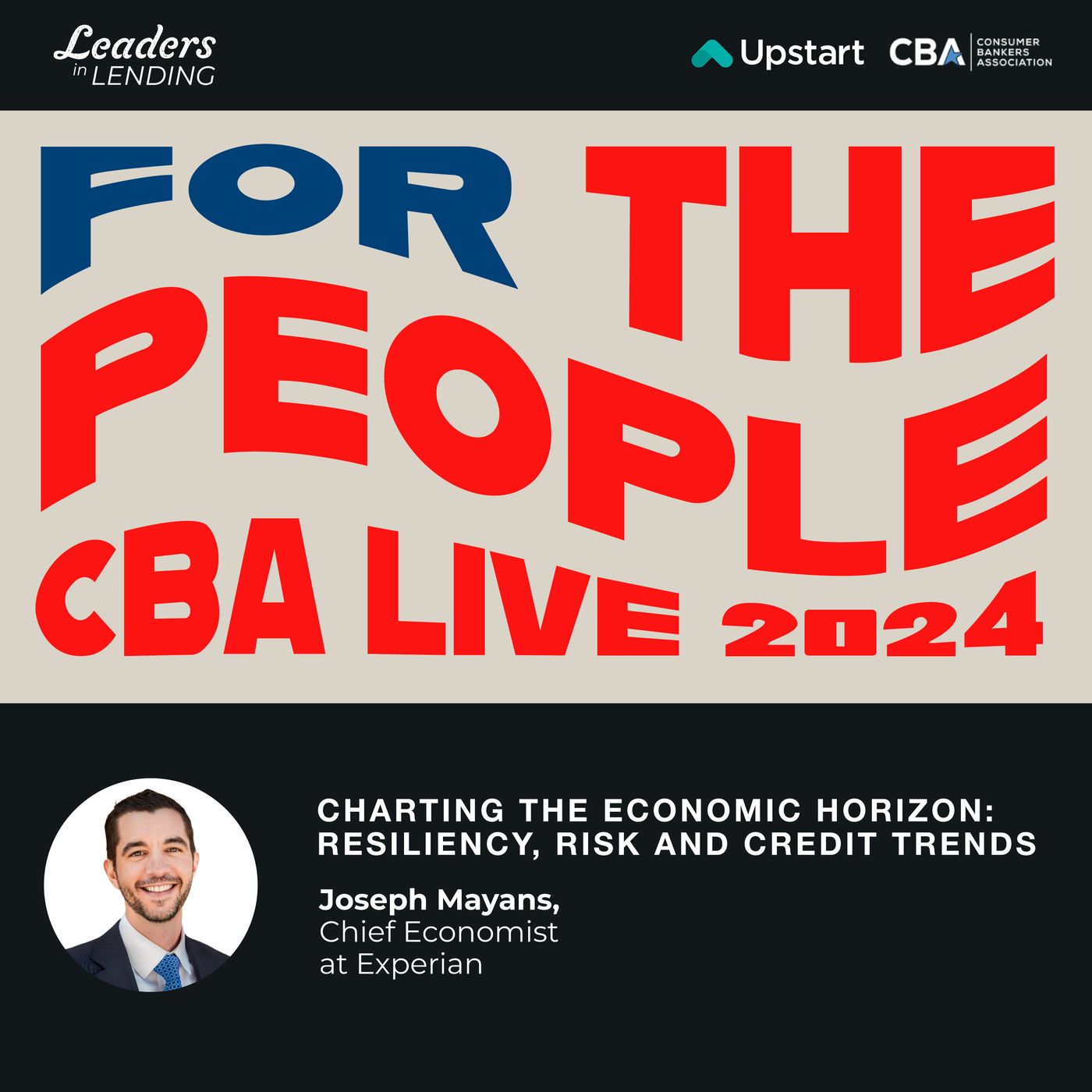
Charting the Economic Horizon: Resiliency, Risk and Credit Trends


To reliably forecast what the future of finance the economy holds, you must be able to assess the current moment.
This week, host Lynn Sautter Beal speaks with Joseph Mayans, Chief Economist at Experian, who shares his economic and credit outlook for the year ahead in 2024, along with consumer credit trends and potential risk areas.
Join us as we discuss:
- Key factors shaping a more optimistic 2024 compared to 2023
- The dichotomy between a strong economy and labor market with slow credit growth
- Consumer spending and increased delinquencies
- The housing market and potential risks on the horizon
0:02 You are listening to Leaders in Lending from Upstart, a podcast dedicated to helping consumer lenders grow their programs and improve their product offerings. Each week, here decision makers in the finance industry offer insights into the future of the lending industry, best practices around digital transformation, and more. Let's get into the show. This is Lend with Leaders in Lending and happy to be joined by Joseph Mainz, who's the chief economist for Experience here on the podcast today. Thanks for being with us, Joseph, Well, thank you so much for having me. Do you know this actually my first big time podcast and then part of well good Well, We're very glad that you could be here, especially at CBA Live, knowing that you presented earlier so you had a busy day, you know. If you could like tell me and our listeners about about yourself, about your role at Experience, and about your background kind of what led you to being an economist. Yeah, so, yeah, I'm the chief economists for Experience North America. We also have great economic teams in the kank in Brazil. But really how I landed here? So just quick background, So my undergrad is in philosophy and I actually got interested in economics.
1:15 I used to day trade all the time in the life, very well studied. I made money, lost money, and I was like, no, I need to really kind of fundamentally understand what's happening here. And so that's what I got my master's in the econ just fell in love with the discipline, and then I went on and did banking policy for the US Senate. So I came out out here for DC for a while, and then I went to Salt Lake, was an economist out there for a large regional bank. Then I started my own economic consultancy company, and then I started working with experience in that way, and then now I'm in house with experience. I spend majority of my time, about seventy percent of my time working with financial institutions all around the country. So I think I did my end of year tally. I spoke over one hundred organizations, like last year, from the kind of the largest financial institutions all the way down community banks, credit unions, spin techs. So yes, it's awesome. Well that's interesting.
2:08 I'm sure you travel quite a bit then, probably to see all of those clients, and probably a good exchange of ideas to kind of hearing what's happening and nationally, but then also you know regionally and locally what's happening. Oh yeah, it's fascinating because each segment of the market is really and they've reacted to the market, the environment we've been in less severe use differently. Each has its own unique challenges and it's very fascinating to give it to get the different perspective. The other thing that, you know, one of the biggest thing this is a relatively new role at Experience and one of the things I've been focused on is there's so much data within the company and all you have to consumer credit data, commercial credit data, rep view of data, you know, housing market data, consumer spinning data. But part of it, as you know as an economist, it's like being a kid in a candy shop. It's how do you bring all these pieces together kind of give a richer view of the economy that you can did elsewhere. Sure well, and I think it's it's hard to believe that we're really at the almost at the end of Q one, so as we think about looking ahead to twenty twenty four, we're already part way through it. But you know what are you, what are you thinking or what are you seeing as kind of some of the key factors or indicators that are that are shaping your outlook, and then also what is your outlook for the rest of the year. Yeah, I think it's really interesting. You know, I spoke last year here at CBA Live and the sentiment was very different. It was right during the you know, the regional bank crisis, you know, a couple of bank failures.
3:38 By that point, concern was definitely in the air. If you look back in twenty twenty three, much more the sentiment out on the street, among economists, among bankers were recessions on the horizons. Sure, right, if you look at where we are now, I think everybody I just spoke from a room pull of bankers, everybody is has been very surprised at the resiliency. And so what you've seen is economic growth is outperformed expectations really again and again over the last year. But you know, when I look forward, I see that the economic growth continuing. I think if you look at the Fund Reserve just put out their latest forecast, increased the path of growth for twenty twenty four. Our internal forecast again show a solid, solid year of growth. So our view is not is not recessionary this year and we have a solid growth picture. I think there's always risks on the horizon to think about what are some of the I guess biggest indicators to you then, I mean I think there you mentioned earlier just the volume of data out there, and I know I you know, I worked in investments for a long time and did a lot of due diligence and some of the high frequency traders who use a significant amount of data, so there's there's almost an endless amount of data points you could look at. But to you, like, what are some of your going to top indicators, either leading or lagging indicators that you're looking at in your work to come to that that kind of assessment of recession likelihood. Yeah, for sure. So I mean they got most interested at the moment. I think it's been the biggest driver of our growth and probably
5:08 the most surprising thing is the resiliency of the labor market. So if you look back over the last three months, we're adding on average two hundred and sixty thousand jobs a month. Prior to the pandemic, where we also had a very low unemployment rate three and a half three point seven percent, We're adding about one hundred and eighty thousand, so we're we're adding a lot of jobs every month. Unemployment overall remains very, very low, and so when you think about the economy, consumers, consumer spending drives two thirds of growth. That's where kind of that drive has been. And I see continued growth this year, and so to that as well, consumer spending has been strong, has been stronger than I think many economists would have expected at this point. Do you do you think so? Do you think maybe we're seeing too much growth? Like do you think there should be a little bit of a pullback or or do you are you more kind of reacting to what you're seeing versus necessarily have an opinion on where it should go. No, I don't think. I don't think we need to see a significant slow down. You know, there was a question earlier last year, you know, will the unemployment rate need to rise materially and so the economy slow, some inflation slows, And I think the answer is no. You've seen inflation make a pretty significant progress over the last year. May not be exactly where the Fed wants to see. You. Affliction has picked up a little bit in recent months, but overall it's been moving in the right direction. And I don't think you need to see a big slowdown or changing growth. I think I think we're growing at a good rate. And you know, you mentioned the you know, the the fence forecast for twenty twenty four and what are your expectations, and you know, maybe kind of share with our listeners, like what
6:41 the Fed is saying and then and then what you and your role at experience are thinking about interest rate changes. Really just over the year. I think farther than that out gets a little bit harder to go. Yeah, yeah, you're exactly right. After a year, you know, it's that's that's pretty difficult. But you know, I would say, one, there's been a shift in the market. In December, the Fed had put out the previous forecast where they expected three interest rit cuts this year, and immediately, you know, market participants started pricing in six and maybe seven rate cuts this year, which was which was I think way too many. Mark got a head of itself there. And what you've seen over the In the latest meeting when the Federal Reserve just just met and released their latest projective projections, again they reiterated three rate cuts this year, and that to me again feels right.
7:32 I think it's pretty it's gonna be pretty close whether maybe they do three, maybe do two. I still feel three is the right path, and I still think it's probably roughly a coin flip at this time. I think they cut in June, I think they cut in September, and I think they cut December, and that allows the FED to basically cut weighty meaning cut weighty meaning cut. You know, they can take a more cautious approach that way then at those meeting, and it also allows them to They released their forecast so they can provide more context to their overall view. You know, in terms of financial institutions, you know, that first rate cut is going to send I think a signal to the market that the FED is now going to be moving into this more of an easing cycle at least not keep rits so restrictive. And that has all kinds of implications. If you look at the challenges financial institutions have had with deposit costs right especially after the regional bank crisis, there is a big challenge to retain get deposits. You never want to be seen, especially on you know the market is having any challenges there and also deposit costs. Obviously it's rates coming out. It helps with consumer demand for lending things like that. Sure, Yeah, and we definitely spend a lot of time talking about when the bank failures happened, like the worry about the contagent is it just going to get worse? And sometimes I think it self perpetuates where it becomes a consumers believe in. Enough people believe it, it will it will kind of manifest itself. So it's it's I think
9:03 it was relieving to all of us to see that not not cometril and to those be a little bit more kind of localized to a few institutions. You know, certainly with with with rates kind of being and staying high for consumer lending. You know, as you think about just credit growth in the in the market right now that I think demand for loans is a little bit less and we're certainly seeing that in the personal loan market because rates are high and and so people are not borrowing. What are your thoughts about kind of just overall credit growth, whether consumer commercial availability of credit and where you might see it start seeing some kind of stronger growth areas out there, so I think it's been for me. It's the most interesting dynamic that's played up over the last year is that you had really a very strong economy, You had really good labor market, you had good spending, and yet credit growth has slowed quite significantly over the last year. And so what I'm watching going forward.
10:03 It's slowed for a couple of reasons, and it's what I'm watching is that Number one is recession concerns. Right especially after the regional bank crisis, everybody's concerned about potential for a recession last year, even though the economy was good, people are just waiting for the next shoe to drop. And when you have the institutions are much more cautious than what they do on their investment lending. But the other thing you had was you have delinquencies beginning to rise, and as delinquencies rise, institutions tighten their lending standards, they base your lending standards, and that reduces the supply of credit. So that's going to slow growth. And then you have the interest rates, which remained high, and that slows the demand for credit. So you have recession concerns. You had reduced supply for credit, and reduce demand for credit. And so what I'm looking for this year to anticipate kind of this turnaround is really what develops in those those three segments. And if you look at recession concerns, you know, just for instance, you know, eight months ago, when I ask a roomful of people, do you think there's going to be a recession?
11:01 Every hand realizes Today I just spoke to seventy five many people I asked, do you think there's gonna be recession? Not a single hand rais Maybe that was a shad group, but that's the sentiment that I've been getting. That's that's a good key. And I think things are moving in the right direction. And once you know, as you mentioned before, once we get more of a staging from the Fed that this higher rate regime is probably coming to an end, it gives a little more certainty to the market to kind of move forward. And what do you think? I mean, it sounds like as you think about like the kind of order of operations, like what has to happen first, Like you know, certainly as rates rose, then delinquency standards titaned. As defaults rose, then delinquency standard titans. Do you expect to see it kind of on the reverse of that coming out of it, where interest rates have to be cut and then some timeline before you start to see maybe a little bit of easing of lending standards. Yeah. Yeah, So I think the two aren't necessarily. I think the lendings standard piece is going to be more connected to what happens with delinquencies. And generally, when I speak with financial institutions, you know they're anticipating a delinquencies to maybe peak at the back end of this year, you know general maybe middle of next year, and so you know, thinking about that piece, you know, that kind of gets you, gets you going on the lending standard. I've looked at historical cycles. So last year I wrote a paper it's called Timelines of Recession and Recovery. Well, I started looking at all these variables that are important for financial institutions, all kinds of living market variables. And Okay,
12:35 when what happens in the two years leading up to recessionary time period or period stress, what happens during recession, we're happens some two years after. And so using that context, when I think about it, when I look at the lending standard piece, the lending ctenter titaning piece. If I if I anticipate in that the delinquencies are probably going to peak the next year or so. If you look historically kind of when the pace of lending standard peaks too, when year your credit growth or revolving consumer non involving consumer credit kind of hits its bottom, it's about five to six quarters. So if you think that kind of peek at the early part of twenty twenty, you know, first quarter of twenty twenty three, I mean first half of twenty point three, it's actually Q two, then you're looking at maybe back in twenty twenty four maybe for a credit bottom. And when I speak to our partners, they seem to have that share, that same sentiment, and so I like to use these kind of tidelines as a baseline view for then you start bringing up the variable to say wall maybe that's maybe that's too early, When it's too late. The institutions are definitely thinking about that. Are you seeing or are you thinking about? Is that is that spread across kind of the credit market, the type of consumer. And I think there's some evidence out there that like maybe prime or people who appear to be prime borrowers, or more stress than historical and maybe performing worse than they were expected to perform in credit. Is that something that you're seeing in the data that you're looking at and the institutions you're speaking to as well. Yeah, I think that's a
14:05 really interesting question. So if you think about when institutions first, and the narrative, narrative has been that inflation, these cost of living challenges has really hit that kind of lower income consumer the most. And what you saw is when institutions rushed to tighten lending standards to kind of mitigate some of that risk. A lot of that tightening was focused in those subprime near prime consumer segments, not so much on the prime and you've definitely seen the more stress of that segment of the market. But I've been speaking with some especially I hear this more in the fintech community about stress maybe starting to creep up a little higher in the prime near prime prime segments. And you know, if I was looking at the role rates, so the percentage of accounts for credit cards that are rolling into higher status of dean see you look at the subprime segment.
15:01 Obviously it's a very it's been more of a steep angle, but recently the past couple of months, I've kind of seen it plateau out a little bit same from near prime nearpome not quite a steep, not quite a accelerated role right there, but it's still a little step. Also started flatten out when you didn't see those I looked at the prime consumers over the past three months, and that real rate hasn't ticked over, it's just kind of gone up a little bit, And so I think there's some interesting dynamics there. One thing I'm looking at closely because of that is I'm looking at the role of ripped rent costs. So you know, over the since being pandemic, rent costs have gone out a by like thirty percent, and a lot of times negative rent. You know, you have a if you miss your payment or you have an overdy balance that's not always reported to the bureau, so it doesn't really reflect on your credit score, but that doesn't mean there's not stress there. And when you look at the segments, you know, overall rented income has gone you know, from roughly thirty percent, like thirty eight percent of medium rent to income, which is pretty pretty high. But if you look at the segments, if you look at the the the ringers that are renting at apartments that are like fifteen hundred, two thousand dollars, they're rental stress or their rate of increase for their negative paintent behavior kind of peaked, you know, last year like twenty twenty two, but it's kind of moderated. The higher income bucks like twenty five hundred to like three thousand dollars, we actually saw a much steeper increase in that it's not quite as high overall, but steeper increase and not much We don't really seen much improvement there.
16:33 So to me, that's a little bit of time that kind of that kind of hits on the point that there may be a little more stress in that prime segment because I'm taking making an assumption that the high people who are renting at higher chef levels or higher income probably higher score. Are you Are you seeing any difference in geography like I'm you know, I know that unemployment obviously very low and continues to be low, but there have been very large layoffs, particularly across the tech centertor of relatively high paid employees. Are you seeing anything or do you look at that geographically or by industry or are you seeing any like pockets of stress that they explain that or is it kind of too early to tell. Well, so I think the two parts, going back to the rental piece, the Federal Reserve has done a study on this that one, renters have seen a higher increase in credit card debt, and they've also they also have higher delinquencies that homeowners. Right, that makes sense.
17:29 Homeowners benefited very greatly from the home valuation increases, while renters, I just had to pay more. And that stress is even more concentrated in like those second home vacation home communities where you have people who've been living there the whole life. You know, there's not a lot of housing stock, not a lot of renting units, and you have all this work from home. People move in to the area, pushes up rental prices. Home prices increase, and now if you're a renter there, I've been there for a long time. Now you got to eat that cost or you got to try to move. So that's one piece. The other piece, you know, yes, I mean definitely there's variation unemployment rates across the country, but broadly, you know, if you look at the tech layoffs in particular, yes, you know they significant within the market, but broadly as a whole, on the component of the overall labor market, it's still pretty small, and layoffs overall still you know, if you look at the the number of people who are filing unemployment each week, it's still below pre fandemic levels. That's interesting.
18:33 It definitely seems like a pretty unique economic environment and with a variety of things that as you said, last year, everyone was confident we were heading to recession, and this year much less confident. But certainly we can always be surprised. And I think you had mentioned that some of the key factors really driving that growth, the economic growth for the for the US is consumer spending and consumers really driving that. Do you think that that is going to continue for the foreseeable future, that we can expect to see that really being driven by the consumer spending. I mean, I think so, Like I don't think, you know, consumers have been spending at a very strong clip. You know, I don't think we're going to see the kind of strength of growth like we saw last year. I think consumers they'll still have the ability to spend. So if you look at wage growth by income quartile, So the Federalserve Bank by land Up puts out a good series on this.
19:26 But basically, you're looking at wage growth from the lowest income and quartile to the highest roughly around five percent now, and whatever measure you take of inflation, it's wages are cling faster. So wage growth is exceeding inflation. If you look at real disposable income, so incomes after tax sudjusted for inflation on a year on your basis, that continues to improve and net worth net growth networth for households is roughly thirty percent of up pre pandemic levels. You think about all the home value gains, you think about stock market gains, those those components together tell you that the consumer they have the ability to spend. I think the other piece to that that is the next question, and it's like, well, you know, you know, have they spent through their savings, the finance the spending if they need to. And I think if you look at overall on the aggregate debt burdens when adjusted for the incoming increases we've seen over the last couple of years, it's basically pre pandemic levels.
20:26 And historically stress a well, now there's definitely different pockets of stress and pick up, but I don't aggregate. Yeah, yeah, it is interesting that you see. And I think the impact of stimulus during the COVID years was probably greater than most of us expected it to be. And then there was a lot of anticipation of the student loan moratory ending and consumers having to pay those back, and that really hasn't turned out to be a big impact either. And we are still seeing condefered by a lot of durables, so the durable purchases still remain really high, which I think is interesting. You know, you'd mentioned those kind of high debt loads, like our people are people maxing out? Uh, it actually made me think of something, you know, interesting that you mentioned, Like with rent increasing, that's kind of a it's almost like a you know, off balance sheet item. It's not on your credit report, so similar to maybe the buy out pay later and some of the new fintech offerings that that are not reported in the same way, maybe don't show up in a traditional event to income if the credit report is the source of that. Like any thoughts on that that maybe there's some like a hidden or obscured risks out there that we can't see right now. Yeah, I think I think underappreciated risk. I think so. I think I think the rental the rental piece definitely bears watching, you know, if you look at the buy out pay later space, you know, as an economist, and I think we're going to start getting more more visibility into this.
21:49 But whenever you can't see a potential debt load, that's you know, it's opaque at the moment, you don't have a lot of visibility into it. That's always something that you have to worry about the size of it though, you know that and how how much that may impact consumers. I think that's kind of speculation at this point, but you you always have to keep that in mind when you're thinking about how much debt does consumers have, and you know, looking at the overall that overall aggregate debtloads still manageable. If we look at you know, kind of our internal data looking at some of the debt income for you know, subprime, your prime, that's definitely risen faster when I think to some of these challenges, you know, the increase in debt, it's if the economy keeps doing well and you know, we don't have you know, wholesale layoffs and things like that. It's not it's not that big of a problem, especially in the shorter term. Obviously, higher debt loads and an environment where you lose your job, you can't find in the job when recession, that's more problematic. Sure, so what do you you know as you think about like rent is increasing, but there's also some obviously housing prices are still very high, and then interest rates for mortgages fluctuate a little bit but remain high from what we've seen, not high historically, but high from what we've seen over the past several years. Do you think that there is a is interest rates come down? Do you think that there's a place where where maybe home buying becomes more advantageous again, particularly for people who don't own a home. And then there's the you know what about the people that are kind of locked into a very low fixed rate and feel like they can't move over, can't can't upgrade or move up to a bigger home.
23:23 I just kind of general thoughts on the housing market today. Yeah, so I think on the housing market one generally, you know, I think we'll see what's the FED makes their first movie start seeing interest rates come down a little bit. I think we will see a little bit of a pickup, not only just in home building, because home builders have really pulled back a lot of affordability challenges, especially for first time buyers and the new home market. But I think that I think we will see kind of a pickup and growth there, but not a lot because so many of the mortgages, to your point, are locked in, like eighty percent of mortgages are locked in under five percent or something like that. So there's some there's some room for improven in there, not a lot, you know. Honestly, I don't feel that bad for people who locked in an interest rates two and a half percent. You know, values rise and so yeah, yeah, it's it's really it's not a bad problem to have, I guess. So it's unless you need to move for work, if you know, something like that's true, unless you have to. But there are some there have been a lot of articles like, oh no, people can't move because they have these great interest rates that locked in for thirty years in this home that was valued at twenty five percent. Then today it's like, well that's a that's a different kind of if you're going to have a housing problem. So I think that you know, we've talked about just that kind of forecast of the economy, your ideas for what you you know, your thoughts on what you think that the fen's going to do and a credit growth, consumer behaviors. What are like some maybe key risks on the horizon, things that you know, we we've gone from expecting recessions to know probably not at least imminently respecting expecting
24:57 one, but we it's out there that could I think disrupt that economic stability or growth in the coming year. Things that could surprise us, not like a black swat event type issue, but it's something more more typical or that could surprise us and derail where you think we're headed today. Yeah, So one thing I always like to think about is why did the economists and bankers and you know, much of the industry get the recession called wrong last year? And for me, it's really two reasons. I think that we, by the way experience, we did not forecast the recession last year, so we were on the good side of that call. But we overestimated the impact of great hikes on the labor market. So BED raises rates or five hundred basis points unemployments basically where we were when we started, okay, and we underestimated. The second thing is underestimated the resilience of the consumer to continue spending.
25:57 And part of that is because labor remain so strong, but part of it is because consumers have just had a desire to keep spending and the dynamics have shifted to where they can continue spending. But there's a lot of you that all of the excess savings has run out, consumers are going to fall to cliff that didn't happen. But when I think about that, I think about Okay, So in the back of my mind is did we get the impact portion wrong or did is the timing wrong? So maybe these stresses that we thought when materialized last year are still in our on the horizon. So if you look back historically at the previous periods of right height cycles lived at the eighties and the nineties on the pre GFC period recovered, you look at when the FED started raising rates, so when they stopped raising rates, and basically every instance they're un a plane where it was lower. Okay, we're not that far from the Feed stopped raising rates, you know, third quarter of last year. So but we're in we've been cheering that. I think rightfully, so we should be. We should be pleased where the economnists, where the labor market is. But then you're thinking, like, well, is this really so special, because then if you look three years after, or even if you go two years after when the FED stop raising rates, in four out of those five cycles we ended up a recession unemployment rate rise.
27:17 So one of the question is is this dynamics so special? Now? Have we avoided recession at the moment, I think the answer is yes, I don't see a recession this year, but always in the back of your mind you have to to maybe we got the time of the impact wrong. Consumers too, you know, consumers they don't you know, they don't have as much cash on here and as they did last year, and so but I still think that the impetition. I think consumers can continue spending this year. I don't think it's going to be as much. But I think you always have to keep history. I think history can keep you humble in periods like this, and you always have to keep an eye on that. No, I think that's a great point, and I think particularly there are a lot of you know, you mentioned the Great Financial crisis. There are a lot of people working and who are adults who are buying homes and starting families and who are not working during a great financial crisis, so they kind have only seen a positive economic environment and this is maybe the first time that they've really seen some stress out there. So well, anyways, Joseph, thanks for being on the podcast. Great conversation. Love hearing about your thoughts on what we can look forward to in twenty twenty four. Thank you so much.
28:18 I appreciate the option up Start partners with banks and credit unions to grow households and expand consumer lending through its leading AI lending platform. Upstart powered banks and credit unions leverage AI to offer higher approval rates and experience lower loss rates while simultaneously delivering the exceptional digital first lending experience that consumers demand. Whether you're looking to grow and enhance your existing personal and auto lending programs or you're just getting started, Upstart can help. Upstart offers an end to end solution that can help you find more credit worthy borrowers within your risk profile. With all digital underwriting, verification, loan closing, and servicing. It's all possible with upstart in your corner. Learn more about finding new borrowers, enhancing your credit decisioning process, and growing your business by visiting upstart dot com slash lenders.
29:08 That's Upstart dot com slash lenders.

