CRO Perspective: Balancing Risk and Innovation in Banking



Over the past few weeks, there has been a shift in the nature of risks in the banking world — the federal government playing a significant role in stabilizing. These experiences have highlighted the dynamic nature of risks in finance and banking and the need for a responsive government, ready to take action.
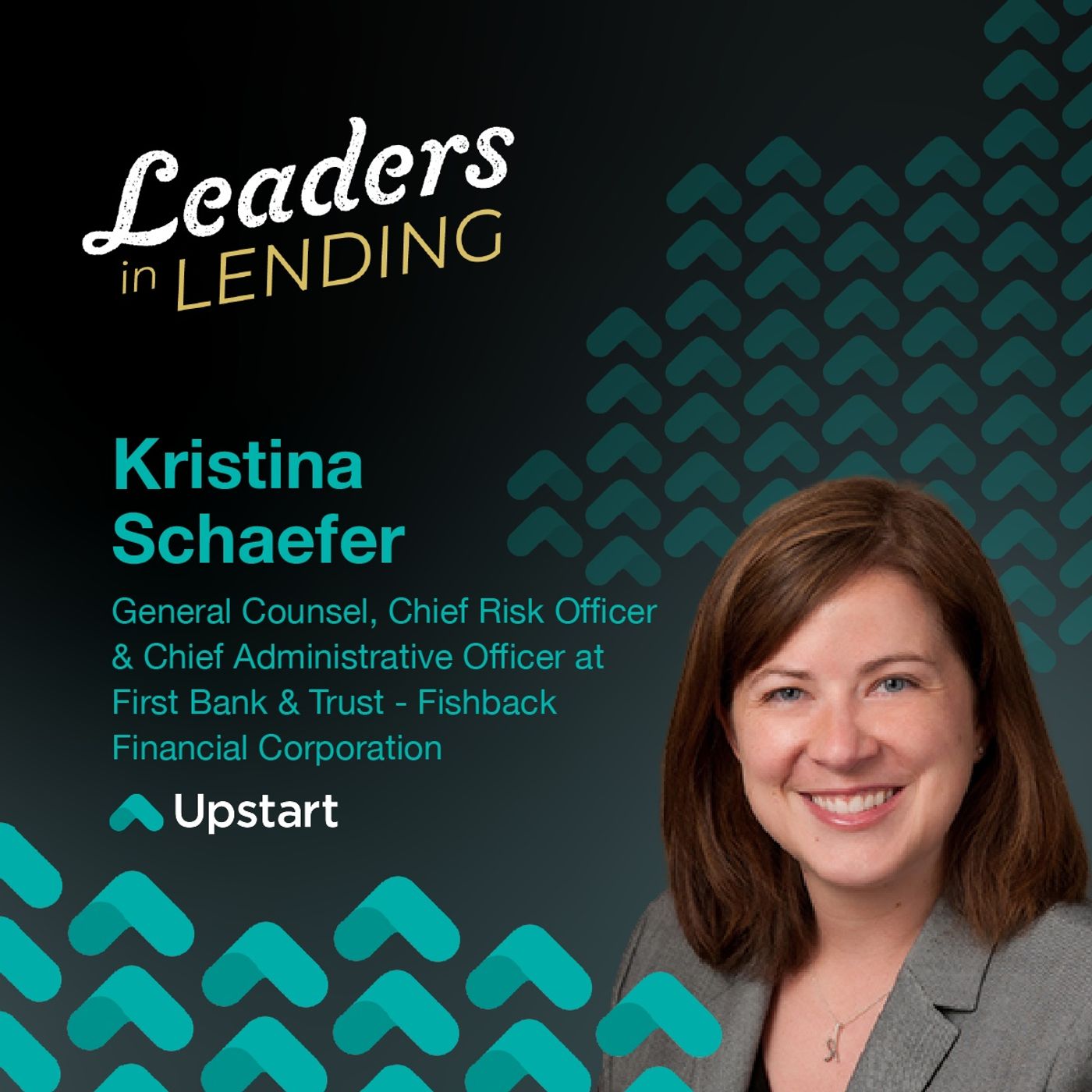
On this episode, we’re joined by Kristina Schaefer, General Counsel, Chief Risk Officer & Chief Administrative Officer at First Bank & Trust. We dive into the evolution of banking (and government involvement) over time and what it means for today. According to Kristina — banks must adapt from traditional methods to meet the quickly evolving needs of today's financial markets.
Join us as we discuss:
- The past, present and future of the banking and federal government relationship
- Current state of risks, and what it means for federal involvement
- Importance of people, culture and community in banking operations
0:02 You're listening to Leaders and Lending from Upstart, a podcast dedicated to helping consumer lenders grow their programs and improve their product offerings. Each week, here decision makers in the finance industry offer insights into the future of the lending industry, best practices around digital transformation, and more. Let's get into the show. Christina, Welcome to the podcast and thanks for joining me today. Yeah, thanks for having me. You know there's an old what is a Chinese curse? Say, may you live in interesting times? I think I feel like we live in interesting times. So I wanted to start with two categories of questions. One, you own risk if that's correct? Yes, risk, Yes, risk. The last week or two have seemed like the nature of risks have shifted or maybe changed. How is your perspective on risks or risks that we're not on your radar come on your radar ar? So you know, how is that shifted in the last couple of weeks and specifically, depending on when this thing publishes, we're talking about the failure of Signature Bank, Silicon Valley Bank, the fear of contagion and run on other banks. But it's a pretty big shift or I think it's caused some people to think some things are risky. Then maybe they didn't think we're I'm curious your take on on how it changes your perspective. Yes, I think that's true. I think for a long time, you know, it's it's been since two thousands since we had had a bank failure. And I think what this recent failure, particularly were Silicon Valley Bank demonstrated, which is the power of quick communication that also exists now that didn't historically. We saw the news start to spread fast. We also saw the role that good PR and maybe bad PR can
1:37 play and fueling something like that. You know, the timing of the events the last week with Silicon Valleys failure, We're just interesting with silver Gate announcing they were planning to liquidate, the announcements that were coming out that they were, you know, they lost all this money on Silicon Valley and they were going to turn out and do a big capital raise. You know, that's that's an interesting timing and it just it caused it caused widespread panic. And I think, you know, from a bank perspective, I mean, we always pay attention to liquidity, but banks have been enjoying being flushed with deposits for the last several years, and now as the economy kicks back up, you know, people are pulling money out at their deposits because they need it to run to run their business, not what And of course you know the other issues that maybe were a little bit unique to those two banks in terms of what was in their portfolios. Yeah, exactly. And I think concentration risk is just going to continue to be critically important as banks look at their at their loan portfolio. You know what percentage of your deposits and loan should be in which particular industries. And you know we've always looked at that, but I think now you're going to pay very close attention to it because that's what's catching everybody's attention now. Um, you know they had twenty five percent of their depositors in this they had fifty percent of their depositors and that and you know that's that's good metrics to know and to know where your bank is that we might need to know the percentage of our depositors that follow each other on Twitter. What looks like in terms of how that contagient. I think
3:10 it a silicon value. Brank was at least exacerbated in terms of people pulling out the funding. You know, the actions over the federal government over the weekend, I think we're helpful in some respects because certainly it called the waters with all of those people who were tweeting prolifically about their loss, and of course I understand why they were. Many of those people were worried about making payroll, different things like that because they didn't have access to their funds. And if you think about large complex commercial customers to pay your staff, you probably have more than two hundred and fifty thousand dollars in anyone bank. So I understood the fear and why it ramped up so quickly. But I do think the actions over the weekend did calm the waters a bit. You know, people didn't think they were losing millions of dollars. So that Monday, when when the rest of us opened, you know, we were seeing the fallout that I think perhaps we would have seen had they not taken those actions.
4:04 I think the other interesting thing about the run here was just how wrapping me twenty five percent of deposits coming out in one day. Yeah, I feel like that's exacerbating a concern. I'd heard from some institutions, which was this increasing rate sensitivity on the side of depositors, that like people were pulling their money out because they're I'm getting emails all the time from so Far or whoever else at three and a half percent on a checking account, which is I mean, I'm not that young, but getting more than a percent just feels absurd to me on a checking account. Now you have people offering three percent something like that, in the sense of this is kind of combining in a world where the safety of deposits just isn't maybe what it used to be, both in terms of how much I have to compete for them, but then how quickly they could shift a different direction for whatever reason, whether it's fears about the bank or the banking industry, or it's you know, some sense of like, hey, there's some guy every here offen me a little bit more money. I'm going to go go take advantage. I think I think that's absolutely true. You know, technology and the ability to open accounts online as well as well as email marketing just makes the market more sensitive to people being able to pull their deposits more easy maybe a better way to say it. You know, when I first took on my checking account, I would have had to walk into the bank give them all my information. And now you can click a couple of buttons and transfer the money, transfer the money out, so that you know with an issue, I think most recently.
5:27 The other thing is people are not as sticky as they used to be, and some of that does does you know people just they will go somewhere for a better rate. They might leave some money at your bank. But people do rate shop. But it's a lot easier to rate shop now because there's information everywhere. You're either getting an email or you can look online and compare rates big billboards and whatnot too. But it's just very easy to compare rates right now. And then as a bank, to you match everybody's rate, what do you do in that situation? It's yeah, competition for deposits is suddenly very very fierce. Yeah, it's good. It's going to be kind of a new world. It's not been our I think, our normal. Let me let me shift topics a little bit. I know your governor recently vetoed the ucc A memos. I think tell me a little bit about the background on that. For anybody who's not as familiar and then you your perspective on the change there. Sure, So every so many years the Uniform Law Commission comes out with suggested revisions to the UCC, the Uniform Commercial Code, and they recently came out with revisions in twenty twenty two that are out in many state legislatures now I think twenty or thirty something like that, you know, just depending on your legislative cycle. And a lot of the updates were to address things like emerging technologies and so one of one of the main things that this bill did is people had a hard time lending against bitcoin, about taking bitcoin as security for particular loan, just because of the nature of
7:01 bitcoin. A lot of people don't you know right now, bitcoin is a general and tangible from a UCC perspective, and the way you perfect your security interests on in general and tangible is you file a financing statement. Well, people who have bitcoin, they don't. They don't want a filing statement out there saying that they own this bitcoin for a number of reasons. And the only other way to do it is to take control that which that's a little bit difficult for a bank to take control of this. So one of the major updates to the UCC was defining things like bitcoin and cryptocurrency as cr CR no make me sound smart as I can't remember. Oh yeah, cear, I have to stop and think about what it sounds. Because they wanted to improve the negotiation negotiability of bitcoin. The other issue that was happening with bitcoin is as someone would have encumbered your bitcoin, there wasn't a great way to track it. So it also under a current UCC was more difficult for there to be a market. There was a market barrier to the transfer bitcoins.
8:05 So that's, you know, the main thing that came out of these amendments. There's some other things that were updated. You know, just like several years ago, we talked about faxes, then we talked about email. You know, a lot of the UCC still talks about paper, and there's there's not much paper anymore. But what has come out now is there's a certain segment of the population that actually believes that as a result of this, that the government will have more information on your records. There's a there's a very big segment of the population that believes this is some kind of way for the federal government to understand everything that you're doing. The other thing that happened with this UCC amendment is it defines it defines money, and it does talk about central bank digital currency. It contemplates that, but we don't have one other countries do. Until there's a federal digital central bank digital currency, that doesn't really matter. You know, a state can't start their whole central bank digital currency. But I think there I think these people also believe that these amendments will create this central bik digital currency, which is problematic for a number of reasons, and it's just not true. I think people are worried about the definition of money. Who thought we'd be arguing about that, But money for purposes of the UCC has a specific definition. I think people just maybe and
9:39 don't understand what the UCC is and what it isn't. You know, the definitions used in the UCC are really about, you know, how banks make loans, how commerce transfers. It doesn't change the definition of money across the nation for being secrecy purposes, for anything else. It's just about commercial transactions. And our governor believes some of those arguments and has indicated that, you know, she believes it's a freedom issue, and we just I disagree. I don't think it is our governor has always taken a lot of pride in being a business first state, and you know, we want to make things easy in South Dakota for people to do business. And if we're one of the only banks that doesn't end up adopting the UCC amendments, I think the exact opposite will be true. In fact, I think had we had we passed or had she not been told the UCC amendments, I think it would have been a good thing because it would have permitted us to take security interests in bitcoin and eliminated all those barriers. So here here we say I never you would have asked me last year what issue I would be talking about from South Dakota's legislative session if we not have been whether we should pass the UCC No. And it's it's like a bank lawyer geek moment for me because this is you know, this is combination or my legal background and my bank background.
11:05 But I think I think that is a little bit of a disadvantage because it allows misinformation to be circulated very quickly. People just don't understand that. Interesting, Yeah, tell me a little bit. You talked a lot about bitcoin and cryptocurrency in there. Are you guys doing things in crypto. Where do you think community banks ought to be when it comes to engaging with crypto? Such an interesting space. Obviously we talk a lot about Silicon Valley Bank because it was the larger of the two banks hell, but the other was Signal Tamago is really closely aligned with crypto and being the back end for a lot of crypto services. What's your sense of where banks are on where what you guys are doing or what you think is interesting in the crypto space for banks these days? Well, there's a lot of regulatory guidance out there, and I think some banks don't know whether they should do it. I mean there's I think there's a lot of fear surrounding the crypto industry just in general.
11:56 What risk does it actually pose to the bank? But I think a lot out of that depends on how a community bank might be using it. Maybe cryptocurrency is an asset that someone can have as part of their furrow one K or in um, you know, sometimes a crypto maybe a crypto mutual fund, things like that. I think the custody of crypto assets is probably the actual issue that most community banks, frankly, just from a technology standpoint are capable of doing right now. But if if most, if most community banks were to pull their records their customers are buying and selling cryptocurrency, they probably have customers. We have in South Dakota, we have bitcoin miners.
12:39 Um, we have people who are I don't know if energy is cheap here, but you know, we have we have those businesses and in fact, in some of our communities they love it because they're like making all sorts of money on the electrical bills. Um, you know, a rural country because of these bitcoin miners. So you know, I think it's going to be a slow adopt in many of the community banks, and if if they do, I have heard of some of the core providers linking up with a way for customers to buy crypto. So you're linking through the bank, but it doesn't actually really impact the bank. It's just a way for people to buy crypto. Yeah. Yeah, it's the whole crypto custody. I mean that the real crypto hardcore folks are like, if you're not self customing with like a hardware wallet in the year, then you're not really doing crypto. And I go, well, then the average consumer is probably never doing crypto.
13:31 That's the requirement to really be in the game. And I think a lot of it is you make it accessible. So one thing coin base has done, I feel like it's like, hey, I can like just you know, you can go through the MetaMask route and get and you have a wallet and do that. But you know, you can go to coin basins, go click and I oh and some ethereum, I bitcom own whatever, and it feels much more accessible. I feel like that's, I want to say, necessarily underappreciated. Many crypto do appreciate it, but I certainly when I hear that, like, do you don't have your own you know, self custody. I'm in self custody in my cash either, you know. You know. I think one of the interesting things about crypto is people generally, although some people are both camps fall into two paymps. One is it's a useful investment tool, it's an asset. You know, you buy it because you hope that it will appreciate in value. And then there's another camp who really things that they should be able to pay for everything with cryptocurrency. They focus more on it being used as a as a payment mechanism, and I think sometimes the goals of what you're using cryptocurrency for differ, and so how banks would approach it would be different, you know. I Yeah, there's probably the third group too right to think of it as a stable store of value to replace currency, which is kind of counter to the asset. I mean, at some point it's that for that to be true, the hey, this is a great asset, they keeps going up in value, Like, it's not a stable store of value that's going up a lot, And as long as it's going up a lot, it's going to be subject to also coming back down a similar amounts. So what do you think of it
15:01 as a replacement for the dollar? Is a stable store of value, You've got to get to a place where the price isn't accelerating or desolarity in dramatic And so that's the other thing. I definitely hear the like payments. I hear the hey, I'm buying it because it's going up and people made a bunch of money. And the real I think the real hardcore people who think this is the future really view it is like a better replacement, something will be more stable than the dollar. Eventually it's obviously not where it's at today, but that conceptually it should have a framework that is not subject to inflation, to central bank you know, changing interest rates as we've seen that shifts the value of your money and dramatic ways outside of your control. That it's a it should be a more stable store of value if it works the way it's whether or not it's there now is a different puation. But that's like, I think a third camp of people who really believe in this is the future of you know, the way we store value. In fact, as we've been debating this ucc information in South Dakota, a lot of the people on social media and whatnot are talking about the fact they're saying, you know, I am a bank, um, and this is this is going to make sure that I still have my money when you know kind of the world crumbles or the banks all fail, and it's a it's an interesting again, it's an interesting approach for those hardcore, hardcore booth. Yeah, well I'm not I own a bitcoin, but not enough to have thought that it's a better store of value at least not yet. Um. Anyway, we're going to shift totally to a different area, which is you have an interesting role and that you are in charge of risk, but also HRUM, which is,
16:33 you know, I think, a sightly different area. But you did describe to me when when we were speaking earlier that in some ways view people in HR not HR like activities, but like the human capital is one of the greatest areas of risk in the organization. So I'd love for you to dive into what you mean by that and how you think about the importance of people and how you manage the kind of risks around that and how you manage them well. We do out at our bank say often people are most valuable asset and as a result of your asset a subject to risk. Um you have to take care of your asset, and I think we've seen that particularly COVID accelerated it certainly a lot where people can work everywhere basically for most for most companies, and so as an organization we are competing for the best and the rightest people from not just banks down the street or a talent over, you know, across across the country. And so not only do we have to constantly be thinking about attracting new talent, but I think a lot of times people miss retention. Talent retention. You can you can attract people sometimes, but you need to make with attractive benefits or you know, good interviews and a good sense of community. But you need to make sure that you're attaining people too. And one of the things that I think has been interesting is we've watched kind of the shift in employee warrants and employee needs. Is you know, some some sort of benefits will appeal to some people, but if you, you know, maternitily, for example, if you have no plans to have children, is that an attractive benefit? And if not,
18:03 what's comparable? What's important in your life? And what is your employer doing to support your interests there? You know, whether it's maybe pet insurance or financial support for you to take care of getting an advanced degree, or maybe leave to take care of an aging parent. So I think you just have to be constantly thinking about people because at the end of the day, we can't do any of the other things we've just been talking about without people, at least not yet. I mean, I know there's AI and whatnot, but we still need people to do the majority of things in a bank. So you need people, and I think a lot of times because of our focus on technology and whatnot, you start to lose sight of the people that are needed to run an organization. I want to ask you a slight shift on that, because I love to focus on people retention. But one of the things I was told my first job was at IBM, and I was told by somebody when I joined that I says people often joined a company but they leave a manager or a team, meaning that those benefits. A four oh one K looks good, the salary is good, But then, like Mike, real experience at the company is mostly about the person who manages me, the team I work with, the day to day experience of it's it's not the kind of the general benefits, and that often it's that kind of individual experience that matters the most in terms of retention. So I'm curious how you think about the risk on that level, because there's the kind of benefits or that which often can be important, like having a kid. I don't have maternity leave that I like like, which may not come back or I
19:33 may it does. But on the flip side, I think, how do you manage training, training employees, managing culture so that people are enjoying their day to day experiences often equally if not more important in terms of retention and employee morale and satisfaction. I'm curious how you think about that on that level. I think that's absolutely true. I think company culture is also just as important as your managers, but maybe that your managers are embracing company culture. Somebody said it doesn't matter, it doesn't matter what's on the wall owners, what's happening in the halls, and I think that's true. A lot of organizations have very great culture statements, very great. You need to make sure that you're living them, otherwise there's no point in having a culture statement.
20:18 I think that the role of a manager is increasingly important because there's just not that loyalty. You know, you don't hear about people working at the same place for forty years, So people will eat their manager. And so as a manager, you're going to have to learn to manage different If you have teams that are fully remote or primarily remote, that's a different style of management than we've been used to in the past. I think the other thing that we find is people genuinely want to feel valued, and for a long time that was money, and I think there's there's still a role that money does make an employee feel valued, but they want to feel seen and they want to feel heard. And you know, previously a lot of managers, you know, this is your job. You will show up, you will do it, you will do it well, and you like your manager. But now I think it's more about listening to your people, even if you don't agree with what they're saying, but making sure that they feel heard and that they feel like they have an input into the company. And that's that's just a definite shift even from from what I first started in banking in order to be successful, because if people feel like your manager doesn't care about you and they're treating you as a cog in the wheel, what's what what uses it to stay there? You want to feel like you're bringing value to the organization and the community. You know. I think we've also seen, particularly with this next generation, is you know, they care about the community, they care about the world that they're living in, and they want to know what the corporation or what the bank is doing to support the community, whether that's
21:52 your volunteer or donations, reducing you know, recycling, even are you recycling at your bank. That's just increasingly important to people as well. And I think sometimes it's easy for people to what we work Immunity Bank. We've always done that, you know, which is true. But you need to toot your own horn a little bit in terms of making sure that everyone understands the good work that you're doing. I think a lot of banks are kind of humble that way. I think we have to be more articulate. I mean, don't go out and break about it, but you can be articulate about the good work that you are doing, because that is very important. A lot of people entering the workforce, they want to know they're working for a company that does good. I love that, and I love that phrase what's happening in the halls versus what's happening on the walls. That's a great description of the I mean the inspiration poster that's on the wall that tells you it was supposed to be like, that's not I was talking to our r HR leader the other day and she was making the comment that like, you can write whatever you want on a sheet of paper, but ultimately culture is like what you do and you write on a sheet of paper, does not that doesn't change the incentives, what's rewarded, what's punished, what's accepted, what's not accepted. Then you can't change by writing a memo unless you're actually going to live live those values in some way and change the structure of how you do things. I think that's a great point. And the other thing I wanted to riff on was you made the comment about like your involvement in the community and helping your employee that I've also found that it's super helpful to help employee, see, you know, stay connected with how their job helps your customers, because sometimes you can be in this kind of back office or even
23:26 your customer face you're saying, I got to take some calls. I've got you know, your que and your satisfaction scores and your wait time and whatever and these kind of metrics, and you can lose the connection of how your job helps the institution serve a customer a member of the community in a real way. And I feel like that connection is equally important to feeling value and purpose in your role as saying like, how do you how does what I'm doing connect to I see. It's a lot for our machine learning people are data science is going, but you know it's a numbers game. Well, now you're like, you're helping people get access to credit, that's what you're that's what you're doing, and you're helping manage the investment assets. Like those things are important, but it can be easy to lose sight of that connection between your day to day and the customers that are being helped by the services the institution offers. I would agree with that one hundred and ten percent.
24:11 I think particularly if we think about banks. You know, thirty years ago, almost everybody was touching cash or you know, running checks through and talking to customers. Now, if you think about how banks operate, a large portion of you know, how the bank actually runs is not done. You know their positions that nobody frankly outside of the banking industry knows that exist. They're not aware that there's you know, a huge IT departments or large compliance departments. You know, my role is difficult and then I do you know risk You have to be deliberate about understanding and sometimes connecting the dots for people because you know, the compliance team is reviewing truth and savings disclosure. Okay, but what does that mean? You know, how does that tie into the bank's growth goals. You know, I'm drafting the loan document. I think one of the easiest ways though, to kind of combat that back office versus you know, frontline customer facing role is to just be deliberate and communicating and to bring the people along with you in the bank successes. You know, if you have a big loan closing or loan growth, make sure that you're also being communism of the people loan operations, or that you review the documents or helped you with the closing, ordered the appraisal, because sometimes I think people lose sight of that connection to the bigger purpose. And then I think as an organization, you have to be deliberate about why banks are good
25:42 for the community because otherwise people just see it as yeah, we do loans, we do deposits, right, but in many communities without a bank, small businesses one start, people won't buy their first homes. You know, people can say for college, you can plan for retirement, like banking is one of the few curs that impact X people on almost every point in their lives, and so you have to be very deliberate in helping the connect the work that these people are doing on a daily basis to that simple fact. A very few industries can say that banking, banking, and you know, lending can. But it's sometimes it's just easy to lose sight of that. When you're, like you said, answering seventy five fold calls, or you're reviewing seventeen different marketing ads, you have to really stop and if someone doesn't understand it pointed out to them, or let themselves celebrate the success of the ultimate customer result. So I'm about to right after this, I'm going to go to our all hands meeting. And one of the things we do here at Upstart that I think is really helpless as they read a a borrower written review every week to the entire company, and we kind of pull them out because you know, we get reviews written good and good and bad. But I think oftentimes it's you know, I'm getting this loan to help me X pay off a bill in the expect or pay for this thing, or I'm getting out of credit card debt. You know that connection to that's a really human being whose life was impacted by the services that you're offered. I think is really important to help us stay aligned to not just like what you're trying to do, but the purpose and the why I'm behind what you're trying to
27:15 do and how you're helping people, and that's I enjoy that every week. I look forward to listener to that being right. It's a fun way to stay connected to the mission. And as we had a fun experience recently. We're a member of our fraud team, which is normally kind of a back office and I hate using that term, but non customer facing role sort of position. They went out and did training in one of our communities and we were talking about scams. Well, a couple days later, this customer comes in and they have somebody on speaker phone. They walk into a lobby, they're like, this is what this is what this employee was telling us about. Like it's actually happening to me right now. It was amazing, right because that real example when like literally a couple of days later, this customer, I mean, we're not happy to customer encountered the scam, but it just really allowed that person and fraud to see what a difference they're training made.
28:07 As this person walks into the bank with the with the scammer on speaker and we're like, yeah, I've got the scammer here trying to take my money and I'm not going to let them. Oh that's great. Um, so I we're running short on time. But I did want to ask one other category for you. It's something I love to ask people in the risk role generally, which is how you think about your role in relation to the lines of business the other parts of the organization, because I feel like sometimes risk and it kind of sits like with legal can get a bad name where it's like well as the guys who say no and make it hard to do all the stuff we know we need to do and want to do, and the kind of like the obstructionists to to to innovation sometimes. And I'm not trying to put that on you, but I think that can be the perception people have of risk. And so I'm curious how you think about, uh, you know, your role and engaging with the other parts of the organization, um to keep a positive and be a good partner to them versus you know, being an obstruction to things getting done the department of No. Yes, I am familiar with that with that characterization, you know, I approach it in two separate ways. One in order for an organization to be successful, you have to have asset generators and asset protectors, because if you're just generating assets and no one's coming along the back end to make sure that you've got appropriate controls or reviews and whatnot in place, your organization is not going to be successful. So you really do need both just to counterbalance each other.
29:33 I always say that if people think that you know the compliance team, if everything they're sending is getting it approved, that's probably not great. There should be some natural tension there, and that tension should exist because you have different overall goals. But the top goal is protecting the company, and that's the goal we're all working towards, is to have a successful company. Some of us do it by generating revenue, some of us do it by protecting it the other. The other approach I try to take is really to be a partner and explain the why. I think a lot of times where people at risk sometimes get that attitude is there's just like, well, no, would I understand. But if you're there and you're like, well, have you considered this would this work for you know this particular customer situation? Could you say it this way? In this particular ad. If you give people options or ways to help them problem solve, then they're going to see you as more of a partner than just saying, you know, that's not a proved you can't do it that way. I think the other thing that is helpful is honestly sometimes I think people think that like you made up that particular rule that you're citing, like you did not write your congressman or woman.
30:44 You know, I think that's also helpful, Like if you just empathize with them. I know this is a pain, I'm sorry, this is what the law says. We're going to have to just work through this together. You know. People just again want to be heard and they want to understand the why behind you're taking the position that you are. Yeah, I love the why, and it is the the You're not the rule maker, just the one there to When we started the business, we had this rule for a while, this goal of like keeping our CEO out of jail, which is a bit tongue in cheek, nobody really thought he was going to jail. Was like, let's not screw up so bad. We're you know, we had a regulator knock on the door about what the hell are you guys thinking, or you know, somebody knocking on the door from the federal government or a state agency, gone, what on earth are you guys thinking?
31:26 Uh? So you need those people to protect it, you know they early It feels like very personal protection when you're scratch um, but it is an important role. Well, this has been a great conversation. I get three questions I ask everybody at the end of the podcast, so ask your current. Here we go three questions. Number one, what's the best piece of career advice you've ever gotten? Um? You know, just to show up as the best version of yourself. Um. Every day. Just show up as the best version of yourself. Um. It's easy to get distracted. Um. And then take them on, you know, every days a new day, to show up the best version of yourself that day. Could I give that advice to my kids every day? I hope, I hope it sticks every now and then. All right, Segod, question, what's the best piece of advice you've gotten about the banking space in general? You know, it's a marathon, not a sprint. I think it's it's very easily to get discouraged or to focus on one particular problem, But you know, my bank has been around since a great depression. It's it's a marathon.
32:23 We make decisions every day. Some of them are based on right and what's good right in that moment, but most of all it's it's a long term. It's a long term play. Yeah. I like that. It's a marathon on a sprint. The last question, what's one bold prediction for the future. I see, um. I think we're going to see more banks partnering with FinTechs, and more banks looking outside of their core providers for solutions, and in banks looking to solve problems by additional relationships instead of relying so heavily on their course just to solve their problem. That's an interesting that's an interesting statement, and it always runds me whenever people talk about the fintech bank relationship being like this was a new trend, and I go, well, the cores are kind of like the original fintech. It's been around for as long as there's been technology and banking. There have been financial technology providers provide solutions to banks and credit unions. But it is interesting to think that it's been a somewhat for I mean, not super recently but for a long time as a relatively stagnant set of players that were broadening and now you've got a lot of I don't mean that in a negative way to the course, but it was a small group that was kind of pretty stable maybe a better word.
33:37 And you're seeing a lot of entrants in that and that's an interesting will be an interesting space to see evolved because there's I think a lot of opportunity and maybe no faster pace of innovation than we've seen in the last handful of years. Yeah. Somebody said last year or two years ago at ABA convention, you know, the pace of banking has never been this fast and it will never be the slow again. And I think that is one hundred percent true, particularly as you look at just solving problems. How are you going to solve this problem? Are you going to partner of the fintech to do it? Are you going to wait for your core provider? And is frankly that the best product for your bank? I think that's what we're going to see in the next the next year or two. Excellent. I love it, Christia. Thank you so much for your time today. This this is a great talk. Yeah, thank you. Upstart partners with banks and credit unions to help grow their consumer loan portfolios and deliver a modern, all digital lending experience. As the average consumer becomes more digitally savvy, it only makes sense that their bank does too. Upstarts AI lending platform uses sophisticated machine learning models to more accurately identify risk and approve more applicants than traditional credit models.
34:42 With fraud rates near zero, Upstarts all digital experience reduces manual processing for banks and offers a simple and convenient experience for consumers. Whether you're looking to grow and enhance your existing personal and auto lending programs or you're just getting started, Upstart can help. Upstart offers an end to end solution that can help you find more credit worthy borrowers within your risk profile. With all digital underwriting, onboarding, loan closing, and servicing, It's all possible with Upstart in your corner. Learn more about finding new borrowers, enhancing your credit decisioning process, and growing your business by visiting upstart dot com slash foward dash Banks. That's upstart dot com slash foward dash Banks. You've been listening to leaders and lending from Upstart, make sure you never missed an episode. Subscribe to Leaders in Lending in your favorite podcast player using Apple Podcasts. Leave us a quick rating by tapping the number of stars you think the show deserves. Thanks for listening, until next time.

