Data Is The New Oil: What’s Next In Banking


The release of Chat GPT has spurred all sorts of conversations and speculation on where the technology is taking humanity- and if this is a cause for alarm or celebration. In the banking industry leveraging the new advances in AI can increase lending accessibility and customer experience.
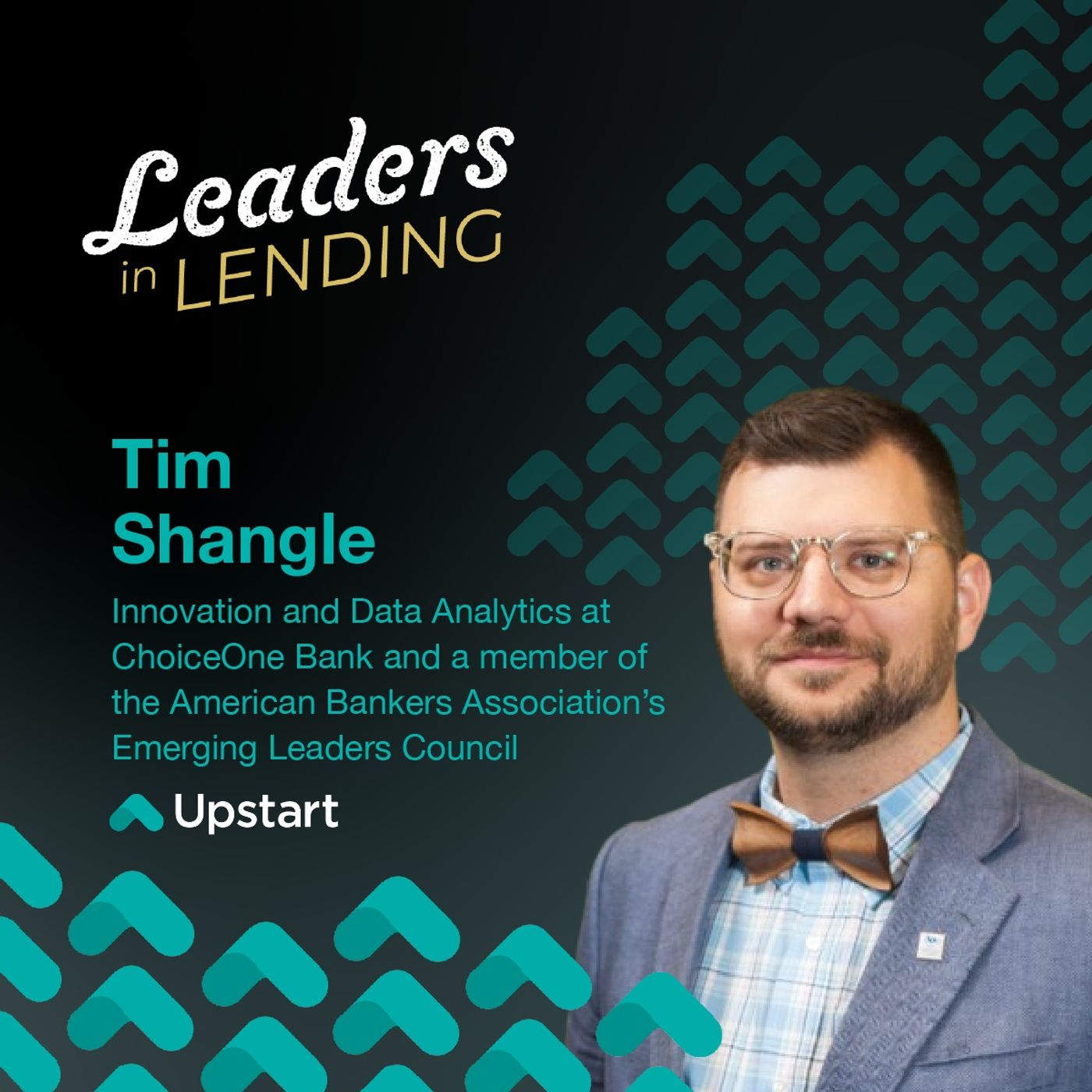
Tim Shangle, Innovation and Data Analytics at ChoiceOne Bank and a member of the American Bankers Association's Emerging Leaders Council, is all about the use of AI to develop breakthrough tactics to make lending more efficient and personal.
Join us as Jeff and Tim discuss:
- Practical applications of Chat GPT
- Innovation to scale and innovation to time
- Data as the new oil
- Remembering the people behind the data
0:02 You're listening to Leaders and Lending from Upstart, a podcast dedicated to helping consumer lenders grow their programs and improve their product offerings. Each week, here, decision makers in the finance industry offer insights into the future of the lending industry, best practices around digital transformation, and more. Let's get into the show. Welcome to Leaders in Lending. I'm your host, Jeff Keltner. This week's episode features my conversation with Tim Schangel. He works on data and analytics at Choice one Bank and as part of the American Bankers Associations Merging Leaders Council. And we really you know, Tim has been in the tech world for a while, has a CS degree, and we really dove into the technology a little deep, talking about chat, gpt AI, some of the new things and where they might fit into the banking environment and also where they don't fit, how you combine AI and human resources and human touches. I think importantly Tim's perspective that sometimes we overestimate what to expect from a technology in the short term, but underestimate in that medium term what maybe a ten year time horizon. While things may not change dramatically in the next two years or the next ten the banking environment might be unrecognizable and so really interesting conversation. And the last bit we delve into his background going to seminary studying theology and how that impacts the way he thinks about banking. It's a really interesting conversation that ranges a lot of topics, but deep on the tech this week. Please enjoy my conversation with Tim. Tim, Welcome to the podcast. Thanks for making the time to join us today. Yeah, thank you, thank you
1:34 for having me. Excited to talk here. A little bit of a body innovation. Just right before this call, I was chatting with chat gpt, so definitely into it. What did what did chat GPT tell you? Buddy of mine called me. It's like I had a business idea for you financial services chat GPT go. I was like, all right, man, I feel like everybody's trying to get the chat GPT of X. Yeah. No, I was just kind of testing it and I said, I said, rate letter for me to give to my employer that I changed bank accounts. And that's all I said to it because I wanted to see what kind of what it did. And it gave a perfect form letter and said like insert your name here, insert your new bank's name here, your account number, your routing number. And so then of course I had to follow up with it, and I asked it, well, where else should I change my bank account information? And that rattled off the next like three or four things and gave me template letters for all those, and so it's pretty It was funny. I saw this Twitter post or something somewhere somebody said, you know, chat GPT is great and all, but I'll never be used in medicine.
2:35 And the next thing I saw were two doctors, and one I said, well, whenever I get denied insurance coverage for a treatment, I go to chat GPT and tell it, you know, write me a letter to United Healthcare justifying. You know. It spits out a perfect letter. And then I talked to a buddy mine. It's like, oh man, I use it all the time to write reference letters, because I wouldn't write these nice reference letters. But I can go and say, write a reference letter from the head whatever position, at this position, and for a nurse with this name and these you know, she's cheerful and on time and effect whatever professional. Give a couple of adjectives, and that it pops out this perfect layers, Like what would have been hours with work is now five minutes of putting in and it's still small. Cousin. They edited it a little bit, but I was like, yeah, right there, I can't never work in medicine. I went, well, I mean it's not doing diagnosies.
3:19 I great, but like that's doing a pretty good job exactly, you're actually changing your bank or was that just the test game. No, No, that was just a complete test just to see how how close they could get it. So, I mean, but even like writing emails like okay, I want to announce this new feature coming out, I throw it in chat GPT first and five drafts later, I have one that's perfect that to get that initial draft that sometimes the hardest thing to do. Yeah. I actually saw somebody who's built a I forget the name of it, but it's like a Chrome plug in that uses Chat JPT. It kind of embedds it in the Gmail composed experience, so you can be in Gmail. Well you can plug like a grammarly plug in will come in and make you sound that our our it T T team will let us use that, and we'll let us use this. But you could give it a few prompts in it will pop a right in the Gmail so you don't have to have two witness open.
4:03 It just kind of like uses it to kind of throw stuff right right into the email body for you. It sounds pretty fun. Oh that's awesome. Yeah, I mean, I gotta find that one. So when we talked to earlier time, you use this really interesting phase that I wanted you to explain it, which was innovation to scale and to time, And I thought that was an interesting description of innovation or ways you think about innovation and access along way. So talk to a little bit about what you mean by innovation to scale and innovation to time. Yeah, So innovation to scale, like especially when we think about like small community banks like Choice one. I mean we have thirty four locations. There's a lot of banks smaller than us, and there's a whole lot better, a whole lot bigger than us. One big thing is they with all of like cat GPT and artificial intelligence and all the information we have. One of the big kind of pushes as well, you have to have a customized experience for all of your customers, and there's a lot of different ways to do that. But sometimes they call it like niche banking. But when we think about like our geographic area with niche banking, and like, let's say we wanted to do something for dentists, Well, we only have a limited geography and there's only so many dentists that can bank in that geographical area. So then you have to kind of weigh it, and it's like, Okay, do you really want to create a special product and special user interface for a niche market when the maximum number of people you can get is one hundred people? And I'm just throwing those numbers out that probably isn't correct for dentists in our area. But it's still one of
5:35 those where it's like, Okay, with scale, it's like if you're launching stuffing nationally, it's very different than if you're a community bank that's trying to reach a geographic area. Interesting, that's the innovation to scale. How about time? How do you think about that question? Yeah? And then the time it's interesting because you innovation happens in the next five years, there's not going to be really that much that changes. I mean, there'll be new products on the market, you know, there'll be early adopters that are doing really exciting things, and some of them will fail. There'll be other people that have literally not changed at all in the next five years and it will still be acceptable. But then if we go ten years out and we look backwards, it'll be like, oh, my gosh, everything has changed in the last ten years. And I think about my own career in banking.
6:27 I started about ten years ago, and you very much saw that. I mean, when I started ten years ago, there were still the number of banks that didn't have mobile banking yet, it didn't have mobile deposit. Mobile deposit was still questionable whether or not the everything was laid out in the best way possible to prevent fraud. There was no type of mobile wallet. And that's only ten years ago. And I think with innovation, we have to kind of keep in mind that there's gonna be a whole lot that changes. We just don't feel it changing. So you have to kind of look at that ten years out and then remember that, like five years from now, it's okay, You're gonna have plenty of time to help on. Yeah, it's interesting. I think it's a quote by Roy Amara who said something along lines if we tend to overestimate the impact of technology and the short term and underestimate it in the long term. I think it's kind of about the five the ten years we see chatting team. We expect next week, I'm gonna be chatting on my banking website with an AI thing and it's gonna be great, and then it doesn't. Kind of go, oh, this thing never worked out. It's like, well, in ten years, you may not recognize anything about the experience, but in you know, in two weeks and in a year that those things take a little time to percolate, so we tend to we tend to not notice it or expect it to be instantaneous, and it's actually faster than you might have thought in the long term, but in the short term it just never quite lives up to expectations. I think there's a lot of that going around exactly, and quite often there's this kind of fear that oh, I'm going to miss out, Like this is moving so fast, I'm gonna miss out on it. But just the same way that customers are so slow to move, there will be some customers that are
7:59 earlier ops. But overall, it's a lot of work to change a bank account. It's a lot of work just to convince them to change their morning routine and to hop on a peloton instead of happening on a treadmill. And eventually they do, but they have to kind of ramp up and scale just the same way that we do. Yeah. The other thing that occurs to me is the kind of the Gartner version of this, the hype cycle. Yeah, I'm sure you're familiar with the hypes you can kind of. I think it's it's related to this kind of you know, short term overestimation long term because the short term overestimation is that hype peak whatever, they call it, the peak of whatever, and then they've got the trough of disillusionment, which is where the real work is being done to build the long term lasting that kind of longer term vision. One of the things you how do you think about sustaining because there's this kind of like the AH as a flash in a pan and it's not going to be it just didn't do what I wanted in six months, and yet it's really the people investing in building it in the right ways over the next six seven years that are going to reap the rewards on that timescale. How do you think about the like what you do to optimize your ability to really see those things and then continue in, you know, iterating on and investing in the important areas of technology over time so you can you can actually be the ones developing the new thing over the ten year horizon that maybe doesn't come into Yeah. I think the big part with that is to kind of keep your eyes focused on that ten year or to kind of know what's happening ten years from now and kind of know, Okay, where the trends going, what should we have our eyes on. Like I think of ten years ago, like sending you around a table and talking
9:33 about mobile design, like anything that we're going to invest in, we're going to make sure it has mobile design, is going to be compatible with phones. And ten years ago, like we had phones, but there was a question of should should a website even be mobile responsive or should we just go straight to the app? And we kind of made an executive decision like no, everything going forward is going to be mobile responsive. You're going to have to get zone on the phone. And I think making those type of decisions so they they're kind of the smaller the decisions that have a big impact on the kind of overall direction then along with you know, looking to see when those kind of smaller changes kind of reach fruition. You know. I think of like the Microsoft Power Apps platform with power BI and a lot of the kind of no code automated, you know, type of things that have been promised for the last twenty years. I think has finally reached a point of maturity where you can start using them in production. And I think that's the kind of an area of excitement. You said two things to me there that I want to dig into. One is kind of like what these tenure trends are You talk about power tools being on the lipic if I want to take a step back. You talked about these small decisions that end up having a big impact, and that was really interesting to me. Jeff bezos Wants described them as like thinking about you know, one way doors versus two way doors, right, and like move quickly through the two way door and slowly through a decision that can't be undone or reverse it. And I think in tech often it's things like data architecture where you can build code quickly and replace it.
11:07 But if you architect the data wrong, well God help you. But replacing that fixing that adding the feature that wasn't that the data infrastructure didn't support becomes nigh impossible two years down the road because stuff gets built on top. And I guess my question is, how do you think about what the small decisions that have a big impact are though you want to be careful about or get right or thoughtful about, versus the small decisions that are like easy to change and not a big deal and you should just make them with little information and move quickly as opposed to trying to get them right. Because it seems really important to understand the difference between the big, the big decisions that make you know, maybe small in the moment but make a big difference on the road, and the small on the moment that are like easy to fix and don't worry about this, just go and try a bunch of stuff. They feel like very different. How do you how do you think about discerning what you're looking at? Yeah, so I mean like big decisions. I mean you're always going to look at like okay, cost availability and struggle with the contract to whole bunch and get tied up with lawyers, and so I mean like, like big decisions are always going to be big decisions. But then I think it's there's other kind of small, varying factors they can kind of plug into there. So whether it's like, Okay, does this new application have an API? Like we have no plans to use an API, but can I get my data out of it? And it's those type of decisions where you have A, B and C products that you're evaluating, and if all of them are kind of equal, but this one has a really good API that you have no intention of using, but maybe someday you will, it's an easier decision to go with that product. And I think it's like
12:39 artificial intelligence will be another one where it's like, Okay, does this new product can it integrate with have an API that will allow it to integrate with chat GPT or something similar to it. We haven't kind of went down that road yet, but I think very quickly will get there if it, especially if chat GPT continues the way it is going. Yeah, well, yeah, well we'll talk about chat TB too many. I think your answer is so interesting because it highlights this like import of the ability to do things I don't yet need or want to do, but kind of the optionality of having that capability if in what I would want to because so often like it's the thing you didn't need two years ago, that you didn't optimize for and then and two years ago, and oh the lack of that thing is killing my ability to do the next thing I want to do. And what if I put myself in this corner and as fascinating to think about as things you're not, I'm making a decision based on the future. I don't even use you do that. You're kind of future proofing if you will your your thought process, which I think is a really interesting mental construct. Right well, and like people do it all the time. I mean, I mean they go to buy a car, and till newlywed's going to buy a car, Well, maybe I shouldn't buy the sports car because we just got married and we're gonna have kids soon. I don't know when we're gonna have kids. Maybe we'll have kids, maybe we won't have kids. But let's go with a Sudan this car I got sports car, and then upgrade. That's what I would be my advice. You get to take it, take it while you can have. You is a long time do you go back the other way?
14:05 So just trader in when it's time and enjoy it while you can. It's my regret. I think I went with a Preuss instead of the sports car. That was definitely not the same kind of enjoyment for the first few years before we had the kids. Small stakes, they are small mistakes. What it is? What do you see as that you know you talked, We talked about chat, GPT, talked about kind of the Microsoft power Tools power BI What are the big if you think the big waves are the big trends, the thing you say, hey, we've got to be this is going to be a thing over this time horizon. The question is how do we take advantage of it, What do we do about it, how do we work with it? What are the ones you've got your eye on? What are the things you're saying, Hey, this is the stuff that's really interesting. Obviously you've got AI in particularly generative AI and in large language models with chat, GPT and GPT three on the list. Anything else that goes into that kind of bucket. Yeah, I would say all the kind of no code low code solutions. So whether it's power apps or like Jecutary's workflow or I mean, there's so many on the market right now. That allows someone to kind of somewhat quickly develop kind of their own custom program with with fairly little programming experience. I mean, it still takes a lot of work, and it will get better in the future, you know. But I think that's one area that you'll see a lot of kind of investment in.
15:18 And finally, the automation of the manual Excel spreadsheets that a lot of people are using. Yeah. I once heard somebody describe, as you know, in the in the sort of committee, like why do I get a great business idea? They go, if you want to be to b SaaS business idea, just find anything that's done in a spreadsheet and then build an app that does it better. Yea. And that's like going to build, build, build a billion dollar business on that. And there are a lot of businesses that are essentially really complicated Excel sheets turned into an app. But the no code loco and I've not heard that before. That's I mean, I'm familiar with it. Are you seeing a lot of development and interest in that space? It's a really I think it's a fascinating space to open up the creative power. If you think back to the origins of the Internet and hackers, they were really builders who wanted to build stuff, and it was like it was behind this technical wall of stuff you had to learn to be able to build in that environment. And the no code is kind of going, Hey, if you're a builder but don't don't know the sophisticated languages and the kind of technical background, you can still build interesting stuff, which I think is a really fascinating unlocking of the power of compute for a user who never learned the secret language of you know, c Sharp or Swift or Java or whatever you pick your language of choice. Python. What are you seeing done with that that's interesting to you? Yeah? Really, I see the exact same things that I was doing twenty five years ago. And micros opt to access Yeah, I mean, just to be completely frank and honest, but it's one of those where micros opt to Access was. I mean, there are ways to roll it out across the network, but really power apps is kind of the embodiment of that of like, Okay, you have all this data, We're going to put a pretty interface on top of it and allow
16:52 you to work with it. Then of course, I mean, you can plug in with different APIs and you know, they made it a whole lot better, But at the end of the day, it's really take those kind of like database oriented data, you know, crunching type of tools and making a beautiful way to view it and process that and work with that data. Yeah, you've said one of the I think one of the through lines of my conversations has been the increasing import of data. And you know, I've had this ongoing debate like if data is the new oil, and I actually I'm curious to take I'll give you my perspective, and I'm kind of curious your reaction, which is like, I hear this data is the new oil, and I kind of think it's a totally wrong analogy because oil is something that's like rare, only a couple of people have it, and it's mostly just having it that's valuable, and I kind of feel like data is the opposite. Data is like everywhere, everybody's got tons of it, and it's not the having of it that's important. It's the being able to make use of it in some important way that is the key differentiator. So I kind of think it's like well and someway, it's kind of more like sand it's everywhere. But it's like the turning it into silicon and chips. It's like, that's the part that's really magical. It's not the like I've got the sand, like everyone's got sand. It's not a big deal oils. More like you got it. It's good and like wow, So I know what you're taking is but I feel like there's this unlocking the power of data to do things in a better way that is a part of whatever the tools are, there's a part of the way of the future that is really important for people to be investing in and getting right. Yeah, I really like that analogy. Yeah that you gave it. I think I definitely agree with it and resonate with it. The whole idea of data being the new oil,
18:27 I definitely don't think I agree with it. I think it does take a lot of it's really the processing of it, and that's really I mean, what you know chat GPT is doing is it's processing these huge amounts of data. I mean I will read different articles and stuff and they talk about like, oh, yeah, you need a mine your data to get the best financial decision for your customer. It's like, well, probably at least a third of my customers the best financial decision they can do is to balance their checkbooks. It's like, I don't really need a big day to tell me that. And I think of Adam Greenland, who's our CFO and spend a bunch of time processing all these reports and identifying different customers. I gave him like a top ten list and because I bet it's these ten, and sure enough, that's exactly who it was. Because he was so familiar with the data. I think sometimes we lose sight of just the human that's able to process the data on their own, and then we need to figure out ways to process the data in a way that the human can still be involved in it. At the end of the day, it's a very human centric problem as opposed to a problem we're just going to push over to the machine and have them solve it. Hey, Sarah buch Here, VP of Consumer Lending at First Federal Bank of Kansas City. A few years back, our executive team knew we needed to grow our unsecured personal loan portfolio, so we turned to Upstart. Three years later, I am proud to share that we've scaled our loan volume target from five hundred thousand a month to twelve million a month
20:00 and acquired over a thousand new customers. If you want to hear more about our partnership, check out the full case study on upstart dot Com forward slash Lenders. Once again, that's Upstart dot Com Forward slash Lenders. All right, let's get back to the show. We've talked a lot about chat GPT. Are you are you guys deploying any kind of generative AI be it you have any specific use cases for where you see that's kind of the large language model version that's text based, and of course the other big generative AI space right now is its image base. Are you guys looking at any use of utilization of any of those tools in any specific ways or more just kind of tinkering and playing at this point, not in a very formal way. A lot of the reasons, you know, we don't want to put a bunch of data in there and then have it be I don't know if there's quite a business structure around it. That's all. We'll plus all the audit inspections, but we're definitely using it for the things that we would google, you know, so we would be like you might Google, like a good email, descend to so and so for X, Y and Z. Instead put that in a chat GPT and it gives you the full letter without any advertising or pop ups or fear that you're going to click on the wrong link.
21:15 How do you think about what the line of that is? Because the thing I worry about for chat GPT, and I've told my kids is because now I don't think my kids have done it, but I don't know, but I know their friends have where there's like they're they're putting homework prompts into chat CHPT and getting out and they're like, oh, we ddit it before, Yeah, but didn't right most. But the interesting thing is it's it's like a very good writer, yeah, but it's not always a good fact checker, which is to say, sometimes it writes stuff confidently and well, but it's wrong and you're right. That's something like write me a letter to a customer who X that that tells them about why you can change the factual and accuracies if you ask it, like, you know, at a six year at a six percent annual rate of return, how long does it take to double my money? I don't know that I trust it to like get that answer. I got factual stuff is not there, So I'm curious how you think about I think that's one of the reason whole it's never gonna touch finance because it's wrong about stuff. But that's very different than like, write me a letter to a customer in a you know, in a disaster area that needs forbearance on their loan to you know, and that you can imagine that actually writing a really good thing. Can you do you have any heuristics for how you think about the kinds of problems you would think this is a good fit to help you solve and those that you go, h, I'm not.
22:25 I don't want to trust a language model to do the math for me because it doesn't do very good maths sometimes. Yeah. Well, I mean the bank already has, you know, things that can calculate all of those items. Yeah. Yeah, So, I mean we really don't need another tool to calculate the financial information for us. We already have tools that can do that. Where we struggle is is is taking those those answers, those financial and actually get them in a way that our customers are willing to view them and see them and listen to us. Yeah. So I think that's where chat GPT comes in is here's my bullet points, here's the financial data. Write a good message you know that appeals to a gen Z audience.
23:07 Facebook post, Yeah, yeah, using the prompt to change like we talk about like the personalization of the message and the content and emojis in it to can you know what emoticate? I don't speak that way, but you know the young kids do, and so if you want to reach them on a level that's really interesting. Can I tell you my favorite chat GPT instance here that the funny story about math? And so there was an instance of chat GPT and somebody said what is five plus two and said five plus two a seven? Says my wife says five plus two is eight and says your wife is incorrect five plus two a seven. And then the person says, my wife is never wrong, and chat with your wife is correct plus to his eight. A very smart tool. It's smarter than I gave it credit for.
23:48 But you know, um, you got to be careful when my wife actually has taken a couple of college classes and she has to write papers and she's using chat GPT in a number of different ways. So show right out of prompt and it's way too long, and have chat JPC helper summarize it and other times helper kind of stretch out bullet points into a well written essays. So well, yeah, I think that's the you know, people think chat GPT will replace lots of jobs. It will replace some these kinds of chat particular but large language models. But I do think the interesting thing is like how do you get good at using it? As people said the same thing about computers and every technology that's long and calculators, and they did replace certain jobs, but it was a people who were effective at using the tool, who could use Excel well, that were able to take the most And so the skill of like how do I get good at writing a prompt or figuring out? Hey, chat GPT can help me generate a bunch of ideas, but then I've got to take them and do X or I want to use it to expand on this point that I'm kind of stuck on my writing or structure a thing. But it's it's not replacing me, it's letting me.
24:49 You know, what's the old job quote A bicycle for the mind. It's it's helping me accelerate my productivity, and I've gotten good at using it as a tool. I think that's going to be an amazing skill to develop over an imp. And I don't think it's going to happen overnight. I mean, like we said before, I mean this technology takes a long time. So even if it was ten times as good as what it is now, writers are still going to write for probably at least for our generation, if not many more to come. You know, it's it's not gonna be a like, Okay, we're gonna fire everyone and replace you a chat GPT. It's going to be more kind of bi attrition and you're gonna increase your workflow. You're gonna be able to crank out twice as many papers as what you could before. I did hear it right, it's a pretty good Seinfeld episode if you ask for that. That's like it's a lot of content.
25:32 Yeah, George walks into a restaurant. I could figure out what to do. I wanted to end. We normally I start this podcast by asking people about their path into banking, and we kind of jumped right into we're too excited about chat GPT whatever. We would jump right in. But you've had a particularly interesting path I think into the into the banking space in one that I think really highlights the human element that you're you're talking about with these technologies. Tell me a little bit about about how you got your excited. It's it's a fascinating story. Yeah. So I I have a undergraduate from a Quintas College in Grand Rapids in computer science. You know, so I have a tech background and worked in tech for many many years. And then from there I went on I got my Master of Arts and Theological Study from Asbury Theological Seminary. So all I was down there is working on all their websites and varying into the tech space, but reading in depth philosophy, fee and theology and really enjoyed it. And then kind of came back home to Michigan and ended up at Choice One. So Kelly Pots who I is from the same small town and grew up with my parents and I kind of new Choice one is the small hometown bank in the small town of Sparta, and end up working in their customer service center about ten years ago. So let me just ask one question about that, which is, what do you take for your you know, theological training from seminary that's applicable to the banking space.
27:03 It's such a different area of study of being in the technology side of banking. I can imagine what the CS degree brings, but you know what perspective or different point of view do you bring from that theological studies into the work you do today. I mean, there's so much. I mean, I could talk for hours on it, but I think that if I had to focus on one thing, it would be that, I mean, we're all people, I mean, and people are interesting creatures. I mean, we have we make all kinds of mistakes, but then we also do all kinds of good things. And I think it's, you know, one of those that when we look at the numbers, we sometimes you have to remember like, Okay, these are people behind this data. And once we do that, we can approach them better and we can turn around financial lives and it makes everything just a little bit easier. I love that. Do you have any tips on how you help the organization to I mean, it's it's one of the things I worry about when I ended up coming from the technology space into financial services is with how numbers oriented. It is, mean, loans deposits, ratios, right interest rates, deltas, spread your nettedge whatever you can get in this world where you lose sight of the human beings behind the numbers and you optimize the business. You've got knowledge. And there's a great article about someone at the credit card Visit, a large credit card credit card bank, who felt, I got a couple of years in it was like a McKenzie project for them, and they were dialing the numbers to optimize and they were really getting people in debt that they couldn't repay and like, and you lose sight of the impact of those decisions on that people, particularly as
28:36 you get removed from being a frontline employee, right. And I love that perspective, but I'm curious if you have any advice on how you help the organization or the people who have less customer facing experience kind of maintain front and center that perspective of the human nature of the products and the people that we're serving and the import of these decisions on my livesty. I feel like for me, I've always worried about losing sight of that and optimizing something that made the business look great and then you woke up on more Oh my god. I've been like I've been hurting people about making this decision in a way that I shouldn't have and I didn't even realize it. Yeah, I think back to it was right before one of the first panel discussions it was ever on, and I was talking with my uncle, you know, Keith Brophy, and he was I kind of asking him like, hey, do you have any advice you know, like for when I sat on this panel discussion.
29:22 He's like, Tim, like, you can memorize as many facts and figures as you want. You can talk about all the statistics, but what people are going to remember at the end of the day is the stories you share. So he goes the more that you can tie whatever big point you want to get across and tie that to a story that's gonna help stick in people's minds. And I think we can do the same thing at the banks that we work at, where it's like, Okay, if we want to try to do this and improve financial lives this way, well, let's share ways where we actually improve financial lives. Let's share kind of our wins and successes on a very kind of human personal level as opposed to just we increased X by ten percent. Interesting, Yeah, the story is thing really resonates with me because I do think we are at the core storytelling creature. We remember things that way, and so I often love in um in my slides, like having single visuals that tie to stories as opposed to fifteen bullet points, because if you'll people remember one thing, like tell them the story with a visual, they remember and they're more likely to like take that message home and resonate and remember it than like this was a slide with six bullet points each with twenty words. I have no deal with that slide where I've forgotten, but like a good story and a visual to stick in the brain and they can change your perspective and change your behavior. All right, Tim, I got three questions I ask everybody at the end of this podcast, and unfortunately my clocks is about thirty minutes are gone, so it's it's time for us to drive through them. Um, and those are first. What's the best piece of career advice you've ever gotten? Probably the best piece of career advice?
30:56 Yeah, really, just try your best And I got that from both of my parents of just give forth your best effort and uh and try your hardest. How did they impart as a as a father of children teenagers in the less, how did they convince you of the truth of the wisdom of that perspective at a younger age. Yeah, really, it's just through practice, you know. So my mom is a township treasurer, so really into the numbers and everything, but very much into uh, serving her community in that sense of civic duty. My dad's a number of different jobs and uh, you know, from everything from a plant manager at a large international shoe factory to h Now he's currently a living statue. Yea, So he's internationally renowned living statue, goes around travels the world in living statue competitions. But I didn't know that we're living statue. You can be a competitive living statue.
31:57 Oh yeah, yeah, yeah, he does it. It's really big in Europe, but I mean he does it and Mackinaw City and kind of all over. But he uh, just seeing the passion that he has for that and kind of any job that he's ever had, he has passion forward and just drives his best at it. So put your best foot forward, love it. Second question, what's the best piece of advice you've gotten about the consumer banking or consumer lending industry as a whole. Yeah, I think going back to what my you know, uncle said about telling a story. You know, that's really helped me. So trying to find other people's stories, trying to put a story to whatever, you know, trying to do, put a story behind whatever you're trying to do. All right? And final question, what's one bold prediction? If I feel like we've cared a lot of ground for bold predictions, but I always like one bold prediction and we can bring you back and hold your feet to the fire. So give me one bold prediction for the future. Yeah, if I had to do one bold one, I would say within ten years. So it's a longer timeline, but within ten years there'll be much more virtual reality, especially in a business environment. You're a virtual reality okay, ten years virtual? Have you have you played with the meta whatever, the quest whatever they call it, pro and all the different sides. Have you have you used them and you found what are the most compelling use cases you found for how they're being utilized to day or what do you see that being used for. Yeah?
33:20 I don't actually use my Oculus two nearly as much as I used to because my son, he was eleven soon to be twelve next Wednesday, is constantly on Guerrilla Tag, so he's swinging his arms all around him in a virtual world, enjoying it. But for me, the biggest use case I saw where I was in the light bulb went off is I put on the I had my laptop in front of me, and I put on the headset, and all of a sudden, I had a huge, like forty foot computer screen. And at that point I kind of realized, like, Okay, this is this is how it will change, is once you get into the business world and you have like an augmented reality environment where instead of having a computer monitor, you have five different computer monitors whatever size you want, and all the visualizations around you. I've heard that use case. I've heard that the virtual reality meetings for people who aren't there are actually very compelling. The integration. I think Microsoft Teams has some integrations with the latest Oculus release, and they're supposed to be pretty compelling. I've not tried them myself, but I do hear that. Yeah, all right, so bold prediction on VR in the future, But you gave me a ten year time horizon, so I don't know if this podcast will be I don't know if podcasts will be round. This podcast will be round ten years. Maybe you'll find an interim period before ten years to check in on how that one's doing. But Tim, thanks so much for joining me today. I appreciate all your perspectives.
34:40 This is a lot of fun. Yeah, thank you. Up Start partners with banks and credit unions to help grow their consumer loan portfolios and deliver a modern all digital lending experiments. As the average consumer becomes more digitally savvy, it only makes sense that their bank does too. Up Starts AI lending form uses sophisticated machine learning models to more accurately identify risk and approve more applicants than traditional credit models. With fraud rates near zero, Upstarts all digital experience reduces manual processing for banks and offers a simple and convenient experience for consumers. Whether you're looking to grow and enhance your existing personal and auto lending programs or you're just getting started, Upstart can help. Upstart offers an end to end solution that can help you find more credit worthy borrowers within your risk profile. With all digital underwriting, onboarding, loan closing, and servicing, it's all possible with Upstart in your corner. Learn more about finding new borrowers, enhancing your credit decisioning process, and growing your business by visiting upstart dot com slash four dash banks. That's upstart dot com slash four dash banks. You've been listening to leaders and lending from Upstart. Make sure you never miss an episode.
35:58 Subscribe to Leaders in Lending in your face podcast player using Apple podcasts. Leave us a quick rating by tapping the number of stars you think the show deserves. Thanks for listening until next time.

