Deposit Management in a Post-SVB World

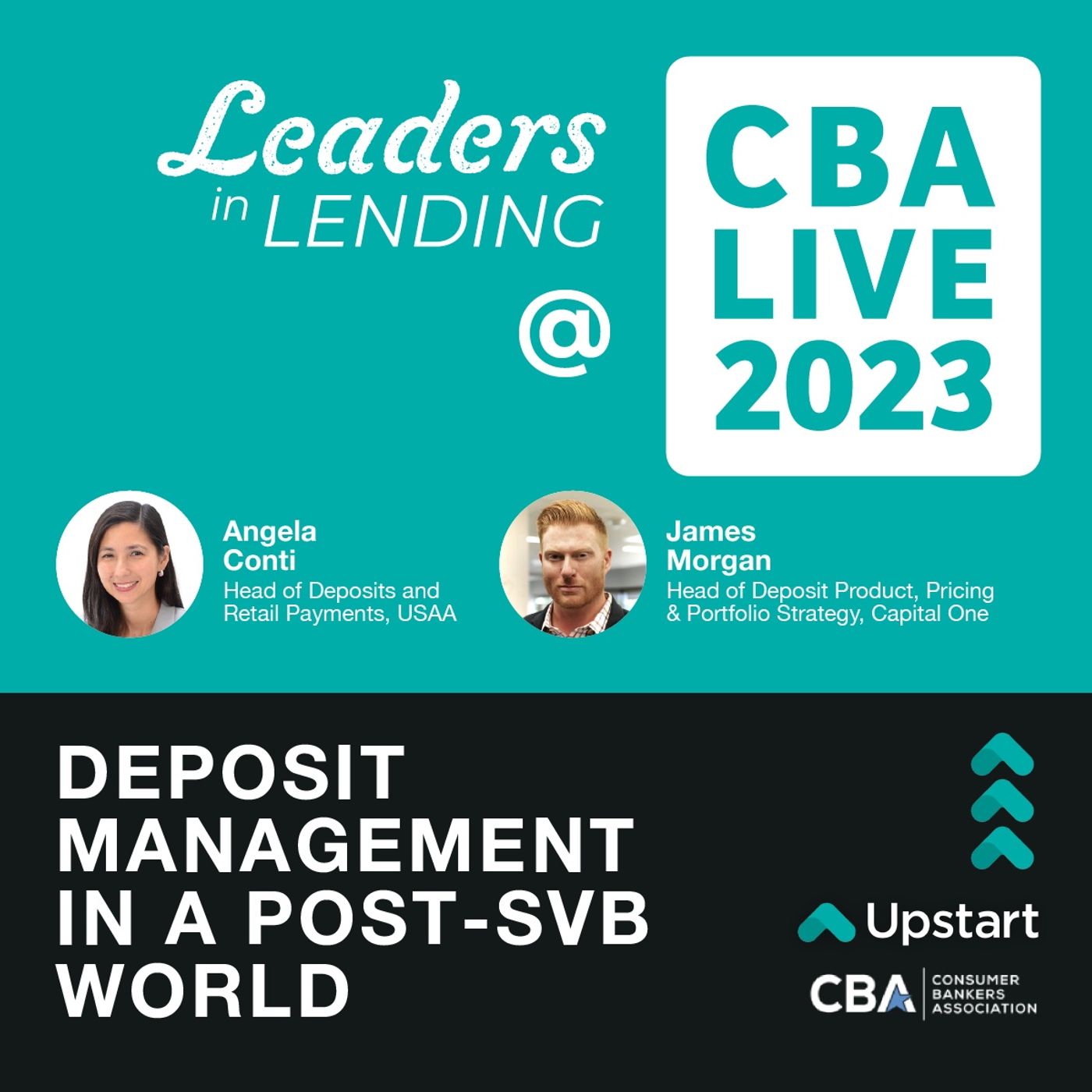


Though deposits at many institutions are down while uncertainty around the future is growing, Jeff sits down with two experts in the deposits space who offer strategies for organizations to thrive in the current financial climate.
Angela Conti, Head of Deposits and Retail Payments, USAA, and James Morgan, Head of Deposit Product, Pricing & Portfolio Strategy, Capital One, join the show to demystify declining deposits and post-SVB uncertainty.
We discuss:
- The lingering effects of the pandemic still influencing deposit behavior
- Illuminating the benefits of digital acquisition
- What your organization can do to maintain a competitive edge
0:02 You're listening to Leaders and Lending from Upstart, a podcast dedicated to helping consumer lenders grow their programs and improve their product offerings. Each week, here decision makers in the finance industry offer insights into the future of the lending industry, best practices around digital transformation, and more. Let's get into the show. Welcome to Leaders and Lending. I'm joined live and in person today by Angela County from USAA and James Morgan from Capital One. Thank you guys for taking some time out of what I this is a very busy day to come and talk with us. Well, thanks for having Yeah, this is going to be fun because we're usually a lending podcast, and day we're gonna talk about deposits, maybe the most boring banking, most traditional banking product of all time.
0:46 But just let's start with this question, what's the deal with deposits? What's going on in the space of deposits? Pretty boring couple of weeks and at deposits are kind of all to talk these days. Yeah, I think it was a pretty interesting time, maybe pre SBB turbunsypols of that, but it's been an interesting time, mostly kind of coming out of the pandemic entering into inflation obesusly central processions, and so it's a lot of predicting where the world's going to go, what does that mean, how does it impact segments differently, different banks differently. So it's just an interesting time to be studying the brawl. Yeah, I mean, I completely agree, and I feel like the deposit space was one of significant stability for a long term the pandemic head and there was a dramatic change right in consumer behaviors and how their money was flowing in and where they choose to store their funds, how they transacted, and as we're coming out on the other end, there are a lot of things that persist and a lot of things that change, right, So it's a very exciting time. So I want to want to say ignore we can get into the SEV and kind of what's happened. I feel like that's more of a short term thing, although do you think there's some long term lessons to takeaway? But talking about what were the major trends as we went into the pandemic, I think, particularly post the stimulus being introduced all of a sudden, there was like a lot of my personal savings rate hit some obscenely high number that has never hit. I mean, you look at that
2:17 graph and it's got this one like little thing that looks like an error. I mean, if you saw that in a statistics classic, where's where's the data point that was erroneously entered and you go, oh, these couple of amounts are really long. Well from a segments point of view or a products point of view, what was really happening there? And then what's happened on the tail end is we've seen the end of stimulus, the savings rate go back down to normal or below normal. What's kind of been the trend between consumers and products or segments and products and in deposits post the pandemic, not that we're post, but post the stimulus at least I'll say yeah, I mean I could start there were a lot of changes underway. And when the pandemic hit, right, folks were many were flush with cash right and there we were in a very incredibly low rate environment, and so the concept of what are you going to do with that money? We did see savings rates increased. We also saw balances in checking accounts because arguably there wasn't all that much difference between whether we had in and checking account of savings account and folks.
3:20 As the world opened up, there was pent up demand rain and saw spending start increasing. We're in good economic times and now as we reflect on where we are today, we see continued spending and we also see movement in the balances right that we've We've been talking about quite a bit recently. So I think that pandemic was that seismic cheat. There's certain things about consumer behaviors that are persisting to digital is one of those silver windings and all. It seems to be more stable than some people have shared. But yeah, a lot of change, for sure. Yeah, I would echohlbad. I think the the initial pandemic surge was comprised of a number of factors. Right, Like I missed Mulis part. You also had this staying hello less spending.
4:12 Now we've got the revenge spending the kind of like a little bit. And I think there was always a mentality what was must come down. We didn't do anything to earn that search, right, Yeah, and so there's you know, kind of an implicit assumption that that would eventually normalize itself. That took a lot longer than so you did end up finally back to this repune spending thingum coupled with inflation is going to be made. Some of these things happened faster, so I think the dynamics of the initial surge saw at least her consumers a disproportionate amount going to primary checking accounts, and so banks that played heavily in that saw a little bit more searched. Others some of your calmline direct stating players not so much, and so you're starting to see some of those things start to flip as we come. One of the things it was interesting to me as we've seen I mean post us phbe but I don't think entirely we've seen. I mean what my CFO tells me is the first time in history we've seen decline and deposit balances in history, as far as you can see the numbers. That's interesting to me that the outflow, but also the sense that there is the ease of the fluidity of movement between institutions seems to be much Himan SPB experience twenty five percent of deposits coming out in a day, which I think, you know, you can have a discussion about the risk management practices they had, but at the end of the day, like there aren't many banks that are prepared for twenty five percent of there are deposits to vanish. It as a pretty traditional run on the bank that would hid at the institution. And it makes me wonder how much are we seeing increased competitiveness in terms of sensitivity rates Consumers going hey, I can actually
5:42 there's this online account and I can go get four or five points on an account that used to used to never even think about. Interesting you're checking out, like, you know, I got point oz eight or whatever. I went, Oh, it's like a little bonus. But I was never moved picking an account over that, And I feel like there's maybe a shift to where there's a little more competitiveness. So I'm curious, is that something you're seeing around competitiveness for rates and what are the other dimensions upon which people think about the value of an account of one institution versus another, Whether kinds of value are there in those accounts. Awful way just think it was like it's just a check it it's just like kind of just a thing that you don't think of as having very much differentiation. Yeah, I think a lot of it has to do with the cycle. I mean, I think the premis of your questions started with SVP, but I would go before that. Even if you think about the last rising rate cycle, FED rates feaked at two and a half, were past that, So you know, I think that's just a function of the dynamic extremes of cycles themselves. So where this particular time, now you're pushing five percent half five percent, and it starts to make things like CDs interesting again. Particularly markets aren't forming the way they need to be, you know, and a lot of the things competing for your deposit dollar have kind of fallen away like a year or two, like retail investing, Bloom Robin Hood, a lot of people got bird kind of came back from that crypto and kind of what's happen and there, you know, I admittedly was staking some of my bonus into, you know, to a stable coin thing at nine percent. Yeah, you're the one's talking about that today for Haithe and so you know, it was I bonds, you know,
7:15 it was the kind of the biggest game in town. I'm over the past six months for really misk adjusting yep. And now you're those are coming back down to Earth as well, and so now I haven't we've seen CB demand and the way we haven't seen in years, which is pretty interesting. Yeah, I mean, I would say I think it varies quite a bit based on who that target consumer is or that hand customer, right, because if it's someone who has a lot of money or business, right, there may be quite a bit of rate sensitivity they're in if it's at their discretion ease move and we didn't. We have and continue to make it easy to move money right as an industry, which is a great thing. But if you think about someone who is living day to day, like maybe in that more mass market, the other elements around halleyeen bank and who you trust right like um, if you've got a sense of safety and security is their convenience in that account, You've got other elements set up, you might have your bills automatically deducted from that account, and you might have other relationships. Those elements matter as well. Rate is not just rate. Rate matters too, but to varying degree. So i'd say what we've seen, because you did touch on you know, the STB aspect, what we've seen has been quite
8:45 a significant empowered especially in the commercial space, but in consumer retail deposits really quite a bit of stability right in the week of all that tumult in the in the industry at marge, is your sense that the uh, the massive shift in the in the larger particularly the commercial accounts, is that's happened in the wake of best Is it like a temporary like what's going on with the world? We need to find you. I'm going to come back to my local bank or where I was at before. I mean, certainly, I gotta call. This is one of the weirdest calls I've ever gotten from financialiser goes, do you guys need to move your money out of the deposit account? I say, why is this for safety? I went, who moves money out of a deposit account for safety? Usually moved out for yield at the expensive safety. And yet for a moment that felt like not the right trade, which was very weird. But I also feel like, then six months are going to go back and go, yeah, it feels pretty safe again. I'm going to go back and put my money back where it was.
9:41 In terms of high you measures. I don't know how much of that kind of commercial shift is a more structural long term thing and how much of it is a more short term reactionary experience. Well, so I can't claim significant depth of X for effects for choosing comers. I am consumer ely focused, how or that that's that's safement. It has long been regarded as rate sensitive, right like it's so in the information and that the analysis that we've done it very much looks like a duration like a matching issue, right, Not a fundamental difference in the depositors behavior, but rather mismanagement around how you think about matching duration after the Just a fundamental banking mismatch, is what I would say, which is why I think that trust factor and trusting the management to know how to understand the consumer or the end customers behaviors and ensure that the strategies are appropriately matched it is important. My first comment is I would probably rephrase your advisor and say do you need to spread one of around as opposed to maybe say exactly like that, but you know, the concept is right. The broader thing that I wonder about is the nature of concentration.
10:58 I think that can be a consumer ormercial aspect. You know, particularly with so many banks in America that they're all fighting for differentiation in some different way. Yep, that was theirs. I think in the in the end, you have to do that responsibly, and I think there's I do think it is a great wickup call for kind of traditional boring banking. It's done really well. R short, lend long heads your risks. I think like there is a value add that's there, and I think we're it's a stark reminder, you know, FDIC is pretty boring you. The interesting thing over the past few weeks has been FDIC has been interesting too. Older massive fluid clients we know more about it that are looking to maximize it, and then for younger customers just learning about it, just understanding what it is. It's now on the AR. I think for many of the younger consumers, like the idea that your deposit isn't just sitting in cash in the bank, but is actually like kind of lent to the bank and they're doing things with it is almost a wake up quickly. Maybe it's not just as I'm sitting there does not work. There's a risk that they can lose is my deposit? Like I didn't understand that was true, which is I mean obviously not under the account of the idea that it could be lost and the government would need to ensure said lots is kind of a wake up call though. I think a lot of consumers it's just had no idea that that was a thing A long time since we had to do that. I think it's my mom did make me watch It's a wonderful life. I don't know if I would not before.
12:18 I work think. I think that's how you learned about it. The kids are watching that again anymore. I don't think they're watching that anymore. I think that one's I mean occasionally. I mean I've shown my kids, but I'm not sure that it's a common watch for the average teenage of these days. So you talked about one of the kind of maybe more durable, lasting changes being the digital acquisition. What do you see as the next thing coming in the digital acquisition and if that becomes up front on the to your point, the war for differentiation, how do I like, what is it that people should be thinking about when it comes to digital acquisition, digital account opening and the kind of thing that fast follows after it, which is fraud and now we think about reducing the friction and making an experience that we like, but not also introduced seeing a lot of risk of you know, mouthfeasance.
13:03 Yeah, I mean, I would say that digital acquisition has to be easy, right, and so it's on us to figure out how to prevent the fraud, how to mitigate the fraud. And luckily in our ecosystem there is a ton of data right into those of us who are in the industry. It's on us to make sure that we can set that up for success. And so I think the core of the drive to digital and that persistence is consumers and customers at large of seeing the benefit of convenience, they seeing the benefit of how they interact in digital spaces, and for us to continue to drive that, we've kind of make sure that that value exchange is very clear that they clearly see benefit, that they don't feel as if we're trying to tell them, hey, you want to do this, but instead you should you We really need to integrate ourselves in a way that makes it apparent to them how it's easier, how it's more convenient, how it is see and really and really see that totally agree. I think, you know, post pandemic, you're really looking at a world that has a higher demand of digital fluidity and ease of service, um, you know, and coupit once been on that journey for a long time. Well, I've been an account opening all that kind of um, you know, bring up the right part, that dirty underbellue of that is we're also protecting from fraud at the same time. Yeah, and that may just be what's next because very often fraud defenses or hand in hand with friction for good customers, and so there's always this kind of push and pulled dichotomy of creating friction for good customers is kind
14:35 of how you defend or have better rates defense rates against fraud, right, or you know, the opposite could be true. I make it easy and fluid and way too exposed to fraudsters, and so you know it is going to be a vowel for data and capability on doing that well minimizing the most positives. That kind of the balancing of those who thinks is really hard is we find it even harder and lending to the extent that like when you put friction front customers, you end up driving away the goods. You end up actually negatively not just losing the accounts, but negatively affecting your credit performance because like the best customers won't sit through the friction. So then not only did I and I get to balance, but I negatively affected my credit performance by putting the friction it. But it's like I can have a no friction process.
15:15 It's kind of it reminds me of my r CEOs sometimes. Class. It's the lending business is the easiest business in history to grow and she's hard to get your money, man, but there is room for hope, right and I go where like even in lending, Like when you think about how far we come in terms of instant positioning, right, Like, all of that to eat is out there, and as banking becomes more and more real time, it's yeah, it's it's just an exciting challenge. It's one that we're Yeah, I feel like we're just at the early stages of getting really good at these things, and particularly machine learning AI models. We have to go into chat GPT, but the things that it is doing even we're what we spend a lot of time in the AI space. We've got a lot of AI models and what I looked at, I want, are they doing something we're not thinking about? Because the delete frog in terms of abilities so large we start applying this technology in the right ways, can we get really good at these things? And I think, I think there's a lot of opportunity there, but it will be Yeah, I think it will be a competitive space. That's how boring deposits become exciting. And they're not boring it a leak. Not I think boring about deposits either think I mean, I don't know if you guys want to comment on this, but deposits will become I'll be curious. The stability of deposits I think has become into question.
16:22 And so like if you think about not that we need to delve into SVV, but I think at the end of the day making long term bets that maybe you're not great right in terms of interest rate risk, they still aren't bad love Like I have lot people call all s people hell a lot of bad loans, but then it actually bought us treasuries and they're not bad loans, they're just wrong interest rates. But there's an assumption that I can I can survive the cycle because my deposits are saying so I don't. Actually I can live through a low return. It just hits my returns attle bit. I like it's fine. And the idea that your deposits can come and go like held to maturities, only held to maturities as long as your depositors don't ask for their money back, and the percentage of depositors that might do that, I think we have to now think that that's a more fluctuating number than we maybe thought five years ago. That's going to change risk management and the way you think about the risk of your deposits permanently for I think many banks, and that's understanding your risk and your ability to maintain stability deposits, I think is changing pretty dramatically in terms of how the market thinks about it and probably how banks want to start calculating how at risk are my deposits? How do I think about the likelihood of some larger number of deposits coming out the door that causes me to be exposed in some way I wasn't expecting for sure, I can only speak for Capital one where notoriously conservatives the three practices you know, so does sound really good right now? They do? They sound conveniently good right now, But I mean, I do think it's going back to my station on Classic boring banking and doing it being risk managers at the
17:52 core of who we are, whether that's from capital, liquidity, credit, risk, floods the organization that way, I definitely it's like sub heads. Yeah for sure. Yeah, I mean, I completely completely agree. I feel like the fundamentals of the business are critically important. You've got to understand them and got to appreciate them, and got to control and watch that data and watch the ve here, right, so that you're not caught off guard or surprise, because understanding what's a core deposit versus a deposit that has likelihood and body is very very important. Not every deposit is incredibly right sensitive. Right, people still have money in their operating account and their checking account.
18:36 They still have convenience even more or dollar savings accounts. Right. They might have goals that they're setting up they're saving towards, So watching that closely is one of their our obligations, right, is to monitor that and ensure that we are we're creating the solutions that are meaningful for our targets. Are there new points of data or ways you're looking at that and the you know, not just we are in the pandemic or what happened sf be at Over the last couple of years of deposits have become interesting. Are there different ways you're looking at distinguishing between core and more transactional deposits that are more and less at risk? And kind of like thinking about that because that's an interesting category of like how do we understand that? Particularly is the nature of what we're trying to measure might be shifting a little bit under our feet. I mean what I would say to that is we have more data today than when I started in banking twenty few years ago. I could have ever even dreamed imagine, right, And so the concept of getting down to like the detail of intra day how things are going, not just at the segment level, but down like getting really really granular. I think that's where we're headed. And we're we've made tremendous progress. They're in and we've got you know, certainly more to do in that space, but it is possible, right, Like you need to understand like what is of interest, what is of importance to your target customer solution against that and ensure that your strategies are not betting or an interest ry, because that is not a job if any backo to do either, but rather that you are thoughtful in how you're managing your books, and
20:07 you're using your deposit book to enable prudent lending and other ways injuring your capital and investments. So I do think there are lots of silver alignings in this and the CORE. I guess to your question about stability, the fundamental around primary checking and just that CORE operating a care rate, like, there's really much that's more important than like, I worked really hard to earn this money. I need a safe and secure, an easy way support out right, those fundamentals, I think they are going to persist. I don't see that that CORE is becoming overly volatile in the future. I think they're very different segments till agree. I do think there's there's an interesting thing where we're talking about the non rate intangibles. Trust security, Well, that's security in all forms broad defend your data, and then we're also always looking at the data to trying to figure out if we can analyze and figure out where that is right and really kind of obsessing, you know, what are the indicators of that trust, of loyalty, of deposit resilience, thinking about multiproduct relationships, the entire value that you're offering out there. Do you have the tools to help people grow and manage the money, are reducing their stress levels based on a servicing experience and things like that. So that's where it becomes really interesting.
21:30 We're using data and analysis to try to get to that kind of core stickiness typob idea, and at the same time we're chasing something a little bit more intangible and earned. All right, So last question for you guys, what's what comes next? It's been an interesting He's not been a dull last call at twelve twenty four months, but what are your predictions for what comes next in this space and what bankers should be doing to prepare for what's coming. No one makes to make it predictions. It's a scary time to make a prediction as we think of how I feel like the consumers have spoken like they want everything in real time, they want it missionless we have, and I feel somewhat repetitive here, but I think that data as a differentiator is going to be critically important. Right. We need to work with speed so that we can make it easier for that end consumer. We need to come up with lights that we can provide actionable insights in the moment tack so that it doesn't feel like work to bank. It ought to be something that's very seamlessly integrated into their lives. And there's been so much advancement in the speed of processing data that I can see that as a reality in our future.
22:41 We've made really great progress along that journey, so that that's where I think we're Also I feel like there's this thing for not just Bank, but any any instititions, like the presence of so much data. We have so much more data, but turning that into actionable insight that is a thing that is still a struggle. And sometimes I feel now like often for for anybody in a large organization, like yeah, used to go to the store and there's like two options of something you want this A or B, and out it's like there's thirty five options. I don't know. I just want to I don't I don't know what to do. And I feel like data is that way now where there's so much it's on it's harder to extract though the insights from the data because there's so much of it. You're that's learning how to do that. Building institutional capability, the technical capability to turn data into real knowledge, insights, useful information for your customers, for your own internal stakeholders, is like such a critical skill to be building and take advantage of what's coming. Yeah, to transform the complex into the simple. Right, Yeah, there's room magic in that. Yeah. I think going back, I think it is kind of the dual mandate of customers new expectations, like they don't order food in the same way or people the same way, a burden.
23:49 And I think about these kind of non finance expectations setting that's out there around us that says everything's fluid and easy, and then we just talked about protecting your data, protecting you against fraud and all those things are kind of a competing dual mandates. And I think them actually is trying to get that right, you get that bell trying to balance the two and iliver the expectations while falling down on their prudent risk management. There we got there. We got nothing dull about deposits. James Edge, I appreciate you guys joining me today. This is a fascinating discussion for a guy in the lending space to learn about the deposits space. And I appreciate your sharing your thoughts. Upstart partners with banks and credit unions to help grow their consumer loan portfolios and deliver a modern, all digital lending experience. As the average consumer becomes more digitally savvy, it only makes sense that their bank does too. Upstarts AI lending platform uses sophisticated machine learning models to more accurately identify risk and approve more applicants than traditional credit models. With fraud rates near zero, Upstarts All digital experience reduces manual processing for banks and offers a simple and convenient experience for consumer.
25:00 Whether you're looking to grow and enhance your existing personal and auto lending programs or you're just getting started, Upstart can help. Upstart offers an end to end solution that can help you find more credit worthy borrowers within your risk profile. With all digital underwriting, onboarding, loan closing, and servicing, It's all possible with Upstart in your corner. Learn more about finding new borrowers, enhancing your credit decisioning process, and growing your business by visiting upstart dot com Slash four dash Banks. That's upstart dot com Slash four dash Banks. You've been listening to leaders and Lending from Upstart. Make sure you never missed an episode. Subscribe to Leaders in Lending in your favorite podcast player using Apple Podcasts.
25:44 Leave us a quick rating by tapping the number of stars you think the show deserves. Thanks for listening, until next time.

