From Ledgers to Algorithms: Revolutionizing Financial Data


Ultimately, providing the best financial advice or service is all about having the right data in the right place at the right time.
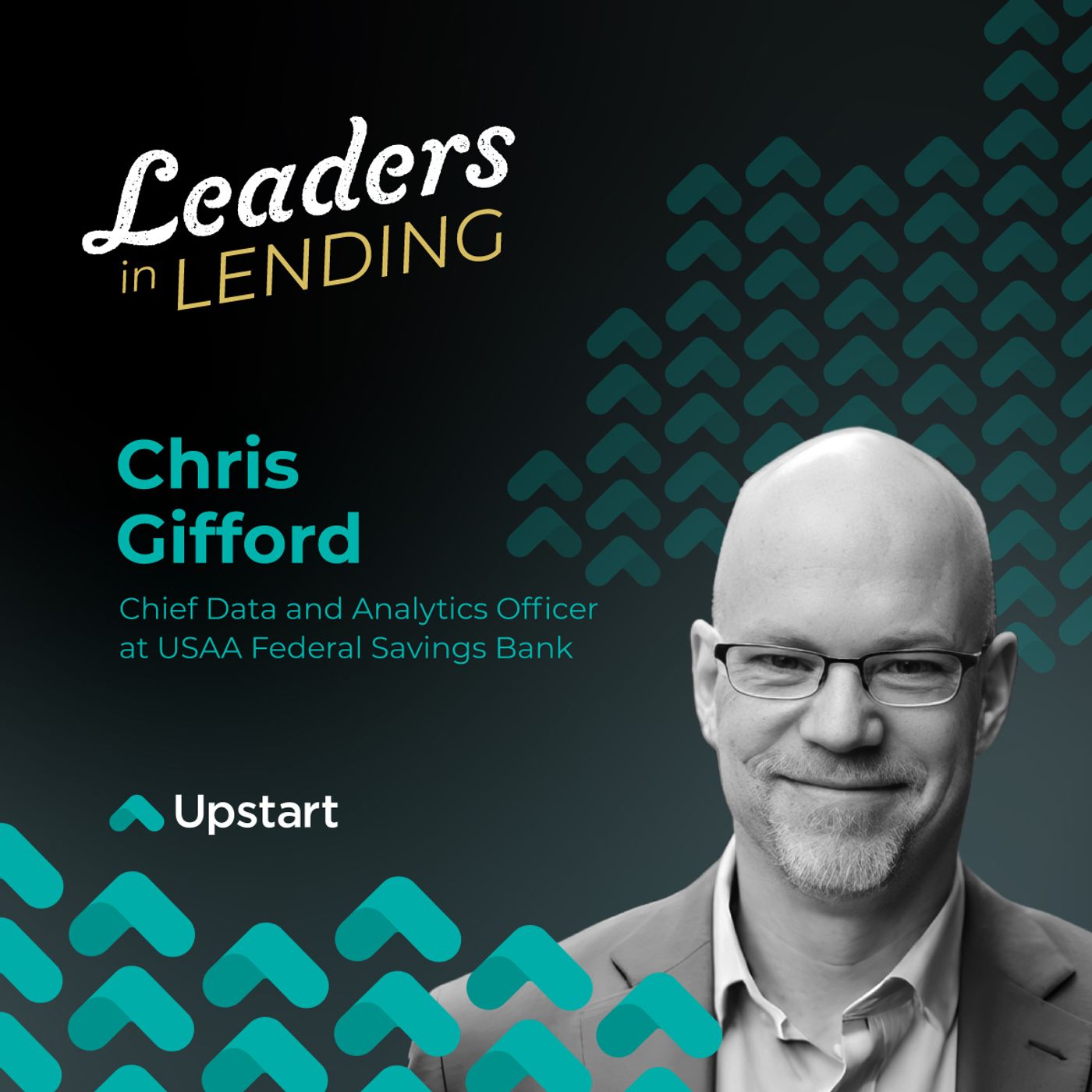
This week, host Matt Snow speaks with Chris Gifford, Chief Data and Analytics Officer at USAA Federal Savings Bank, about the evolution of data analytics within the financial industry—as well as the importance of having a strong data foundation. Chris also shares insights on driving innovation through real-world problem-solving, the democratization of data, and the need to break down data silos for seamless integration.
Join us as we discuss:
- The democratization of deep data analysis and its effects
- What factors organizations should consider when deciding whether to build, buy, or partner for technological solutions
- Using timely data analysis to give personalized advice to members
- Strategies for fostering a culture of innovation within data analytics teams
0:02 You are listening to Leaders in Lending from Upstart, a podcast dedicated to helping consumer lenders grow their programs and improve their product offerings. Each week, here, decision makers in the finance industry offer insights into the future of the lending industry, best practices around digital transformation, and more. Let's get into the show. Welcome to another episode of Leaders in Lending. I'm your host Matt Snow today joined by Chris Gifford, chief Data and Analytics Officer from USAA. Chris, Welcome, Thank you, Matt. Good to see you again. It's been a while. Yeah, good to see you. Always good to catch up. I know, you know, it's been a while since we've worked together, way back in the day. A lot's happened in data and analytics since then, so I'm really glad to be able to have some time to dig into that with you.
0:50 Yeah, I'm back, we're working together, Chase. I don't think our hair was gray, and we might have had more of it. So it's been a while, but always good to check in. And what an exciting and field that we're talking about too, and so much has changed it's hard to even keep up. With It's true and you know, I was doing some research and preparation for our conversation. I wasn't sure i'd find anything. But do you know who and when the first chief data officer could have came about? No, well, you know, unsurprisingly it's in banking, so it was actually Capital One. Catherine clay daw seems to be referenced as the first Cheetah Chief Data Officer back in two thousand and two, so you know around that time we were together.
1:31 Wow, that is interesting. I hadn't I hadn't looked that up, so I knew it's been around relatively short period of time, but very interesting. Cap One makes sense. They do a lot with data over there. Absolutely. Well, maybe we can start with that, maybe give a little bit of an overview of what, you know, the chief data analytics officer role looks like at USA. How did you come to that, and a little bit of your journey. Yeah, so I'll take you back, not all the way to the very beginning. But as I was finishing school and looking for my first job, I took a job at Gie Capital answering the phones. You know, I think you for calling Monogram Bank USA. This is Chris Gifford and so it's been a journey since then, but that was my very first job out of college. And while I was sitting there, I noticed that this terminal that was on the desk in front of me seemed to have capabilities. So I asked for the manual to it and started writing macros to do my job because I was lazy, but had the ability to try to figure out how to make the machine do it for me, and kind of launched into this journey of what we would today call robotic process automation. And I wrote a significant string of macros that did a bunch of my job, and my boss kind of tapped me on the shoulder and said, hey, why are your stats thirty five percent better than everyone else on the floor and you have like zero errors? And so I showed them what I was doing and they said, okay, fantastic, you do that.
2:52 Now you're off the phones. And that was kind of the first launch into data and analytics, computers, computer aid or assisted even digital processing, robotic process automation, and just automation in general. So that started Capital. They have a great program that they identify people with you know, skills or the desire they will train them and so They put me through a lot of training, and I went from there into adaptive control systems, building models back on the mainframe. I didn't use punch cards. I'm not that old, but I know a lot of people that did. But no, we were writing code on the mainframe and a lot in SaaS, but building algorithms and using those in our adaptive control system strategies to drive you know, credit card line management, originations, authorizations, reissue, those sorts of things. From there, I went to Nation's Bank down in Charlotte, North Carolina, Carolina for a bit. This was prior to the b of a merger, doing more of the same but a bigger portfolio, and then moved to Bank one in Columbus, Ohio, and survived all of those mergers up through and included Chase at the end of it. I spent eighteen years at Chase doing more of the same. As I was leaving Chase, I was head of customer Data and Analytics and really building out that full customer three sixty bringing online data products for consumption in various use cases, and really trying to advance the use of modeling into all the decisions and optimization engines. So from a career standpoint.
4:23 That's right at the last minute before I made the jump over to USAA. Gotcha, And so what are some of your top priorities at USAA, Like, what are the challenges there that you guys are trying to solve with data and analytics? Yeah? Sure, So when I joined USAA, they weren't as far along, I guess in their data journey as what Chase was. As you could imagine Chase being a very, very large financial institution. So step one really was build a foundation of data, and it is get all of the data, get it cleaned, hygiened available. We kind of skipped through some of the old are evolutions of data and data warehousing. We didn't go to kind of the big industry third normal form warehouses, went more to a modern lakehouse architecture, and here most recently rehosted the entire analytics environment up on the cloud, which where we can use entire lines of code to expand the universe, increase compute nodes, bring in other data sources. We're now working on implementing cloud native tools so we can do jobs end to end and stay in the cloud the entire time.
5:32 Really trying to press for speed and ease in the use. I think the other part that we've been working on is managing risk. Right, with a lot of data comes a lot of risk, so you have to protect it. There is sensitive data p I I, pc I data and lots of evolving laws, rules and rights around how you manage it and protected data for your we call the members, but for your customers. I think the other thing is you need folks on your team that have the ability to understand how does the business work, how does the business make money, how does a bank make money? So it would be nice, you know, some days I wish I was just still sitting down in the basement of a bank somewhere in a corner, writing code and not talking to anyone. But really, for us to find the value in data, we have to understand the business, build those business relationships with our product owners, our process owners, our channel owners, and figure out if we bring data to the problems that they're experiencing, what kind of value and opportunities exist there. And so I think it's that piece.
6:39 Building those bridges and being able to talk the language of business, educating your business partners on data in its value and how can you use it? Is kind of a key part of the chief data and analytics officers, probably not as well talked about as you know, the modeling and how many petabytes of data do you have and what platform are you on and what tools do you use, but building those just foundational relationships with the business to understand what their main problems are is really critical. One last piece kind of the secret sauce maybe to all of this is you have to constantly drive innovation this area, just like we talked about earlier, this area of data and algorithms and data science and even generative AI.
7:20 I can't go through a podcast without saying generative AI, right, But even these areas that are evolving so fast, you have to constantly be pushing the envelope on innovation. And so some of the things that we drive here your standard hackathons. We've done hackathons what we call it like speed dating. We bring a business people in, we set them at a table, and we send a group of data scientists at them, and they've got two minutes to describe their business problem. And then the data scientists team go table to table to all the business people and they choose, Okay, which problem do I want to try to solve over the next two days, and we invest a lot into these. The teams absolutely love them, and I don't think we've had one yet where we didn't at least get multiple patents and you know, multiple millions of dollars of business value. So it just continues to press uh, press us forward to keep trying to stay on the cutting edge and UH and use all these tools and all this data for for real business value.
8:18 Yeah, awesome. I love a lot in there. And you did beat me to the AI Bingo card first, So maybe we can come back. To innovation as a topic. But you know, you hit on something. I want to get more of your perspective on the idea of getting value out of the data or aligning back to the business, because I think we are in a bit of a maybe a swing of the pendulum here where the focus is less on explainability or understanding how some of these technology work, like ll M or some of the generative AI. Like it just works and it's cool and it's fun right now, but do you see like different use cases where things should be a lot more rigorous around the explanation and like the tie to value from data to the analytics the insight back to the business, or is there is there a use in a world where it's like, hey, it just works, so let's roll with it and onto the next thing, like how do you think about.
9:09 Yeah, there's there's definitely both an evolution and two categories of kinds of models and problems that you kind of solve. So so the start with the evolution of it. I can remember within my career having a I won't say which company, even though I've already named the wall, but somewhere back along that line, I had a boss that said, I don't believe in models. I think, you know, we should underwrite loans by looking at their income and having a person judgmentally decide this or that. And so that that was again not that that's within my career event horizon, right, so we're not that far removed from it, but we have come a long way now into saying no, we can use models to help us make better decisions, even help us avoid some of the maybe subconscious biases that we as humans have when we look at data or make decisions like that. And I think that's where you have to pair it up with the laws, rules and REGs in this space, which really are put in place to help us not put in or allow those biases, or you know, have people being impacted disparately across these different decision areas. So to kind of put a finer point on that, like a credit risk decision, should I extend credit to someone? Yes or no? Is one where yes, there are opportunities for models, but it's probably not going to be a oh it's a black box. The algorithms always right, just trust it, right, We have to be able to show what's going on inside of the model.
10:37 Once you get beyond you know, two or three way interactions of data variables, the brain starts going like WHOA, I don't understand this anymore. And some of these algorithms can have sixteen, eighteen twenty way interactions of variables where we have no Our brain has no ability to comprehend how is it getting to its answer? But yet we can show through additional add on analysis, are is it doing the right thing? Is it making the right decisions? Are there disparate impacts or their unintended consequences of the model, and those things need to be layered on and so again, the credit risk decision is a key one Obviously, fair Credit Reporting Act and available availability of credit to all are key reasons why and necessary so that we have a good, solid and fair financial services industry. Some of the other areas, though, like who should we send a marketing mailer to? Actually, you and I used to do mailers back in the day, right, I don't even think they send out mail anymore. But maybe it's emails, right, or alerts or those kinds of things. So if you send an alert, it's like, hey, are you interested in applying for a whatever? Or Hey, we've got a partnership with this other company, would you like to see some of their things? Certainly it can be annoying to a member, but it doesn't really put them at risk. It doesn't put the company at risk. So there are some more innocuous of things that we've can be doing with with the models and the AI to target and optimize in
12:08 ways that we can't really see or understand. Maybe another one would be trying to figure out why is this customer calling and automatically wrap them to a customer service rep that is best suited to handle that kind of a problem, so again not really harming the customer, trying to drive efficiency some of just those back office operational you know fish where the fish are kinds of things are certainly there. And then when you start thinking about like the cool new kinds of generative AI solutions, man, I get excited. I want to be able to ask my supercharged digital assistance, like hey, go get me new homeowners insurance. And I wanted to like to be able to go do that, right, And so you start getting into could could I could we as a bank? Could we as a country? Could the government allow us to get to a point where we have digital assistance like that that have the free reign to go out and solve these kinds of problems for us? Certainly it's easy.
13:05 Now It's like, hey, here's the entire year end financial report for whatever company. Can you distill this down to the key points and compare to you know, their competitors. That kind of stuff is available, these ministryvia kinds of things I want to be handled by AI and m L And so I think in our personal lives and areas outside heavily regulated businesses, there's probably more opportunities for it to serve us and create experiences that are very cool. Within financial services obviously, and necessarily a highly regulated, regulated business. There there's a lot more concern and caution and controls we need to rep around it. Sorry, that was a long answer, did I did? I covered a lot.
13:48 No, I like it. I think, you know, one of the other things that there's again lots of like similarities and being aware of the history of like you know, even with the more complicated models, maybe it's even more true like the garbage and guard the job right, So you talked about generative AI and some of those, like you know, understanding the data that these algorithms and machines are using to base their recommendations or insights on is important. Even some of the changes in innovation, I'm seeing more of being able to provide references or links like here's why I'm giving you this answer, here's you know, maybe a study I've seen or other sites. So I do, like, like you said, really excited about the space and the rate of change and the ability to add you know, more insight and speed to I think call back to what you were saying, like you know, the the usefulness of these technologies really comes back to how individuals or members are going to get value out of them that we provide. So in terms of other innovations, the hack of phone, I wanted to come back to that because I really like the idea of combining the.
14:55 Business in that. You know, a lot of the hackathons I see kind of come more ground up, you know, engineers or programmers thinking about ways to make maybe their lives easier, or some consumer focus, but usually generated from within those units. Was that something that was always a part of your guys program to include the business or I like that combination? Yeah, and it's something that's strilled into me. I had a really, really good manager at Chase, and again I won't name names because I've had a lot of good managers through the years, but I can still hear his voice saying, solve business problems, right. That's That's what the data analytics team was there to do. It wasn't to advance, you know, the capabilities of science. We weren't doing science fare projects. We were there to solve real business problems.
15:38 And that's something I've carried forward in my career and I've really kind of preached that into my teams, Like I will do hackathons I'm doing monthly, I'll do them quarterly. I'll give out large prizes if you win them, but we're going to work on solving business problems if we're going to take them on. Not to say that there aren't opportunities in those back office roles in the data engineering, especially with some of the generative AI auto code kinds of things like you can think about in Get Up or you know, I've watched some of my team go from you know, writing code long hand, all of a sudden it's just like they're just hitting their hitting tap right, and it's just it's like writing a line of code at a time and they're just kind of overseeing it to make sure it all works. So certainly there are a large number of opportunities in the back office spaces for these kinds of things to have value. But you know, again, at the end of the day, I think it is at USAA and kind of our focus on our mission and our in serving our members, it's really about what's one more thing that we can do to take problems off of our members plate and help them, you know, achieve financial stability in their lives.
16:47 Yeah, totally agree. I like that approach. Hey, there, former host Jeff calviner here to let you know about an exciting opportunity to strengthen your understanding of artificial intelligence and financial services. If you want to better understand the fundamentals of how AI models work and how they will impact the financial services industry, your luck. Upstart is launched an online course and certification designed to do just that. This course will give you the knowledge you need to leave the conversation about how your organization can best leverage and manage this revolutionary technology. If that sounds interesting, check out the course as it's currently free for a limited time. You can learn more at upstart dot com slash AI Certification. Again, that's upstart dot Com slash AI Certification.
17:31 Thanks, and now back to the show. What other innovations have you seen in the past, you know, a couple of decades in terms of analytics, data insights, just that whole evolution within in that space. Yeah, the I can remember kind of in my career. Again I won't say where, but one day we first built the data warehouse, right and before that, I think everybody in the world was using what different names across different companies. But it's like some kind of a marketing extract file em for you know, So the hey, we pulled a file and you guys can start using it. And we were doing analysis and we were creating marketing files and those kinds of things, and then we started loading those into a warehouse. And I can remember we loaded the very first month of data into the warehouse and was like, all right, fantastic. It took four months to get the second month of data into the warehouse.
18:27 But all of a sudden, we had like time series data, and there's a whole new era of analyses that we could start doing. And when you start loading you know, those and constantly well defined structured data with quality, start putting that time series together, all of a sudden, you can just bring data to problems like here's how many widgets you do per time period, and how many have errors, and just this entire amount of analysis that starts just bringing insights into problems. From there you go onto building models and optimizing and then auto optimizing these different things. And so that evolution has been very interesting to watch.
19:07 I think in the modeling space, you know, started out just with straightforward old linear regression, went to logistic regression, and then kind of at a point in time, it just seemed like this entire world of models and algorithms exploded on what was available to us. And next thing you know, we've got random forest and genetic models and just all kinds of things that increased the predictive power in these spaces. Now again that's where we started getting into But can you explain it? She had to be careful which algorithm you used, But certainly you know, over the last man twenty five thirty years, we've seen an explosion of those kinds of models and algorithms available to us.
19:49 The other thing I would say, I'm not a statistician. I don't have a degree in applied math and stats. But what I did was I learned that the tools that these algorithms come in make it easy for a person even like myself, to be able to build models and deploy them and add value into the business. So the enablement of tools and just a significant increase of data, data storage, and compute horsepower has made modeling accessible to a much broader group of people. Certainly, I have tremendous respect and for true applied math, stats PhDs and majors, and I hire a ton of them. But I'm just saying there more and more people can play in the space.
20:34 Given the advent of those tools as well. Yeah, I couldn't agree more. And I haven't gotten to the point where like I'm just tabbing through code yet, but I have found like some of these things do help. You know, there's like an AI assistant debugging my code too. I can remember again like getting started in the mainframe days, like you know, you had the manual, you had your best attempt, and you had to debug it yourself. There was no like going out in Google or looking on for RUMs. And now to today where if I've got something formatted weird or written slightly and correctly, you know, I can get help really on demand if it doesn't run and get that. So it has really democratized, really the ability for folks without that deep training to maybe do more deep analysis or interesting things that previously unable to. Are you seeing because of that our data is data becoming more consolidated or are there still silos that exist between you know, like credit and marketing and like the use case kind of dictates granularity and the types of data or you know, how do you see those things?
21:41 Kind of? So, yes, there are still definitely silos of data that exist, and so even within a company like a bank. There's historically been silos right across the different subject areas, and the advent of the warehouse or even a cloud based architecture is allowing us to break down those barriers and build out environments where it's less out, you know, looking for data in the stata availability instantaneously. I think the other thing is this is again a little bit of an older buzzword, but that API architecture right, so everything should be published and available via API. I think the biggest bridge, or the biggest silo historically that is starting to get broken down is we take all those files as marketing analytics files we talked about are different feeds from different systems of record, and we build out this awesome analytical environment and we you know, we put tools on it, and we have time series and we can analyze, analyze, analyze.
22:38 But the rubber hits the road when what you find in your analytics data you can pump over into your operational space and actually impact what your member or your customer is experiencing. And that bridge analytical to operational to me is the biggest silo of all and one that we all need to keep thinking about. How can we build bridges analytical to operational to make new data widgets, algorithms, alerts, et cetera rapidly available. You know, you can just publish it via API to be consumed into the operational optimization engines, next best engines, those sorts of things. And so, yes, silos definitely do still exist, and we are silo busters right and in that data analytics space and data scientists space and need to continue to do so. I think when you start looking across industry there are opportunities there as well, because there are very very large silos across industries that probably need to be attacked or at least rationalized at some point in the future to think about what kind of experiences and value can we bring to consumer.
23:47 Yeah, that's good. I never thought of analytics, you know, being a silo buster type of a job. I'm sure there's someone out on LinkedIn with. That in their headline right now. Maybe we had that let's get a patent on that real quick, exactly. But you know you've mentioned a cloud too. I'm assuming it's not your own cloud that USA develops. So it makes me think and this has come up with some other guests as well, like the idea of bill buy or partner like as a as you're in this space and it's constantly changing and growing, Like, how do you think about this is a core competency USAA should own. We got to develop this in house versus uh, you know there are people out there that just do it better cheaper than us, and and let's leverage their their technology. Is there like a guiding principle you use or how do you evaluate those situations?
24:37 Yeah, I think you have to be open to kind of all of the above, right, And I think it also goes by you know, the amount of maybe revenue your company has with the economies of scale you've achieved, do you have enough dollars to invest into yourself finding these new technologies or do you need help? And so we think of it here as at least kind My strategy has always been for the knowledge workers, the people that really understand the data and the algorithms and how to draw value from our particular population. People that really want to draw value from our particular membership, those related to the military or their families. I want to keep that knowledge on site. I want to have them be employees.
25:24 Now if we're talking though, architecture or platform or warehouse environment. I find that that can be a little bit more outsourced, right, And so that's where we have been able to leverage, to your point, off prem public cloud and we have built pipes, large pipes. We've enhanced those pipes with AI and mL to test data that's going through those pipes out to the cloud, tested for sensitive data or for drift, or for anomalies, if values of different metrics or things are migrating beyond and acceptable range. But yeah, it really is that opportunity that the people that have built the clouds and built the tools to get the data to the clouds are way better at it than we are.
26:11 That's kind of their single focus. They optimize everything. And so taking advantage of that was a pretty easy, easy decision, I believe for USAA. And then as far as like tools and solutions, I think that kind of goes back to the if you're big enough to generate and can afford hundreds of millions of dollars of investment into you know, building out your own solution. You know, there are a few banks that can do that. There's a few financial services companies that can do that. For the next tier it probably is one of those consortiums or finding a company that does it and buying them or using their products. But if you think about some of those problems that it would make sense for a consortium to tackle, like AML or fraud detection where we're all fighting a common enemy, those kinds of things make a lot of sense. You know, how to target matt for our product versus someone else's.
27:03 We're not going to probably share notes on that or collaborate, but some of the problems I think do make sense for the consortium approach to get after advancing your capabilities using these solutions. Yeah, I think those are great examples, Chris, And it's been fun, like maybe thinking backwards a little bit to the things that have changed, but as you're looking to the future, like what are the things you've got your eye on for, you know, potential innovation that's continuing to happen, things that maybe aren't quite at a commercial scale yet, but you know you could see the potential like what's what's the future of data analytics? Got you're excited? Yeah, thanks. So there's a couple of things that we've been playing around with again in the ai mL space.
27:45 Think about edge computing, So how do we put algorithms and identification and predictive capabilities out onto the edges of this wide network, whether that be on you know, your laptop, your iPad, your iPhone, or yourself phone of any manufacturer operating system. But you know, how do we put things there to observe and help our members, you know, figure out how to navigate our website or how to navigate our app So there's some some ideas and opportunities we think we have to play in that space and then connect that back into our systems and applications as the member is navigating through our processes. I think, like, if you think about what gets me most excited, especially working for USAA and for our membership, think about a scenario we're let's say we're we have all the data from Matt and his entire all of his transactions and all of his accounts, and all of a sudden, we see a sixty thousand dollars remote deposit capture from his cell phone of a check and then we have probably I don't know on average, four seconds before Matt logs off, and we miss the op opportunity to say something to Matt about that check so what is that check? Is it normal for Matt to deposit sixty thousand dollars or is it an anomaly outlier? Does it happen quarterly, annually, it's never happened before. All of those answers to this
29:18 questions would help us give Matt advice on what he could do with that money, right, and we think that advice is one of our best products, and we want it to be one of our best products given the military that we serve. And so if you think about the data needed, So what I just described was transaction time series data that's been analyzed and categorized and bucketed into chunks where we can say is this an anomaly or not. But then also it's like, well it's quarterly. Maybe it's an investment or dividends from you know, coming from stocks, it's a one time thing. Maybe he just got a settlement for a lawsuit. Or maybe it is severance package. Sorry, maybe it's a severance, right, and there's a large and so there's a job change coming. Maybe this is an inheritance, and so there's again a lot of different things. Every one of those things I've described would require a very different response in those four seconds to talk to Matt about what he could do about it.
30:19 Some of the options like does he have a cardlan that he could pay off? Does he have an investment property, does he have an investment portfolio that he's saving for in the future. So, again, all of those data elements coming together bring you more opportunity to say the right thing in those four seconds, the most meaningful thing to Matt giving him the very best advice I think of, especially again serving the military. If we've got say a Navy nuke, so someone that is in the Navy, they are becoming a nuclear specialist and they re enlist. The reenlistment bonus is quite sizable, and it's a very very important role. And so if let's say Matt was Hey, I just re enlisted. This was my reenlistment bonus, that next conversation should be, Hey, Matt, we know you're probably gonna go out and you buy a new Forward Lightning or some big, you know, expensive car. But what if you bought a normal car and put half of that into retirement right now at your age, that is going to set you up down the road. So imagine being able to have that kind of impact on a young service member's life because all the data was in the right place at the right time, the algorithms recognized it and put forth the best advice that they could in those four seconds. Right. So to me, that is the ultimate use case of are we doing this right yet?
31:49 And do we have all of the data coming together in a way where we can even have a chance at putting the best advice out to one of our members within that very short window of time that we have. Yeah, that's really impactful, and I think you're right, Especially with a business and a membership like USAA, that advice or that part of the relationship that you play so critical and maybe brings it back to some of the foundations of banking and financial services, where you know, every transaction did involve a human right there. There was always someone involved. Usually someone you knew who had that personal connection and a different form of database so I just through interactions with the person and knowing their situation. So how do you take the transactional data and make that personal again?
32:32 I think is really could be powerful. Cool. Well, Chris has been great catching up. I think we've covered a lot today. Is there anything maybe we missed that you want to cover before we wrap. No, it's great. I get excited getting together with the other people in the industry that have thought about these kinds of things. I get excited about what the future can be. I wonder how much of this can come to fruition within our career lifetimes, or how much are we going to have to hand off to our kids to you know, finish this work. I keep telling my kids, man, data and analytics is still the opportunity of this generation, and they do not listen. But I hope maybe yours will, or are other people that are listening to this podcast will have more success than I have had convincing people that this is still an exciting, highly evolving, highly impactful field that is going to continue to grow and move forward. Yeah.
33:29 I don't know, Chris, I'm over three. I've got one who wants to be a lawyer, wan who wants to be an actress, and one who wants to. Be a YouTube star. So not really sorry following and dad's footsteps there, But yeah, a lot to be excited about. And thanks again, Chris, hope to catch your chick again soon. Yeah, of course, great man. Thanks. I'll start partners with banks and credit unions to grow households and expand consumer lending. Through its leading AI lending platform, up Start powered banks and credit unions leverage AI to offer higher approval rates and experience lower loss rates while simultaneously delivering the exceptional digital first lending experience that consumers demand. Whether you're looking to grow and enhance your existing personal and auto lending programs or you're just getting started, Upstart can help. Upstart offers an end to end solution that can help you find more credit worthy borrowers within your risk profile. With all digital underwriting, verification, loan closing, and servicing.
34:27 It's all possible with Upstart in your corner. Learn more about finding new borrowers, enhancing your credit decisioning process, and growing your business by visiting upstart dot com slash lenders. That's upstart dot com slash lenders

