Going Fee-Free: Reimagining Member Satisfaction

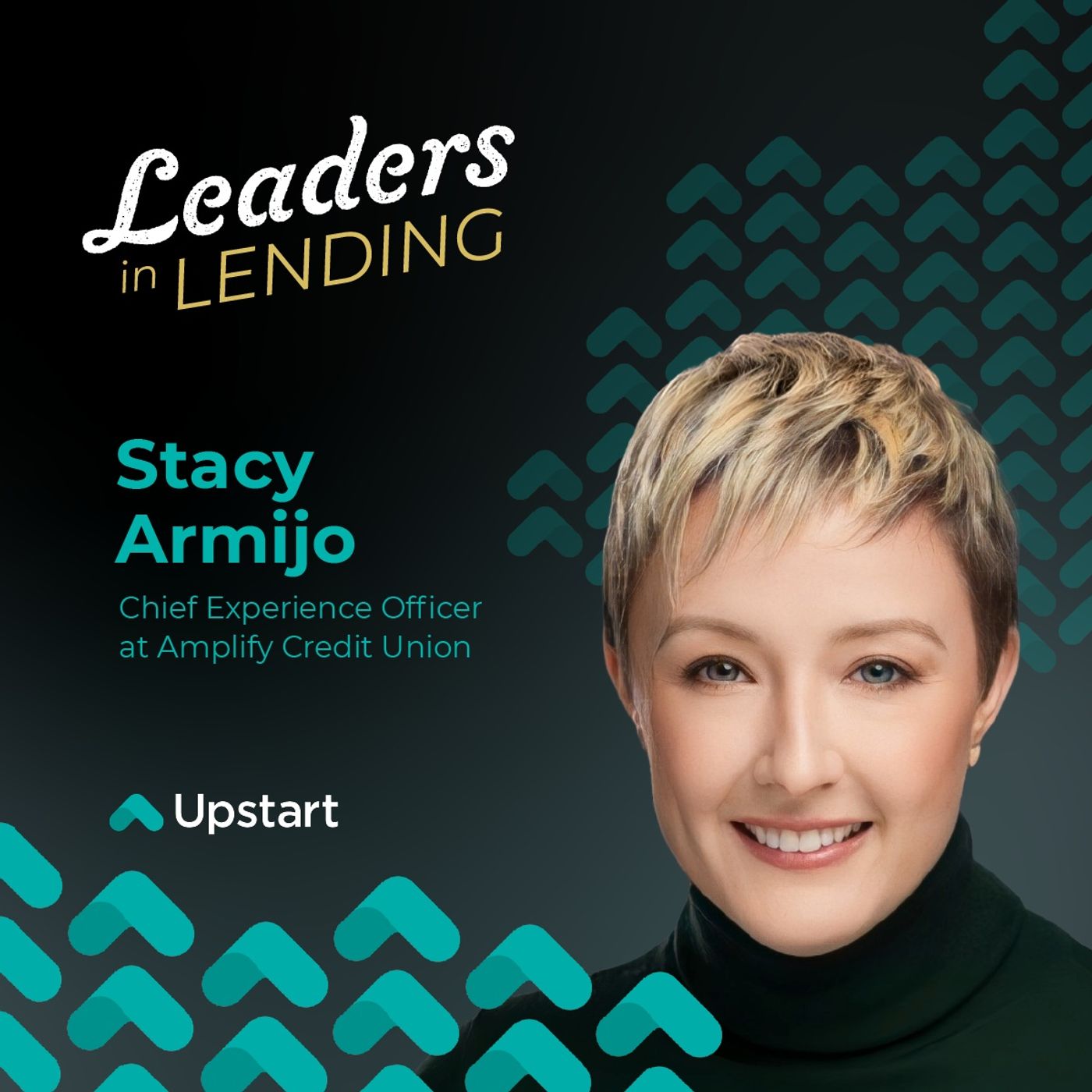


Stacy Armijo, the Chief Experience Officer at Amplify Credit Union, joins our host Drew Megrey to share her path to credit union leadership and discusses how Amplify has made strides to prioritize their member experience, including going fee-free on checking and savings accounts.
Discussed in this episode:
- Diversity in product development and the importance of aligning products with the needs of diverse customer demographics.
- The strategic move towards fee-free banking, including the elimination of overdraft fees, prioritizing fairness, equity, and customer satisfaction.
- Technological evolution and its impact on industry adaptation, from open banking trends to the integration of virtual reality in financial experiences.
0:02 You're listening to Leaders in Lending from Upstart, a podcast dedicated to helping consumer lenders grow their programs and improve their product offerings. Each week, here, decision makers in the finance industry offer insights into the future of the lending industry, best practices around digital transformation, and more. Let's get into the show. Hello, and welcome to Leaders in Lending. For those of you who don't already know, Jeff Kelner has passed the reigns of his podcast Microphone, and I'm honored to step into his shoes as the inaugural host in twenty twenty four. With that said, I'm your host Drew Megory and this week's episode features my conversation with Stacy Armiho, one of the winners of the American Bankers Most Powerful Women in Credit Unions as well as the Chief Experience Officer at Amplify Credit Union based in Austin, Texas. In this episode, Stacey and I talked through her philosophy of having a younger, more diverse demographic within leadership teams, as well as talking a bit about why she thinks PFI or primary financial institution, is a thing of the past and how organizations need to pivot their mindset around PFI. And lastly, we really dive into the thought of going fee free on all deposit products and how that translates to the balance sheet and income. I hope you enjoy our conversation as much as I did. And without further ado, here's my conversation with Stacy. Hi, Stacey, welcome to the podcast and thank you for making the time to join me today.
1:26 Really appreciate it. Happy to be here. Awesome. So I think I'm going to follow suit in opening our conversation today as it's been done in prior podcast. So as a starting play, Stacey, I don't think many of us dreamt of being in the financial service industry when we were little kids. So can you give the listeners a little bit about your journey to becoming the chief experience officer at Amplify Credit Union. Absolutely, it is a non linear journey, like so many of the journeys of others. My background is actually in public relations and marketing, so I spent my entire career before I joined at a regional public relations and marketing agency in Texas, and so I had the chance to learn a lot of different industries. So we worked across a wide variety of types of companies, and I had a wide variety of roles, but mostly it was in areas like marketing and public relations and communications things along those lines. It also though, entailed things like strategic plan facilitation and interactions with executive teams, things along those lines. And it's interesting because I would never have guessed that could have qualified me to work inside a financial institution.
2:34 But our CEO, in particular, has a really different mindset about One of his taglines is we're going to fix what's wrong with banking or we're going to die triin. That is sort of his overall outlook. The irony being he has been in banking as long as I've been alive. So we tell this joke during new employee orientation because it's actually true. He started in banking the year I was born, and so we have sort of a different perspective on that. But despite a very long tenure in one industry, he's sort of an innovator as he thinks about banking. And that's just there's so many things that we take for granted in this industry as truisms that really aren't especially in today's day and age and so he has a different perspective as he assembles the executive team about what areas do we need deep industry expertise, because of course you need some of that in some ways, and then what areas do we need brand new thinking? And so my role became one that was an amalgam of what was previously the Chief Operating Officer and the Senior vice president of Digital Transformation. Those two roles are now roughly what we consider to be the Chief Experience Officer, and so my responsibilities are fourfold. So one is marketing, communications and social impact, and that's see the world I came from.
3:51 The second is retail, so in our environment that's our branches, contact center, and wealth management. The thirdest payments, so all the money movement and a none of the credit union. And then the worth is HR in training. So what we call talent theory there is to put the teams together that make the promise to the customer, the employee in the community with the people who keep those promises. So I spend most of my day sort of going across those and it's been going on six years now, it'll be six years this summer, and I actually officially consider myself a banker today, which is something I never thought I could say. Well, there you go. I know in many conversations that I have with people that are in the industry, the path to get to where we are at. Of course, you never think that you alluded to that. There's no way that I would have ever been able to get where I'm at with what I was doing in my previous life. So thank you for that. That's quite the laundry list of things that are on your to do list on a day over day basis as well.
4:42 So one thing I wanted to cover is when we talked in the past, is one thing I found very very intriguing is you know, your philosophy on a younger, a more diverse demographic, and how an institution, and I think you called it should represent the audience in which you aim to serve. You we talk a little bit about your thoughts and your approach to that philosophy. So I am a believer that teams should never create something for someone without someone. So in I think organizations generally have a bad habit of this, but I think in particular in banking, we have a bad habit of this, where if you look at who is doing the creating. The people doing the creating are one the executive teams of any of the financial institutions.
5:26 And then more deeply, you know, it's the product teams, it's the digital teams, it's the retail teams, it's the people on the ground who are coming up with the products. If we look at the demographics of each of those audiences and we compare that to the demographics of the customers they say they want to serve, there's a huge mismatch between those, and not just in age. Right, of course, we're not We can be designing for gen Z and decide we maybe need a little more experience that gen Z would possibly have in order to do that. That doesn't mean you have to have a one for one, but you can't have a team that is mostly homogenous in age, geography, gender, ethnicity, education status, background, financial status, all those things. The way we think about how our audience consumes and interprets information is not just so simple as a couple of demographic data points.
6:15 And then we've got teams who are all in one geography, mostly they come from one educational background. Their lived experience, in a variety of ways, looks mostly the same and we believe they're going to create a product effectively for somebody that doesn't match any of those things. And it's interesting to me because as customers, think about ourselves as customers, and someone who doesn't relate to us in any kind of way says, here's what you need. How do we feel about that? As customers usually really not good. We usually feel very not good about that. But as institutions, we somehow believe we're exempt from that. So if we want to, like our industry says, we want to appeal to younger consumers. We want to appeal to underserved communities, we want to appeal to new demographics, we want to appeal to people that have different technology habits. We say all of those things, but our teams still look the same as they did when we were mostly doing business out of a brick and mortar situation and in a limited array of lending products or deposit products. And I think if we're willing to think a little differently and pull people in our organization in different ways, what we come up with is significantly different and a lot more likely to connect to our consumer No. I find that very fascinating. That type of approach is one I'm sure many many would disagree with. However, I agree with that, and I think something to expand off of that is in regards to the product stuff and let's talk PFI or primary financial institution. We both know that the conversion of PFI is
7:46 something that is very very low in our industry right, something of the past, but that discussion, of course is still top of mind with leadership teams within the boardroom. But with the different generations, and you alliterated a few of them, so you have you know, Boom, gen X, gen Z millennials and gen Z of course now being that like new wave of how banking is done or how banking is going to be in the future. But with you think about the thought of the evolution of technology, what do you think that the consumer now thinks about how they are going to manage their money and their banking relationships. In correlation to PFI conversion, I think we have to consider who PFI serves. So of course banks want you to have a preferred financial institution, and of course they want to be the preferred financial institution.
8:35 The reason banks want that is because usually banks are really good at one, maybe two things, and then the rest they're kind of just okay at And so they'd really like to believe as a consumer, you're going to get really excited about something and that's the reason you're going to choose. Then that's the thing they're really good at. That is the market they can win. And then they're going to hope you're just kind of lazy and if I just put this next to it, you're going to say, oh, okay, I'll take that too. Oh okay, I'll take that too. And those are the products that aren't really as good as all of the other alternatives out there, or maybe they're not as affordable, whatever the case might be. And we're hoping that that proximity is what gets you into that product. That whole philosophy serves the institution, not the customer. And any time that you orient yourselves around a strategy that pits your customer's interests against your institution's interest your customer is going to win, especially in today's tech enabled environment. So let's turn the clock back a little bit. Preferred financial institution used to have a customer value. It had a customer value when working across different financial institutions was so challenging, right, and so there was a true level of convenience to having all of your financial products in one home because that actually was beneficial to you. That is not true today, and that's definitely not going to be true in a world of open banking. So anybody who is not following what the CFPB is doing and isn't recognizing that, just the same cell phone companies used to rest on their laurels because it was just so darn hard to move your service and you had to give up your phone number, and that's really
10:05 what people wanted was to keep their phone number. The minute you could keep your phone number and change providers, the world changed. We in banking better be ready for that because that is coming. And really, who wants to make money that way? We believe it matters how you make money, and do you really want to make money hoping your customer is too lazy to go find something that is better for them. I think we can be better than that. As institutions, we should hold ourselves to a higher standard and we can be better than that. So what does that mean? Though? That means we have to realign our revenue strategies, so we cannot rely on some sort of passive level of let's say, non interest income that comes from this ancillary product. That is part of our strategy to become PFI if we believe as Amplified does. Every product must live and die on its own merits.
10:54 And that was a relatively controversial point of view when we started talking about it four or five years ago. I can't remember exactly how long. And so every product has to live and die on its own. That means if a customer interacts with us around that product and it's not the best product for them, and it's not compelling to our customer, then we shouldn't be in that business. No, that's not something that we should do. That means, as credit unions in particular, we have to be willing to stop doing trying to be all things to all people. I do think credit unions are getting a little better at this, But as an industry, we have a bad habit of trying to spread the peanut butter so thin. And we need to work across all these different areas and have all these products, and the odds that you have the resources to really win across all those products is next to mil and so get brave, narrow your product list to the things that you can do really well and then create partnerships like have the willingness to say, you know what, we actually really aren't good at student loans, but I can tell you who is, and let me make a referral for you.
11:54 That is how you serve your customer by actually putting their best interests at heart, and not just in the nice, cheery way that we all put in marketing materials, but in the way that I can say from a revenue point of view, here's how I'm going to win by putting my customer's interest first. So if your institution is still trying to plan around and count on PFI, that is yesterday's conversation. That battle has been lost. That is irrelevant to today's customer. Rethink your strategy and do something new. No, I agree, the thing of the past where Grandpa opened bank account at amplify his children's than their children, that is a thing of the past to your exact point of everybody has everything at their fingertips and they're not going to follow suit just because mom, dad, so on and so forth did throughout their banking life. So I want to expand a little bit more on that of one thing that you talked about is making money. Like everybody within financial institutions, of course likes to make money, and of course additional products do bring growth and subsequently added income. Right, but everyone knows another component to income on the balance sheet is fee generation, and a lot of institutions generate fee income from product growth. However, your organization has decided to become fee free, do you have any insights on one the thoughts behind that, and then two, what are the benefits that that could bring of not having any fees on any type of your products? So I'm going to have to restrain myself because i could talk about this for hours. So the first thing I would say is where this idea came from. It actually came from some original customer research
13:26 we did back in twenty eighteen. The question we asked was what makes a compelling checking in savings account because it counts at accounts an account. And it's interesting because we started asking this question before the liquidity crisis, and all of a sudden, we all really care about the answer to this question. And what we found was one of our theories was security. How important is security to a consumer around things like cybersecurity and whatnot? Yes, it's important. And two, I assume my bank has it. It is not a reason I'll buy it, is merely a reasonall leave. That was one thing that we found so and we already had strong security. We feel good about that. Numbers two and three that really jumped forward for us were rewards and fees. I mean, this is not surprising, right Am I getting rewards on my account? Or am I paying too many fees? We decided we did not want to play the rewards game. We feel like the rewards game is it is an arms race. In the minute some other institution offers point twenty five more BIPs in rewards than you do, it's no longer a compelling offer.
14:20 And so if what we're trying to do is create a sustainable, affordable level of funding for our lending operations, which is ultimately the endgame, rewards was not the way we felt like we could do it. So we looked at fees and said, okay, well, we already have a fee averse membership. So this was considered One of the weaknesses of our business model was that our members were already naturally relatively averse to fees. And when I say fees, what I'm talking about are any fees on any deposit product, So think monthly service fees, overdraft fees, checking the account fees, wire transfer fees, all the things. So we were going through this and we thought, okay, well avoiding fees, maybe we could promote our lower fees, or we can talk about how we don't have as many of them, et cetera. And our CEO said what if we just got rid of them?
15:03 And we all laughed like that's actually how the meeting went, and we were like, oh, Kendall's having a bad day. But then it was like kind of couldn't get it out of our mind. So then started digging in like, oh, okay, how much revenue is this for us? How much fee income is this really for us? And Doug Doug Doug And fast forward a year and a half and what we figured out was we can give up this fee income. And this is not just so our industry. When we talk about fees, often people believe we're talking about just overdraft fees, and our case, we're talking about all deposit fees on all deposit products of any kype for any balance or any transaction behavior. We turned off ultimately fifty different fees, and in fact, it was actually a little bit hard to do from a technology point of view because all of our systems are designed to maximize fe income, right, because that's what the institution wants. And so we actually had to work with our vendors to sort of reconfigure a few of our systems so that they wouldn't charge our members' fees. And really our trade off here was okay, well, obviously customers don't like fees, right, this is not new information. But can they be compelled enough to an institution that never ever charges them and there's nothing the customer has to do to avoid them. It actually really is free checking, which our industry has talked about forever and we're the only ones I've ever found that have it so. Free checking, and our opinion is a checking account that will never cost you any money no matter what you do with the account. That's a free checking account.
16:30 It's not an account that comes with a thousand asterixes. So that's what led us there, and so it took us a while to figure out how to build that into our strategy. They are two wins we were looking for out of this. One is obviously we wanted more low cost deposits. Right, if you can get more checking accounts, you getting free money that improves your net interest margin. This is whatever institution wants to have happened. Number two, we want value driven income for our organization, so interchange income. For example, if I can get you to open more checking accounts, then I can get you to activate more debit cards, and I can get you to transact on those debit cards. The interchange income I can get from that and what that can offset. So interchange income is value driven income. That is value to a retailer to be able to accept a payment and make money on what they do. As different from a monthly maintenance fee is not a value to a customer. That's a penalty that is not a value. And for us, similarly, the more liquidity we can get, the more loans we can do. Our business model. We have originate cell service model, So that means when the market is working the way the market typically works before the liquidity crunch, let me put that caveat on it. When it's working that way, we actually can originate our entire balance sheet in one year in high quality loans, and we sell the vast majority of those to the secondary market, and we earn servicing income and gain on sale from loan investors.
17:45 That's value driven non interest income. So why not realign our business models toward things where we only make money when our customer makes money. When our customer wins, we win. I know that should not be such a revolutionary idea, but in banking, most of our business models are. We really hope our customer doesn't notice that they've left six million dollars on deposit in that checking account that's making nothing, because that's super valuable to us, and we don't want them to take that money and put it into an instrument where they could actually get decent return on it. So we just hope they don't know lazy money. Right, this is what our industry talks about. Let's build business models that have a little more courage than that. Let's build business models that speak to our customer and what they want to accomplish. It sounds like this type of approach to is the natural way of obtaining this PFI thing that we talked about without exhausting any efforts. We hope, Yes, I'm interested in the approach leading up to this. I know you guys were laughing in the boardroom when your CEO brought it up. Of a lot of institutions, this is part of their budget, right, They have fixed fee income that they see trend over time and can make an assumption going into a new year.
18:56 What was that conversation like eliminating those fees? Where did you think you were going to recoup some of the income that you were generating from that And hasn't been successful post two or so years of you doing so. So a couple of things. One is I would point to the long timeline over which this happened for us. Yeah, so we were discussing the findings of that research at the very end of twenty eighteen, and we proposed this and got approval at the board level in twenty twenty and we didn't go live with it until two two twenty two. So what we call fee free day now is February second of twenty twenty two is when we went live with fee free. So that's a really long time horizon over which to think about this idea process, the implications. We spent almost an entire year figuring out how can we replace this fee income? What are the pieces we actually engage some consultants after we had our business case put together to tell us what's wrong with it, because no one's ever done this before, and we're like, okay, if we're missing something significant here. One thing that we said constantly is this is a one way door. You cannot choose to go fee free and talk about why that is a moral decision as much as it is a financial decision or a product or a marketing decision. You can't do that and then say, oops, this didn't work out the way that we thought from a financial perspective, we're going to come back and start reinstating fees. So we were very deliberate in how we decided to walk through this process. The reason we say it's a moral decision is because one of the things we learned over the course of that long due diligence period is who pays these fees? Spoiler alert, it's
20:33 not the people with money. The people with money in your institution are not paying a dollar for any of these kind of fees. They don't overdraft their accounts. If they do, it gets waived. They maintain balances that avoid any monthly service fee, etc. That is not who's paying fees in your institution. And we in particular, dug into who's paying overdraft fees, and what we learned was roughly eighty five percent or so of our customer base never used overdraft like it just wasn't even thing. Of the remainder the ten percent is something like that used it. I would characterize it as designed. Yeah, so a couple times a year, you know, something happened a couple times a year. It's a convenience whatever. But a tiny portion of our membership, I want to say it was around three percent delivered the vast majority of overdraft income that our institution collected. And when you really dig into it, what you realize is there are people who are using overdraft protection like a line of credit. Like that is essentially how it's being used. And all we would have had to do if we were really curious, we could have just asked our contact center agents. They could have named who our top ten overdraft users were, because these are the people who call every month and ask can I get that fee waived, how can you help me, etc.
21:47 We're a credit union. Our mission is to improve the financial lives of our members and the strength of our communities. That's what we're here to do. I cannot justify that as a strategy and pretend that that's what we're doing as a marketing idea. Right, started from this, how can we make checking in savings more compelling? But if a caame a mission and so after we figured that out, and then we're going through all the diligence, and we said, well, okay, now we've realized this is just kind of wrong to make money this way. So we're going to not anymore, and we need to make sure that we can do that in a financially viable and sustainable way. So what we're not going to do while we shift our business model, we're not going to put the viability of the credit union at risk. Right, We're not going to make some dramatic move and do something significant that puts all the rest of our business in a difficult spot. We had a couple advantages. One is this type of income was only four percent of our total income picture for institutions of our size, more typically it's around twenty five percent. So I mentioned our membership is already kind of feaverse, so this was already a smaller bite of our income budget than it otherwise would have been.
22:47 The offset was those two things improved that interest to margin and interchange income. Between those two things, we projected that we could actually offset the amount of fee income that we would forego. And as it relates to results, the most recent data that I have handy was we did it kind of a full analysis at one year post fee free, and what we figured out was, if our bed is we're going to grow checking in savings accounts faster than we otherwise would have if we hadn't gone fee free, we said, all right, here's how much we normally would have grown checking in savings accounts. Anything above that baseline we're going to attribute to fee free. And where we landed was we grew savings accounts five percent faster and checking accounts eight percent faster than above baseline. Now, granted, let's remember the timing I mentioned.
23:30 We launched this in two two twenty two. Let's look at that liquidity or crunch and what happened to inflation and interest rates over the course of that same timeframe. So it was really hard to isolate exactly kind of what did this change cause versus all those other environmental factors. But even when you strip all of that out, what we said was this is going to be a slow burd not a big bang. And I think that's really what we found it to be. Is it actually takes us a long time for people to understand when we say free we actually mean it, because our industry doesn't really mean free when our industry says free. So we've we've learned it actually takes a couple of exposures to fee free for somebody to go, oh, yeah, I'm interested in that. And our environment has been a success and now it's baked into our overall picture of how we approach things. So this is no more a what are we sacrificing in what are we doing? It is a here's our core products and the income that we can expect and how are we going to maximize that? That is awesome, So kudos to you your team.
24:22 That definitely does fit the mission of the membership of credit unions. I would love to be in the Amplify office on to to each day. I mean, considering that's Groundhog today, you guys have overtaken your fee free day. Is there like a combination of outfits that are worn within the branches to have a little bit of fun? Okay, now there will be because that's a fantastic idea. I'm glad I gave a good idea there, but thank you, Stacey. I think this is a good spot to transition to. As we've done in prior podcasts, I've always closed out the podcast with a list of three different questions. I, however, am going to switch them up a little bit and compare uson and to what Jeff once did is So, since Upstart is technology company, can you talk a little bit about what is the latest and greatest either application or type of technology gadget that you cannot absolutely live without? Okay, I'm actually I'm going to pivot a minute on this, So Okay, My actual technology I cannot live without is my fantastic speaker, because I love music and I believe in maintaining your energy all day long, and so that's my go to on the regular. But the tech gadget that's on my mind, especially even as a banker, is it's actually my son's. So my son is nine, and he has a VR headset, okay, and it is fascinating to watch him play his VR headset.
25:41 And the reason it's fascinating is because he plays these games where you're connected to other users, and our world likes to decry sort of children and technology and AI and as if it is this, Oh my gosh, human beings are becoming increasingly isolated and they'll never gain the social skills. Children will never get the social skills they need if they are using that. And I sat and listened to him play that game this past weekend, and I listened to him negotiate and navigate conflict. I heard him ask for help, I heard him intervene on behalf of others. I certainly heard him having fun. All the things that you would have typically seen on a playground I saw him doing in his VR game and even in a bigger way. And so as I think about, like what's on my mind of sort of latest and greatest technologies, it is where that will become an environment I think, at least similar to the environments that we have when we pick up our phone and that is its own environment in the future, where that's going to become an environment. How are we as institutions prepared to engage. It's probably not the metaverse. Maybe it is, and maybe it's some version of that, but I think there's something more creative and interesting and practical. Yeah, I don't know what that answer is, but that's what that's what's bubbling in my mind. I agree, it is fascinating me too. I also have children, and I'm starting to get to that stage of life work. I feel like pretty tech savvy, but I see going to my younger children of how do I do this?
27:03 How do you work this piece of technology? When I thought I should be the one that's known. So the evolution of that is definitely fascinating. Question number two a little bit of a different direction. If you could switch your job today with anyone for a day, who would it be and why If I could change jobs, I would want to be David Green on NPR. So he's actually not on MPR anymore. He retired during twenty twenty, but he was a reporter on NPR for a really long time, and in particular, he was what I characterize as the main street reporter. So I'd listened to NPR in the mornings while I'm getting ready, and you hear, you know, the news of the day, Here's what's going on from the Fed, Here's what's going on in this community, that community, et cetera. And his stories were always the main street version of that. So if the lead story was something about inflation, you know, inflation is up, he was going to interview the guy who runs the diner and say, tell me about are you seeing these pressures in your business? What's your remain concerned today? And so this idea of taking these macro level concepts but then finding out what's really happening on the ground and is does that match what we're seeing and is that a connection? And I always felt like that would be such a cool job, is to be able to sort of take whatever's going on today and then figuring out the sort of front row seat for the individual person impact and then getting to tell that story. Well, hopefully I can try to make a plug to David Green to listen to this, to get you to be in his shoes for just a day on MPR. I would definitely listen to that. So that's awesome. I'm down. Make it happen all
28:37 right. Last one, which this question will be similar to what we've always done, and I'll end here with it doesn't need to be anything that is consumer lending. It could be anything that you wish. What is one bold prediction for the future. I think my bold prediction for the future, and you know, I don't know if this is bold or obvious. So one of our areas of business is mortgage lending. That's our biggest and most significant area of our business. Anyone who's paying attention knows. The National Association of Realtors was recently decided against as it relates to specifically the commissions that are shared between seller's agents and buyers agents. And so the organized system of real estate as we have known it for centuries, at least a century, is in the process of being reimagined. I can't claim what the implications of that particular decision or the follow on lawsuits which everyone has predicted and they're starting to come out, will mean. What I do know is businesses that are rooted in a thirty year mortgage and the century long method of organized real estate better be paying attention because I feel like this is not going to be evolutionary change.
29:45 This is going to be revolutionary change. And so if you're in the mortgage lending business and you're not thinking about what are the other products that I've got besides you know, a traditional, conforming thirty year mortgage loan, and if you rely on realtor networks as a significant part of your referral business to your MLOs and others. Paying attention and figuring out what next looks like is going to be really important. If we can learn anything from other industries that have undergone similar transformations. I think what we can know is there's going to be providers who will decide they are there for the interest of the customer and the customer only in this case, that is the home buyer, neither the seller's agent or the buyer's agent. And do you have products that are ready to be there for the best interest only of the customer? And are you ready to make that pivot. That's really what's in my mind interesting. I'll have to follow up with you once the mortgage industry normalizes just a little bit to see if that does happen. Yeah, that'd be great. Awesome, Well, Stacey, thank you again for taking the time to join me today and providing some really great insights. My pleasure. Thanks for having me. Up Start partners with banks and credit unions to help grow their consumer loan portfolios and deliver a mond modern, all digital lending experience. As the average consumer becomes more digitally savvy, it only makes sense that their bank does too. Upstart's AI lending platform uses sophisticated machine learning models to more accurately identify risk and approve more applicants than traditional credit models. With fraud rates near zero, upstarts all
31:21 digital experience reduces manual processing for banks and offers a simple and convenient experience for consumers. Whether you're looking to grow and enhance your existing personal and auto lending programs or you're just getting started, Upstart can help. Upstart offers an end to end solution that can help you find more credit worthy borrowers within your risk profile. With all digital underwriting, onboarding, loan closing, and servicing, It's all possible with Upstart in your corner. Learn more about finding new borrowers, enhancing your credit decisioning process, and growing your business by visiting upstart dot com slash four dash banks that's upstart slash board dash Banks. You've been listening to Leaders in Lending from Upstart, make sure you never miss an episode.
32:07 Subscribe to Leaders in Lending in your favorite podcast player using Apple Podcasts. Leave us a quick rating by capping the number of stars you think the show deserves. Thanks for listening. Until next time.

