How a $4.5B Credit Union Maintains a Direct Line to Members
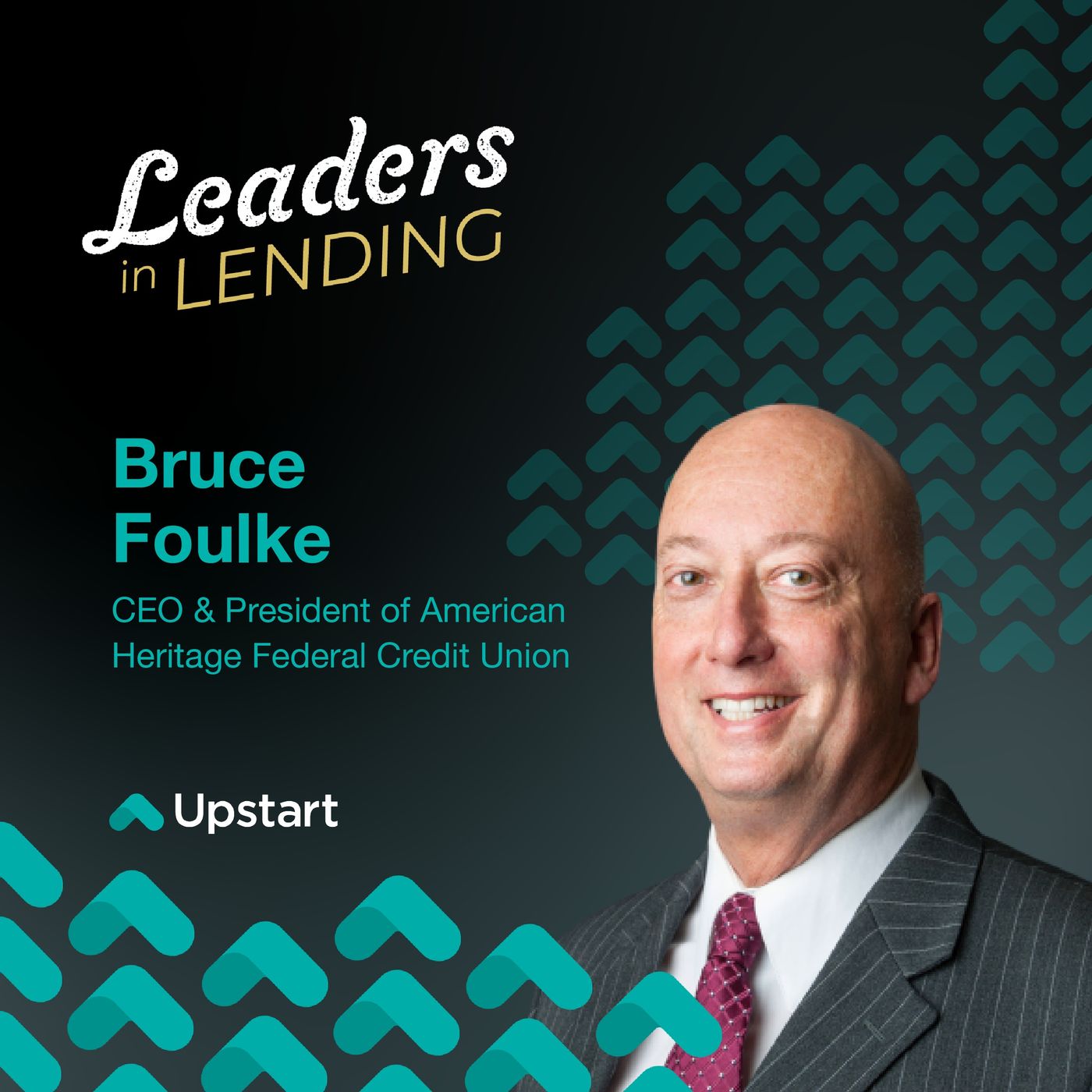


Credit Unions are already known for their personal service, but what happens when you double or triple in size. Does bigger need to mean less personal?
Recently named American Bankers Credit Union Executive of the Year, Bruce Foulke, CEO & President of American Heritage Federal Credit Union, spoke with our host, Jeff Keltner, about retaining personalized service during times of growth.
Join us as Jeff and Bruce discuss:
- Foulke’s experience through 55 credit union mergers
- Maintaining a direct line to the members (even as a CEO)
- American Heritage’s employees’ charitable work and Foulke’s efforts to assist Ukraine
0:02 You're listening to Leaders and Lending from Upstart, a podcast dedicated to helping consumer lenders grow their programs and improve their product offerings. Each week, here, decision makers in the finance industry offer insights into the future of the lending industry, best practices around digital transformation, and more. Let's get into the show. Welcome to Leaders in Lending. I'm your host, Jeff Kellner. This week's episode features my conversation with Bruce full the President CEO of American Heritage Credit Union, recently named American Bankers Credit Union Executive of the Year. I enjoyed this conversation. We dove in with Bruce to talk about growing this organization from just four employees when he got there to over seven hundred with over fifty mergers in the process. But most of the asset growd they've seen them were four billion assets now. Has not come from the mergers. Has really come from, I would say, a culture of hustle, hard work and customer service that he has instilled up to and including a contact the CEO button on their website. It's really a fascinating story about how they've seen the future, how they've really gone out of the way to find ways to serve customers. I think you can really feel that culture emanating from the conversation with Bruce, and we also dive into some of the charitable work he's done, including his trip to Ukraine to deliver ambulances that he had built. So a fascinating guy, fascinating conversation, lots of tidbits of wisdom, and many things to learn, So please enjoy this conversation with Bruce. Bruce, Welcome to the podcast.
1:32 Thanks for joining us today. I appreciate you making the time. Thank you. I'm glad to be here and help to talk to you about whatever you want to talk about. That's a give me free rain. That's a dangerous thing, Bruge. You never know where we'll go. That's exactly right. Well, I start this all my conversations off with the same basic question, which is kind of tell me about your journey into the banking industry. How how did you wind up in the banking and credit union space? He cat When I graduated from college in seventy five and seventy seven, I got two degrees. I was landscaping for everybody that was working in the government, and they all told me and even as Speaker of the House of North Carolina.
2:13 I went to NC State and the Speaker of the House I used to mow his yard, and everybody said, you need to go work for a credit union. I said, what the hell's a credit union? And they said it's like being a banker. He said, okay, I'll do that. So I walked in the door and the guy said actually was Jim Lane, the predecessor. And the guy said, hey, I gotta hire you because you know everybody I love it. So that's how that's how I got in it. And I worked down in North Carolina for a couple of years, and then I came up to Philadelphia and seventy nine and I've been here. I can't hold a job. I've been here, what forty three years? Right now? Forty three years? What I mean, you can't hold a job. That's lot's a lot of longevity forty three years on one play.
2:57 Yeah, actually it is. Well, I want to talk about your your current credit union, because you guys are fascinating. You grew this business, if I understand right, from like four employees to several hundreds. So that's that's quite the journey. You guys have been on, tell me a little bit about how you got into this and what that journey has been like. You know, it was used to be called bud Workers Federal Credit Union, and we were around four million dollars. We had four four employees plus b and everybody in the plan because I used to manufacture automobile parts like stampings for doors and fenders, and everybody was saying, hey, they're going out business, they're going out business. So I went out, I said, you know what, I got to figure out how we could survived. And I went out in the marketplace looking for a merger partner. And I found this small credit union up the road and they said, hey, could you you interest a merger with me? And next you know, it was it was around a fifty thousand dollars fifty thousand dollars credit union was real tiny, which most of them were back then. And so what happened was it I just went after other credit unions to try to merge with me. And you know, I'd done what fifty five mergers over the years. But if you had them all together, you had them all together, then it's not even gonna be two hundred million. And we're four and four and a half billion now and with now I have a seven hundred twenty five employees working for us.
4:24 So that's the background. Well, I'm ask you two questions about that. One. What's the biggest lesson you've learned? I mean, fifty fifty plus mergers, is that's more than most of us will do in a career. What are the things you learned or kind of you know, would do different or have done better as you've gotten down the road and gotten smart about how to do these things. You know. I didn't take the mergers on just to take a merger. I took it on for stability, what it was going to do for my credit union, to preserve our credit union. And that's what I was really scared about, because the government came to me back in the eighties, the government came to mean, say would you take this merger with Bruce, you take this merger. I had so many merger opportunities because the government was not I was trying to find merger partners and I said yeah, yeah, yeah, yeah, So I was. I was fortunate enough that they knew I was one of the few people out there taking a merger. Now everybody wants to take mergers, so you go, figure, but so you were ahead of the curve. It has been a trend, the consolidation of both banks and credit unions are at last. It kind of surprised me. I come in to the industry, you know, almost a decade ago, and how many banks are there, you know, time to think about your universe of the industry you're in. And then you look at the history and they were like, you know, twenty thousand in the seventies and now there's like five thousand of each, and you kind of go, huh, that's been a it's in that line, is like, it's just pretty constant, that kind of decrease in numbers and consolidation in the industry.
5:47 When I came here where there was twenty six thousand credit unions, I was like the six thousand largest credit union. I don't know, eighty fifth largest the fight there aren't six thousand credit unions, I don't think. So you can't be success right around five I think crash. Well, so if you only acquired less than two hundred million in assets, but you've gotten over four billion, you've done something else to grow the credit union over the years, other than just the merges. Emergers clearly, I think expanded your field of membership and you know employer employer partners you were working with, et cetera. But how did you think about the kind of growth you've achieved, Because as I think, almost every credit union in bank I talked to is trying to grow the number of members, the number of customers they have in the fold.
6:30 And you've done that pretty successfully. What's what's the secret? How do you? How have you gone about that? You know when I when I first started out, I went out and I solicited that everybody. It was me, it was Bruce. I was a guy that was the PR guy. I was the marketing guy. I was the loaning officer. So I was out there soliciting people that joined the credit union. I knew how the better sell this credit union than anybody else, and I knew I had to do something differently, and I said, we got to be different than every any else. So we never search charge. So people come to us because we don't search charge at any any of our hundred ATMs that we got out there. So people are and that's what our name has been promoted out there.
7:11 Other people are saying, go to American areas, and they don't whack you a fee or search charging so and then that's how I also get people to join the credit. And they said, out, you know what, you guys are really caring about the community. So I've been in the street myself and I know what people want. And I focused on healthcare industry and the government, federal government industry. They were the ones I was focusing on. And it did. It did come out to our advantage because the health industry is booming right now and the government industry somewhat booming that they show it for work. But that's that's another fifty million question. I hear you used to go into the hospital for all the shifts to sign people up hand to hand combat style with the doctors and nurses there in the in the in the facilities. And you know what, I did do that and I went to all three shifts at the hospital for two weeks. I was exhausted. Its sleeping between the times, and I would do classes where I would actually be in front of a class and people would come to me. And that's how I tried to do it. Initially said I want to do classes, trying to have twenty or thirty people in a class and that's what I did on three three shifts, and that's how we really grow. It was it's still it's still part of our mo that we go into the workplace. Partners as we call them, got to go out there. You gotta be where the people are. Yeah, how do how do you maintain that? As the you know, the CEO is the organization grows and you get bigger and bigger, I imagine, you know, it's harder and harder for you to be the one in the street and be hearing the feedback and feeling that direct connection.
8:43 Are there things you do that try and keep you connected to the customers in the same way you used to be when it was you know, uh, you know Bud's credit. It's just four of you. Yeah, and that's not a Bud bud Wiser. But here's what here's what I have on our website. And I said, I don't want to forget where I came from. I want to have a contact the CEO button that anybody can call me or talk to me when they want to. And I return every single email personally, and I give him my personal direct phone number here at work. And I called some lady that was stuck in Paris, France one time because she was stuck, and she sent an email I said, I'm stuck.
9:26 I can't get my credit card to work. And I called her up. I think it was like two o'clock in the morning, their time over in France, and I walked her through and got her out of Paris. So the thing now going on, people will say, just in my stiff notes, just hey, go email Bruce. He said, he'll call you back, and they know I will call you back. How much traffic do you actually and again, how many members do you have that you are exposing the contact the CEO button two? And how much traffic do you actually get on that We have two hundred and eighty thousand members. If I get one person a day, that's pretty much it. Most of what Most CEOs are afraid to put their contact out there correctly. But you know what, it's the way I was brought up with my family. I love those I love those numbers because I think it really speaks to the cost to you is quite small. You know, calliday is not a not a big deal. And the value I think that people feel in the accessibility is quite high. So I think I think it's quite fascinating that you've got that many members who have the ability to contact you, and they probably feel great that they can, and very few actually do. And that's um. It's an interesting lesson for everybody, I think, because it's clear that you're getting more trusted. There was a bank out or maybe it's still out there, that had a telephone on the front desk that could go right to the presiden CEO. I've heard that, but yeah, I don't get that many. I don't get that many phone calls or emails out there, because you know what, I got a great staff. If you've got a great scaff you know they're going to handle the proms. That's that's key. Jeff Bezos is famous for kind of forwarding emails from customers because I don't think he reads all of the emails.
11:00 I think he gets a few more than one a day, but he gets emails directly from customers, and he's famous forwarding them with just a question mark to the responsible executive. And I think it's the most dreaded email at Amazon. There there's no commentary, there's no question, just a question mark out like something that I'm wrong fixing. How did this get screwed up? Do you ever do you ever farm it out and send these things on to the right people for faster response, and you're scared of your question mark emails. I never did a question right now that you've mentioned it, maybe that's what I should what's going on here? But you know what, as as I said, I do, I do write notes, and I do right to the employees, so I think or can help solve the problem for them. Hey, take care of this. Call me back and let me know that I contact the member. Hey so and says it's going to help you if they don't. Here's my direct number calling exactly. Yeah. I love that direct connection. I think so many people. We've had this conversation with a lot of guests here. How do you maintain as you get bigger and farther removed from the frontline staff, that direct connection to the voice of the customer and the needs of the customer and remember what it's like to be aline employee and what those needs are. I think that's a great example of how you're doing it, and that's critical. And it's like the employees have to have access to me too. Everybody fallsby Bruce. I know a painon but at times. But you know, they all know that I'm real, really, just a regular guy in the suit FI. I'm Margie Clark, President and CEO of Agricultural Federal Credit Union in Washington, DC. When we wanted to
12:31 acquire more members of personal loans, we knew we needed a partner that allowed us to scale quickly and easily. With Upstart, we were able to go live in fifty four days without adding hoodcom and we were able to learn previously under serve ours with upstarts model. If you'd like to learn more about our partnership with upstart, you can read more at upstart dot com, Forward slash Lenders. Thank you, and back to the show. What's what's next for you? Guys? Um? Like, what do you see on the horizon? You've obviously had a tremendous trans transition from small to large credit union, lots of mergers, tons of growth and assets. What's on the horizon, What's you get you're excited about what's down the road? Is it more of the same or they're trends you see emerging that are that are going to change the way you think about interacting And how do you see the future of the of the space and of your business. Well, we were one of the first to jump into of popio with those videoteller machines and we're heavily into that.
13:31 I think we got like a hundred of those machines now in our branches. So people will actually go up to you see a live, live teller behind a video screen. But I don't want to lose that contact. But what I'm seeing is that or what, let's face it, you can't afford people today that don't want to work. So you've got to figure out ways to get people would come into work, or how to pay the answer to the phone. And that's what we're saying. Okay, how do we expand it. We just rolled out two years ago a VANNA, which stands for a Video Advisor Network Associates, where we actually made a commercial of me, of me announcing it to the press that hey, you want to talk to a live person ghost it on your at home on your iPad, here's a number. Just pushed the button on on your American Age website and you'll get a live person to talk to you. You've got to add that personal experience.
14:28 We're trying to get into the AI stuff right now and have our phone's answer to help out with the phone calls out there. So that's where it's going to be at. How do you think about the difference with this, because I think it's really fascinating the second person talking about the video teller machines like a real live person in the telling. Of course, once you've got that, you go why do you have to go to the branch to do it? You can just do the video from you know, in your hoodie sweatshirt like I'm wearing from your you know, from your living room where I'm at um. But it's curious because the AI is kind of like the replacing the human with some sort of technology that can have a basic interaction without talking to a person. And the video tellers it's kind of the opposite saying, hey, you've come in somewhere and I want you to actually have a human conversation with the real person who can talk to you. And I'm curious how you think about the role each of those kind of technologies plays. My senses, it's not like A or B. It's some kind of combination where each of them has a role to play. How do you think about how those things sit next to each other, and how you figure out where and somebody wants to have a high touch experience, and when someone wants to go, how do I just interact with the machine and get through this as quickly as I can? Okay, So if you come to the office, you can either do the we call path machines person at a mateteller where you have the video to tellers, but you also have a smart office and the smart offices you walk in, you sit down and there it contacts one of our concierge people that it goes out and they can talk to the person there right in the branch. All the computer equipments there for the prints, all the signature
16:00 stuff. But what we're going to do now at home, we're going to do every through through docu sign We're gonna send you the documents online. You're gonna just do it there and don't make sure you have your clothes on so I worry about it, man, what the heck? And uh? And then you know that's that's the any way I think we're going to be able to survive and still all for personal service because people are going to get smart and they're gonna know it's A. It's an artificial intelligence machine, and it will ask you if you say, hey, you're a real personalill say no, I'm not. Yeah. They're trained not to lie about it. Unlike the original outsource call centers. I do you remember those where you'd call in and so we'd be talking to you from some foreign country, go where where are you? I'm in Atlanta, and I go I don't think I don't think that's right. They were a little, a little untruthful about that.
16:51 But the AI typically is trained to just yeah, I'm not a real personalist an AI. So that the biggest challenge, I say, is gonna be is skin people to fill the void with not having as many employees needed to run the operation. You know, we got seven hundred some employees here, and you know with COVID, people just said, hey, I want to work from home. Well, you can't build a culture without coming to work. I don't care what you say, and I guarantee you. What do you think? And that should be a good question. What do you think all the major cities United States would look like if nobody showed up downtown, all the shops closed, all the barber shops closed, all the it would be horrendous. It would be horrendous. You know what, you have to come back to work and you have no culture. How do you get a culture? You know you gotta have it. So are you guys back to like five days in the office, what's your what's your kind of post COVID remote, non remote in office, part time in office? Where where are you guys out on the spectrum of kind of responding to this, Most of people can work three after work, three to day's in the house and then two days from home. All my vice presents come in because I want to talk to him, I want to see them, and I just think it's I don't know, I just think you got ingrained a culture. Certainly, I think you've ingrained a culture of hustling and hard work and serving the customer, and that is a little harder to do and feel. There's a there's
18:22 just like a vibe. It's to me kind of like the difference between watching h I just thought of this, but like you watch a sports event on TV. In some ways it's better, like higher deaf you get better video replays, but it's not the same vibe. It's not the same field, right, there's a different experience to being in a stadium when a game is being played with a lot of people. You never you never capture that. When you watch the game at home. You can get you know, maybe better snacks and better beer in a bigger screen for the replays, but you don't. It's not the same experience as being in person for that Eventment company feels the same way. You can't get that same the feel the culture doesn't come through the same way. Even if you have you know, more convenience or whatever, you don't have the spill and beer on you. I mean, what's what's what's the ball game without people's part throwing peanuts on the ground or whatever it might be at your I mean that's like, but those are things are unique to the stadium, unique to the culture of a particular team.
19:14 And it's what kind of buyds those fans together, right, is the experience of of of of living it together and something. Yeah, and you know, and that's what's about. That's it's you gotta be. You gotta be. We're a social people, you know, yeah, we are. We are a social creature. At the end of the day. I'll tell you what my biggest thing and another thing that differentiates American heritage is that we were the first credit Union to roll out not for profit charitable organization called the Kids and Who twenty seven years ago and we raised three million dollars for Children's Hospital Philadelphia, which which we pay for the music therapy program down there. The money goes to a specific program. So I was gonna ask you about your your charitable works. I know you've done quite a bit, but how did you pick the music program in the hospital like it? That's a very specific, and I'm curious why you chose to be specific in what you do with the charitable work and how you picked out particular beneficiary and program. Well, when I was driving down ninety five one a Friday at eleven thirty at Cottman, I don't know, I heard Make a Wish was taking a kid up to the Alaska and I said, I'm going to take a kid to a Disney World. And I went down to Children's Hospital Philadelphia and I told the guy, Hey, I'm taking one of the kids at Disney World.
20:30 He said, no, give me the money. I said, no, no, Jack, And that was his name, Jack. So I get talked to him because he's a drinking buddy. And then I went over to the Sea shore House and that's the rehab hospital and they said the same thing. We need the money because we're the last hospital as a music therapy program. I said, man, I like Disney World better. And they said, do you know what music therapy does? I said, I kind of. He says, music therapy gets kids in moving their arms, their legs, they forget about their pain. It's therapy. And I said, yeah, okay, what's the big deal. I said, I still like going to Disney World. And he says, let me tell you what happened today a kid or yesterday a kid. A twelve year old girl got hit by a car in Philadelphia and she broke her neck and she got became paraplegic.
21:12 And that the art therapist was working with her at at the Sea shore House, and the art therapist they asked her what's that picture of hers? They put a pen in her mouth and they said what's that picture of And she says, oh, that's a picture of my heart. Well, what's all the red squiggling lines for it? She says, oh, that's a picture of my heart on fire. She says, why is your heart on fire? She says, because I can never hug my mommy again. I said, we're in a music therapy business and we raised three million dollars, and it's the employees doing it here. It's not American Harry's rain and check. It's the employees helped raise money. That's the difference. But then a lot of big crazy is a right a half a million dollars or hundred thousand dollars or whatever for their event. But it's our employees that do it. We give them a time off that do so. The employees go down and volunteer and participate in the program. Yeah, they did a lot of We go down and play games with the kids. We actually bought them a robot a few years ago, which greeted all the kids coming into the music therapy program.
22:17 It's kind of cool. I was on national team. What you did. Yeah, it's kind of I don't want to say old school, but it reminds me of the origins of community banking and credit unions. Real, real, true connection with the community that you're serving, not just in the kind of business that you're in, but as a real community organization. That's that's ingrained in em bettered in working with volunteering in the community. It's I love that story because it's it really is about how the organizations embedded with that that that place, the people that are there. It's great. And you know the other big thing about us, about me especially you know, I'm a volunteer firefighter. I just believe I got to help out people. I can't dry by an accent without helping her stop, and I just don't believe that that's that's stuff. But you know, I just came back from Ukraine.
23:00 I believe we were raised money for UH ambulances for over in Ukraine. When I met the Secretary of Poland, Yes, for five hundred ambulances. I told him, I get you two right now, we're going ten. And we raised the hundred hundred, four hundred thousand dollars for ambulances. And they're not to fancy him. You guys just converted vance, right, So you know, And I just came back from the Ukraine, a war zone. Well say you delivered some of these personally, you went over there and delivered some his ambulances. How did that go over with the board and the family flying into a war zone? I imagine that was a tough call to go over there and do it in personally. You know, when my my wife was upset, but I you know, she used to me running out the door, you know and doing crazy. The fire calls and tell me to slow down, but I AWA had no fear. When we got over there, we picked the ambulance up U in Poland and drove it over the border to the viv Lviiv, Ukraine, saw the burned out power plants that Putina just burnt blew up the week before, and then we went delivered it.
24:07 And when we when we got out of the truck or out of an ambulance, we heard the air raid sirens going off. And I'm looking around. I'm saying, why isn't everybody running? And they said, oh, the army takes care of an air force takes care of all the drones and the midiicles come in eighty percent of them. I said, what about the other twenty percent? Man? They said, well, you know they don't come in. So it's kind of fun to walk near a power plant, ye right, yea, So it was kind of a unique. So I was very very happy. And when a good friend of mine, Brian Brant, who were there and that and I'm going to do it again another two months. I'm going to delivering another ambulance over there because I have to. I just can't sit here. That's certainly I think everybody's got hopes in prayer.
24:49 That's doing doing something very real and personal. So it couldos to you for that. I think you should go, Jeff, because I can run faster than you, you can hold on. I like the way you position. I don't think my wife's gonna take that as a good rationale. I don't worry going cruise. He runs faster than me when stuff gets past here, I don't know that's that's gonna sell one. She can't take a joke, but uh no, it's it's great. Well, here's my final three questions to ask everybody. Bruce, I'm really curious your answers. The first is, what's the best piece of career advice you've ever gotten? Don't take yourself seriously. I think if you think you're that great, you're not that great. There's always gonna be somebody better than you anyways. And that's why I like about the best thing I like at the American Heritage is I like to see young people grow up. The ladder, you know, and become vice presidents or CEOs or CFOs. And that's what I really like. And I just enjoyed it, you know. I just I like seeing young people good above the ladder and young anybody below sixty nine. It's a nice broad definition of young people. You got the opposite definition my kids, my kids, anybody over twentieth old. I crossed the band territory a long time ago for my kid. I like, I like your definition better. You're young under sixty nine. It's good. My second question, what's the best advice you've gotten about the kind of consumer banking credit union industry in general? I think we're in a transitional stage right now. I don't. I don't have
26:23 a clue. I think bitcoins destroyed the confidence of what people were thinking as money, and you saw how much people lost. But people are still out there freaking buying that stuff. It's up to twenty three thousand today. I said, what is wrong with you people? And I don't. I think people are just so easy to put stuff out their personal information that they don't know what they're doing. And that's my advice is they watch what you're investing to make sure it's solid maybe back to fundamentals. Oh, absolutely absolutely if they don't regulate it. If I don't, government doesn't regularly and I don't see it flying, but I who notice the people do invest the bitcoin is.
27:14 I mean, I made a bunch of money in bitcoin because I bought one in like twenty twelve, just because I was like, what is this thing? I got to figure out what it is. I don't understand it, and then I forgot about it for like seven years, and that turned out to be a really good thing to have done it. It wasn't exactly intentional, but I was like, well, let's put let's put a thousand bucks in and see. You know, I gotta go. You know, I'm a big believer that you can't really understand something. In my wife in her medical school, they had a saying, you see one, do one, teach one. I kind of like, I can't understand it unless I do it, and better yet, I teach someone else to do it. My mom or my dad's when it is a little less savvy in the technical space, and that's like that's when you really understand. So I was like, I gotta go do it to understand it. That worked out well. For me, But I've never understood the fundamentals of a lot of that.
27:55 I kind of just look at and go, what's the you know, I want to understand the basics and how something is supposed to work. In those same thing with a lot of the you know, what caused the mortgage crisis, you kind of got away from the fundamentals and these CDOs and CDEO squares and you know, there was just nobody can really explain to you exactly what was happening and why and why a bunch of junk bonds could become triple A bonds if you just pull them together. And I think when you get away from the fundamentals, you start to miss something. And can you explain what blockchain really is that I can do that's a that's a computer science concept. I can do that. All these letters that they're out there, how did they get all the same mats or a quickly? And I said, I don't know, you know, amazing, they're not all that quick. They take you know, ten minutes, fundy minutes sometimes to get to a point where you feel confident that the chain will be solid, which is you know, if you compare that to the transaction processing time on a credit card network not so good. And if we actually get FED now and some of the real time you know, interbank transfer stuff, feel say, hey, that's like truly truly resolved transaction and seconds, which is which is not what we really have even on the blockchains. So I do think it will push the state of the art, right, it's going to force us to go, Hey, it had these features that were really nice, like, you know, like I could transfer money with no fees internationally. That makes sense.
29:11 We should be able to do that. There's no reason we got to pay these I could do stuff instantaneously. Yeah, there's no reason it takes three days to settle an ach We can we can. We can shorten that time. And maybe we were as an industry a little lazy in getting some of those innovations, and it's going to push us. But my sense is, you'll, you know, if I can get you know, real time bank transfer, like, well, that's pretty good. Maybe I don't need blockchain. If I can have that in transaction free international transfer things like that, well that's what I'm hoping comes out, you know with the FED Now, Yeah, it works. I don't know anybody doing it. I don't know anybody doing it, I know, but I know people talking about it, and I know a guy working at the FED working on it. So I'm confident that well, that we'll get there and it'll be you know, it'll solve a lot of the pain points for for regular people. UM So, my last question maybe maybe we veered in this territory a little bit, but was always what's one bold adiction for the future. So this is my so I can bring you back in a year and we can check in if you would right or wrong kind of thing. The sun will rise. I don't know how bold that's because it's going on for a long time, pretty regularly failed. I don't I don't change will come. I think the more it changes, the more it stays the same. That's all I would say.
30:26 I don't think you're talking about going back to basically, I think that's what it ends up happening. It's just become more of a basic type thing. What is FED now, that's a basic thing. It just people got involved with it. Right. The more things change, the more they stay the same. I don't know how I'll exactly hold your future to fire on that, but I think it's a it's a good bullet prediction. It is. I think some people think the world is going to be upended, and I think your maybe your statement is things will change, but the some of the basics and the fundamentals are going to stay the same. And that's I think an interesting perspective. All right, Bruce, thank you for making the time today. I greatly appreciate this was a we range from Bitcoin to Ukraine, so I think we's a firefights. We got to cover a lot of ground.
31:06 But I appreciate your joining us and sharing your perspectives. Hi, brother, take care. Thank you. Upstart partners with banks and credit unions to help grow their consumer loan portfolios and deliver a modern all digital lending experience. As the average consumer becomes more digitally savvy, it only makes sense that their bank does too. Upstarts AI lending platform uses sophisticated machine learning models to more accurately identify risk and approve more applicants than traditional credit models. With fraud rates near zero, Upstarts all digital experience reduces manual processing for banks and offers a simple and convenient experience for consumers. Whether you're looking to grow and enhance your existing personal and auto lending programs, or you're just getting started. Upstart can help. Upstart offers an end to end solution that can help you find more credit worthy borrowers within your risk profile with all digital underwriting, onboarding, loan closing, and servicing. It's all possible with Upstart in your corner. Learn more about finding new borrowers, enhancing your credit decisioning process, and growing your business by visiting upstart dot com slash foward dash Banks. That's upstart dot com slash foward dash Banks. You've been listening to leaders and lending from Upstart, make sure you never missed an episode. Subscribe to Leaders in Lending in your favorite podcast player using Apple Podcasts. Leave us a quick rating by tapping the number of stars you think the show deserves. Thanks for listening. Until next time.

