The Future of Small Business Lending
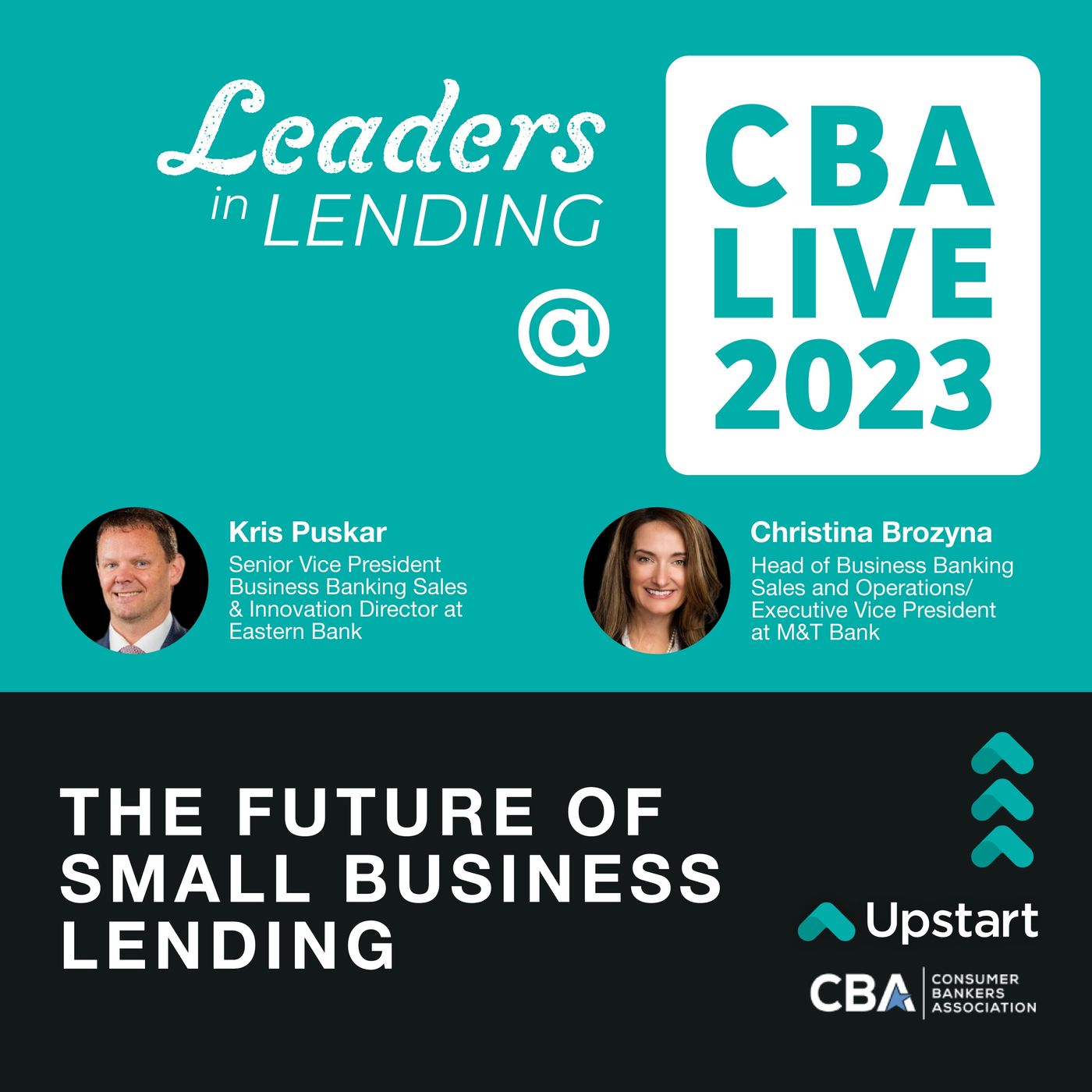
Recent banking failures have everyone in finance wondering what the future holds for lending. Do these signify the start of some significant changes in the lending space? To find out, we’re speaking with...


Recent banking failures have everyone in finance wondering what the future holds for lending.
Do these signify the start of some significant changes in the lending space?
To find out, we’re speaking with Kris Puskar, Senior Vice President Business Banking Sales & Innovation Director at Eastern Bank, and Christina Brozyna Head of Business Banking Sales & Operations/Executive Vice President at M&T Bank. Both of whom are well-qualified to weigh in, holding positions on the Small Business Banking Committee at the Consumer Banking Association.
Join us as we discuss:
- How the recent failures affect deposit sentiment and strategy
- The rise of SBA lending
- Shifting consumer expectations after PPP lending and the digital experiences it offered
- Special Purpose Credit Programs
0:02 You're listening to Leaders and Lending from Upstart, a podcast dedicated to helping consumer lenders grow their programs and improve their product offerings. Each week, here, decision makers in the finance industry offer insights into the future of the lending industry, best practices around digital transformation, and more. Let's get into the show. All right, Well, thank you guys for joining the podcast today. I'm joined today by Chris Christopher, Chris, Chris Pushcar, Chris Pushcar and Christina. And what constitutions are you guys with with Eastern Bank? Okay, excellent? And you guys are on the Small Business Banking Committee here it's CBA correct one, chair and vice chair, Chair and vice chair excellent. We got all the power and knowledge in the rooms to be a great conversation.
0:46 I know you guys had the committee meeting yesterday and I want to talk about like the number one things that were on your mind. And I imagine a lot of the conversation had to center around the kind of disruption in the banking environment that's happened due to the failure of Silicon Valley Bank, the failure of at your bank, how customers are reacting, what are you what are you hearing from that? Well, what's the reaction been to those things? Yeah, it was a big topic of conversation yesterday in our committee meeting, for sure, And I think there's a couple of different things, right, So one is how can we help service those customers if they choose another financial institution that they want to bank with. And then secondarily the safety and soundness of our own financial institutions and really working on retention of our clients, and then the safety and soundness of the industry as a whole. I think those are really the big things that came up yesterday. With that, you have a lot of deposits moving banks, and so you know, as you think about that, you want to be able to take on new clients but also retain your own. And then you're also worrying a little bit about fraud and people having you know, account takeovers or fraudulent wires, so you're really trying to protect clients against that as well. Say, how has the trend been in the I imagine there's this immediate like I got to pull my money out of the banks that are you know, that are feeling And then how has the conversation evolved with clients of your own banks, or what you're hearing from other members of the committee in terms of like withdrawing funds for all just going, hey, I want to move to one of the big guys that feel like they have an almost explicit guarantee if we're all deposits, Like, how is that is that conversation involved with clients? How does it feel right now?
2:14 Yeah? I mean I think it's different for each client, right, So, I think some you have a simple conversation and talk to them about the safety and soundness of your financial institution. They're satisfied with that. Other cases they want to take advantage of more FDIC coverage and they have a product or service that can help them with that. And in some cases they do want to diversify and they want to take a look at multiple banks for their relationships and maximize their FDIC coverage. So you really just have to have a conversation and find out what's right for that client. Yeah. Yeah, maybe. What I would add is a lot of the banking that we do is relationship driven. So the trust, the knowledge of the bank, the presence in the community, they know, they know us, they sort of what we stand for. And what we're about. The folks that I feel like have a lot of questions are probably folks that don't have the relationship, is close of relationship or the media has really spun this to their advantage and they're getting a lot of hits and a lot of likes and a lot of job but not everything that's being shared is understood. So it's just piecing together and having a person that they trust that they'll have the conversation much. Yeah. It also reminds me why this like underlying nervousness about this whole experience, in that I feel like community banks, while often maligned by online I think a lot of was like a digital experience. The big banks kind of have an advantage in investing, but in the small supporting small businesses where really you do rely on relationships. I really worry if we lose if this causes us to weaken our community banks, our regional banks, it'll really weaken our support for small businesses generally that really rely on those relationship based banks in their communities to support
3:46 them. And it's kind of that would be a real blow to our ability to support small businesses and economy generally. If we were to lose support for the community banks because there was nervousness about deposits and that caused them to go elsewhere. It's start and what we have seen actually in the business bank space, that is the spot they're moving the least they're moving retail because they all get it so easy. Yeah I'll just get something online and I don't really care. I want the insurance. In the commercial side, right, they're likely dealing with the CFO, may or may not have a relationship, and moving billions is easy because they can do it in chrunches. But we haven't seen the movement in the business banking space interstically. And I've seen some, but not not nearly to the degree. And we actually heard from Furry knows and that is industry. Um uh, don't so that from the industry.
4:32 Small business deposits have been a little more, a little more spread out between larger financial institutions community banks and some online banks as well, and some smaller credit unions. So I think that's good news for us as a whole company. Have there been any when you see a lot of inflows and outflows? I mean, the number one thing that my mind gets made because I come from the technology space is like fraud, and that just looks like a moment where I go, hey, as an attacker is as a bad actor, man, this is a moment where a lot's happening, a lot could fall to the crack. It seems like a time to attack it, so to speak. Not that it's not advice for any with the attackers out there, but it seems like a moment where you have excessive risk compared to maybe a normal environment. How are you seeing increase in fraud and how are people adjusting to kind of trying to support inflows and outflows that need to be done to support those businesses and also be careful about fraud when people are moving in large sums of money and our frequent basis, Yeah, we haven't really seen it yet, but we are concerned about it, and I think the key is to really make sure you have really good conversations with your customers and advise them of potentially what's out there. There are some products and solutions on the treasury services side that can help you protect against fraud, but a lot of it is just your own internal controls as well, and so we really try to be be mindful of that and have those type of conversations with clients and it is fascinating. The biggest fraud that we see is count takeover, so they perpetrate, they act like they're in the business owner, tell their CFO.
5:53 Right. So it's a tricky spot because it's it's still the advising guidance that when you're connected to your bank, like if you're and you have some of the services, you either see it or you don't open the email or right, you sort of prevent that that takeover. But should it happen, then the hope and the expectation from the bank is, hey, can you just help us with this when you fill in what we lost because we you know, obviously we didn't direct this to happen. And it gets back down to relationship and just that tight connectivity which you can't get from the biggest or the finchecks. Like they're not offering relationships, right, they're offenising great services. But that is that is our strongest suit. Interesting, I wanted to maybe pivot away from recent troubles to longer term trends short and I'd love to think about, like what are the innovations you guys are seeing happening in the SMB space, like what are new products, new offerings, new capabilities. And one of the things that got me thinking about this was the experience during PPP where we really like implemented new processes digital processes, often very rapidly, some more successfully those It felt like this kind of like accelerated learning moment, say hey, we can actually do something pretty different if we have to, and customers actually, I mean there's like think MC guarantees and all sorts of reasons that was a different kind of program. But I do think that the capability to quickly access lending and funding was a really interesting moment in time where we saw that, we saw how customers reacted. Do you see that driving trends towards faster adopt Like, what are the trends you see in the SMP space in terms of products? Yeah, I think there's a few. I think you hit probably the number one spot on which is you know, coming out
7:25 of PPP, the digital experience for the customer was really end to end and they really appreciated that because it helps with have simplicity, it helps with the speed, and I think there's a demand for that, and so I think you'll see an increase in that right now, some banks have that it's typically for smaller dollar loans, but I think that will continue to grow. I don't know if you get the largest of the large loans ever done that way, but certainly there's probably tens of million CR loans. Are probably not the ones going instant digital. I'm probably gonna right because it will take building. They need a two fifty to five hundred thousand. Those are things that I think that you could look at. I think the other thing is we see a big spike in demand for SBA lending, so really understanding the programs that are offered through the SBA is really important for your institution so you can offer those to your clients. And then we're starting to hear a lot of information around special purpose credit programs, which are really set up to serve the underserved community within small business businesses that are owned by people of color, women, veterans, LGBTQ, people with disabilities, and so those programs are gaining a lot of traction now and I think that will be great for the industry as well. Do you have any thoughts on much I had not heard this statement about SPA and are the SPCP of special purpose credit programs. Well, do you know what's driving the demand? Like is there something behind that or like what do you think is causing people to be more interested in those programs?
8:41 Right Nocause that's a really fascinating statement, and I was like totally unaware. So I'm just kind of curious what's underlying that. It's our ability to serve more people most products. So it just really opens up the number of folks that we can help because the guarantees allow us to be able to be much more generous scrutiny like time in business, right, like we'd want to see more history with a traditional Yeah, we can do more to help serve them. Yeah. I think there was some information too that was obtained through PPP where some of those underserved communities weren't provided PPP loans as quickly as maybe they should have through the funding process. You know. I think that that put some heat and light on the industry to make sure that we found a solution to help those borrowers. And so I think that plays into also what Christina is mentioning and then the SBA trends. I mean, I think that there's some great programs out there that if you partner well with the SBA on programs, you can probably lend more customers than the typically would be comfortable with because they provide guarantees on the loans, and so I think really trying to use those products to get more money out into the small business community is essential.
9:52 So I'm going to ask this question, how does one partner well with the SBA. I mean, I think one of the big complaints I heard around PPP was just it changed a lot and then the integration would like the guarantee is getting it was not easy. And I feel like this is the same question I ask people about fintech partnerships, which is like, I feel like there's times that it gets that it works well, and times that it kind of gets it's a great idea, and then it doesn't go anywhere. It kind of sits on this shelf and doesn't get used because there's not a good sense of partnership and like a real operating rhythm. And so do you have you said that if you do SPA partnership, So I'm curious, what do you have advice on how one does partner well with the SPA or make these things more or less or if you're approaching an SPCP and that's a very specific kind of program that I think can feel risky or a little nervous people to emplay like how do you do that well? Like what are the secrets at tips to like actually execute well in that space. Yeah, I think with SBA, I think one of the things is first of all, having a strategy around it. It's hard to just sort of dabble in SPA lending because you really need to stay on top of the SPAH make sure you're following the program guidelines, and so having a strategy I think is core for number one.
10:54 Number two, I would advise have a good relationship with your local SBA office, can bounce questions off of them or scenarios off of them, and they can provide you feedback and insight. And then I think you need to have good controls in place to make sure that you're not putting those SBA guarantees at risk from the servicing work that you do behind the scenes. And I think if you do those things well, it's a very beneficial program for both us and our customers. That's exactly right. I agree with everything you said. What you when you get the experience under like going from you know, doing a few to doing hundreds is a very easy transition, and you have those controls and and the folks in place that this is not a place where you try to reduce staffing and hope that it all goes well. You staff appropriately, you follow the controls, and you can really scal it very quickly in a meaningful way. Fascinating. Is there a reason now that I mean, you mentioned PPP, but do you think there's a reason that interest in these things is increasing at the moment? And I want to kind of wrap that in with a general question around demand around small business line thing because you know, I think you've got the committee was talking about some trends around demand, talking to a little about like what's driving demand and why you think those programs are particular saying more demand now as it driven buyer experiences and pp and the real PPP and the realization that there's people out there that need these funds that we weren't serving before, or is there some underlying business reason that people are kind of like, hey, this is a moment to really invest in these things. Yeah, I mean, I think in terms of loan demand, just to start there, I think that's a tricky topic right now.
12:22 I think it's a very uncertain for this year and possibly into next year because of all of the challenges right now in the economic environment that we have, which is rising interest rates, inflation, labor shortages, supply chain issues. So the willingness or a desire for small business to borrow money right now is a little uncertain because they're dealing with uncertain time. So we'll sort of see where that lands. But I think, you know, when you think about the sp CPS and serving underserved communities within small business, I think there is a demand for what we have sort of already talked about. But also I think you know, SBA has also come out and said they want to be able to help banks funnel more dollars into the communities, both in terms of underserved communities but also just small business in general. And so you know, really trying to think about ways to get creative to lend more money to our customers who are in need, I think is critical well said, and I think they want advising guidance, so very more interested in taking time to spend with their bankers now and getting that. So we feel really good about making a difference in spending time and having those interactions and is Chris shared probably your larger, more stable clients or funding their own transactions and acquisitions or whatever investments are making in their business. So it's a perfect balance because there's capacity in the market and this is a place we can make it difference. Yeah.
13:50 I do love that focus on making a difference to the communities that the regional Community banks. It's just it's really nice. It is. It's was one of the big surprises for me. I was surprised. It's going to sound bad when I say it this way, but like coming from tech into banking, you kind of there's not always a great perspective of tech in the world now generally, but of banking, and you kind of you when you get inside the world of banking, small business banking, community banking, consumer banking, and you realize that people are really just trying to like that's not exactly living and gets a wonderful life, but out they're trying to support the communities and businesses prudently, but as much as we can. All right, I want to ask about one more technical thing, which is I know there's a discussion about ten seventy one rulemaking final rules for the uninitiator, not in the space. What is the ten seventy one? What is the process is going on? And what are we talking about there? Yeah, so if you're familiar at all with HUMDA, which is I'm familiar with HUMDA, all right, we're a good starting point, yep. So they're trying to capture sort of race and gender information a time of application and sort of trying to replicate something like that on the small business side. Interesting, so when they can take a look at application data, they can see then more clearly, you know, are there certain races or genders that are not being served the way that maybe some others are right, And so it's a way to really sort of safeguard that fair lending is taking place as much as possible in the small business community. So we're anxiously awaiting a final ruling. It's due by March thirty first, and so once we get that ruling, we're right up against the wire. Once we get that ruling, then we all have, we
15:22 believe, eighteen months to implement those processes, and you have to be able to capture the information upfront, but also to be able to provide reporting the reporting on it exactly. Any thoughts on what's going to follow on from that, because there's the kind of there's the capturing the data, there's the reporting of the data, and then there's the are we happy with what the data is telling us? And what are we going to do about in the areas where maybe we're not happy? And that's an area I mean, we've spent to be honest, that ups are a lot of time because I think there's this very tricky issue, to be honest, approval rates, actual credit worthiness of the underlying applicants, the applicant pool versus the maybe demographic pool of small business owners in your community. What's the sense of what follows on from and reporting on the data in terms of actions or expectations about what the data is telling us. Yeah, I mean I think it's a multi step process, right, So first is implementation. Second, then you have to go through process of a period of time of actually getting meaningful data. Won't you know, in the first few weeks, maybe even in the first few months, you won't have it, but certainly six months a year you'll start to have that data. I think it'll be interesting for the industry as a whole.
16:22 To see sort of where everything lies. And then as your own financial institution, how do you compare to the overall averages? And from there you may implement strategies to do things differently, to either improve things, or change things or tweak things. So I think as a whole it's going to be a really interesting exercise, for sure. I would add I agree they've been Chris said, that's why some of these special purpose programs are so critical. If we can do these at the same time and align those like, hopefully we'll all be happier with some of the outcomes, for sure. So we're in New York State, So the first move on it is we're interested to find out how consistent with ten seventy one in term of implementation, because some of the things New York State wants us to collect in New York is not legal to collect another places. How do we marry the two together and make sure that the customer experience isn't wildly different depending on in the banker's experience if you have a remote banker, where they're coming in from. Because try really hard to do the right thing by everyone at a time of application and sort of through fulfillment. So that the cadence of some of the additional things being rolled out, it will be interesting to see what we learn because New York State is going to go first. What do we learn and then how do we hopefully learn and help is the ten seventy one ruling continues to follow on a New York likes to be first. DFS is a little a little aggressive on that, and it is difficult if you operate in multiple jurisdictions to have you can have rules where you're required to do this here and prohibited from doing it there, and that becomes very hard, particularly in a world where at least some of our transactions are virtually mediated. So maybe the banker is supporting customers
17:56 in both states going I don't want to do the wrong thing. I'm trying to do the right thing. But man, it's not easy when the rules very so much does exactly right. New scale that the technology that we will all use to support it, whether it's you know it's now or you know, um, folks are doing a really great job of helping build this in. It's going to take them time too held it in, and so we're trying to do a bridge and sort of them a manual way of doing it in the meantime. So we're hoping for some grace in that period, but we're certainly all want to do the right thing and do more loans in this space. Has anybody been looking, I'm just you can just tell me know. But you know, there is the like the CFPB you published the BISG methodology to estimate ethnicity, race gender from applicant. You know, I think it takes like zip in last name roughly um, And I'm curious if anybody, if anybody has been previewing what they're ten seventy one results might look like, because you can, like, it's not the same as collecting the way home it is, but you can kind of like get too roughly the same point with approximations doing that at least understand what does that look like. I'm curious if that's something the industry has been like trying to get a preview on where they're going to land by using some of that methodology. If you're just going to implement the final rulemaking and then and see where we land. Yeah, I mean, I think it's hard to speak for every financial institution.
19:06 For my own personally, we absolutely have and We've actually lost a special purpose credit program just a few weeks ago, so we had to get data from our institution to justify the program and get it approved. So we definitely did. I would be surprised if most institutions aren't either thinking about an SPCP or at least preparing for ten seventy one and saying, you know, give me an estimation of sort of how we fall here, where do we think we're going to land to start? But we did a similar think being with the New York statedf so we had to get out in front of it. So we are feeling good about you know, where we're at and some of the initiatves we were taken in that space as well. Awesome. Well, let me as we come to the end of this conversation, what are other big trends or topics we should talk about when it call it comes to a small business bank. I mean, we've kind of had the things are on my list, but what's is there anything else that's top of mind for you guys or you think that's a big emerging trend it's going to be impacting the space the next year or two. Yeah, I mean, the only thing I can really think of other than what we've spoken about is really just providing customers information, right, And I think we think a lot of products and services and we need to do that as well. But I think small businesses are looking for information about how to run their business more effectively, more efficiently, how do I grow? And so a lot of banks are thinking about education for their small business clients. And that can be done through a website, it could be done through seminars, it can be done through your sales staff and making sure they're educated to be able to have those types of conversations.
20:30 Most likely banks are probably looking at all the above in some way, shape or form. But I would think that would be the other big trend in the industry that I think we're looking at over the next year or so. That's spot on, I would I would say. The thing I would add is it'll be really important that we help navigate customers through these inflationary times. Just Chris shared some of that we talked about yesterday. This is a really difficult time for a lot of small business owners. But whether they borrowed and now it's just so much more expensive, or the labor how do we help through the advice and guidance and education navigate probably just like all the banks, not all the small businesses make it. But how do we do our part to keep them as successful for as long as possible, or how do we help them find other partners to maybe come together with our industry experts, Like how do we do our part to be the convener so they can continue to run their business? Yeah, it is kind of It is crazy to think about the economic environment that we live in. It's very disruptive. And I saw this really ridiculous to me comment somewhere that like, you know, depositors should lose their money in the context for bank run because it was their job to be choosing the bank they worked with. By looking at the finance, I thought, your perspective is that the CFO of a small business should be looking at the balance sheet of local banks and determining who's making the most prudent risk management decisions in terms of interest rate risks with their excess deposits, and that's the balance on the system. Is Like, I think they're just trying to figure out how to manage their own sheet through this, and they're not
22:00 so worried about it because it is it's kind of unbelievable think that we're supposed to be looking at the interest rate hedges that SPB maybe could have put on the bonds that were buying, or whether they were buying too many long duration bonds at too low of a time, Like, yeah, I don't think that was a small They get their own things to worry about. We should be helping them through that as opposed to asking them to be our safety and soundness check on the asset management the bank they're working with. Well, and you hear some conversations too around well, these businesses shouldn't have had more than two hundred and fifty thousand than any one institution, and it's very difficult for small businesses to do when they're working about, you know, making payroll, paying their vendors, they have money coming in, Like it's not just easy to park two fifty or two fifty or two fifty here. So I think to your point, you know, they make the best decisions that they can with the information there they have, but you know, they're worried about running their own small business and they wear multiple hats within that, so it's tough for them to keep track with everything that's happening to the mark in the banking and environment. Yeah, yeah, and I totally agree, And I think there's this kind of weirdness to that answered, like wow, they should have opened accountable like that just is very strange to me. Regulatory arbitrage that's taking place that doesn't doesn't really meet the spirit of what the insurance has meant to do, like, oh, I'll actually ensure all your money just work with a whole bunch of different banks and spread it around Like that feels weird, and so I just wonder if there'sn't gonna be some change in the way regulars.
23:18 And I don't like you guys say this, but I think if we're saying, hey, well we really introduce just open up accounts with ten banks and then somebody's going to come in and be a digital layer that like automatically spread your money that we've just we're not really adding anything. We've just added a whole bunch of complexity to the land in the same place, and we ought to find a simpler way to help people. It is true, like doesn't take a very large business to need more than two hundred and fifty thousand just to make monthly payroll, let alone accounts receivable or invoice payments for a different thing, like, that's not that much money in the context of a business is paying a decent number of people, and I don't think it's unreasonable for them to expect when they put it into Like I was kind of stunned when my financial advisor called me and said, Jeff, we got some money in the check account. We want you to move it out because it's safer in a money market And I thought, Man, what world do we come to where I'm getting the advice to pull my money out of a checking account and put into a money market account for safety, not for yield, for safety, And I thought, well, that's that's an interesting It's an interesting time, and I think we're going to have to support the small businesses and the consumers that like consumers about more than two fifty thousand dollars in the bank account, I feel like are relatively savvy typically and understanding the risks are taking.
24:19 But the small business that's not a massive business, and it does not make sense to me that we're putting them at the risk for Like, having looked at the balance sheet and the different asset purchases, by the bank that they're working with. That just seems crazy. Yeah. Absolutely, and it's fluid. It's not like they put it in their ones and set it like to continuously expect the small business owners to look at all the transaction. Yeah. I pull up that quarterly report in my bank every every quarter and go, hey, what what are you guys doing? I mean tread ten year treasuries? Why we should be in the twos and being the twos man? It's the interest rates are moving like that. I don't I think that's the right expectation. Well, thank you guys both so much for joining to say, this was a fascinating conversation. I certainly learned a lot. I'm sure the audience as well, So I appreciate you to tech the time to do it. Thanks for having us. Upstart partners with banks and credit unions to help grow their consumer loan portfolios and deliver a modern, all digital lending experience.
25:10 As the average consumer becomes more digitally savvy, it only makes sense that their bank does too. Upstarts AI lending platform uses sophisticated machine learning models to more accurately identify risk and approve more applicants than traditional credit models with fraud rates near zero. Upstarts all digital experience reduces manual processing for banks and offers a simple and convenient experience for consumers. Whether you're looking to grow and enhance your existing personal and auto lenning programs or you're just getting started, upstart can help. Upstart offers an end to end solution that can help you find more credit worthy borrowers within your risk profile. With all digital underwriting, onboarding, loan closing, and servicing, It's all possible with Upstart in your quarter. Learn more about finding new borrowers, enhancing your credit decisioning process, and growing your business by visiting upstart dot com slash foward dash Banks. That's upstart dot com slash board dash Banks. You've been listening to Leaders and Lending from Upstart, make sure you never missed an episode. Subscribe to Leaders in Lending in your favorite podcast player using Apple Podcasts. Leave us a quick rating by tapping the number of stars you think the show deserves. Thanks for listening. Until next time.

